"THE BLACKER THE BERRY THE SWEETER THE JUICE/
I SAY THE DARKER THE FLESH,THEN THE DEEPER THE ROOTS!"
TUPAC SAYS

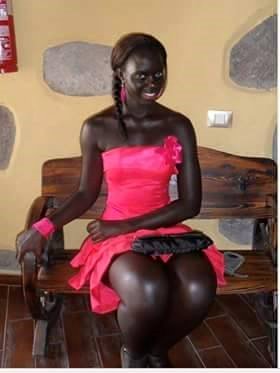
BLACK SKINNED BEAUTY SUPREME!

BLACK SKINNED BEAUTY SUPREME!

"BLACK IS BEAUTIFUL" -NEW YORK CITY STREET SAYING

"BLACK IS BEAUTIFUL!
BROWN IS HIP,
PUERTO RICAN IS OKAY
BUT white AIN'T S___T!"

BLACK SKINNED BEAUTY OOO!

BLACK SKINNED BEAUTY OOO!

BLACK SKINNED BEAUTY OOO!

BLACK SKINNED BEAUTY OOO!

BLACK SKINNED BEAUTY SUPREME

BLACK SKINNED BEAUTY SUPREME
BLACK SKINNED BEAUTY SUPREME!

BLACK SKINNED BEAUTY SUPREME

BLACK SKINNED BEAUTY SUPREME

BLACK SKINNED BEAUTY

BLACK SKINNED BEAUTY

Search This Blog

Pages

WE MUST HAVE A BLACK STANDARD OF BEAUTY BASED ON THE BLACK SKINNED BLACKEST WOMAN

Friday, November 05, 2010

AFRICAN HERITAGE RESEARCH LIBRARY IS THE 1ST RURAL BASED AFRICAN STUDIES LIBRARY ON THE CONTINENT- WITH YOUR SUPPORT WE CAN BECOME THE LARGEST IN THE WORLD BEATING AMERICAN AND BRITISH COLLECTIONS-SEND US BOOKS TODAY!


Home | Arts | Life (Midweek Magazine) | Library locked in forest of elephants

Library locked in forest of elephants


Adeyipo is fast becoming a tourist destination. Located on the outskirts of Ibadan in Lagelu Local Government Area of Oyo State, the village has become home of culture, tradition and knowledge, attracting scholars. Yet, it is still lacking basic social amenities.
As one of the over 200 villages that was once part of the Igbo-Elerin District, the place has not lost its natural appeal. When translated, literally, Igbo-Elerin means "Forest occupied by elephants". According to the oldest man in the place, Baba Eniayewu, elephants once occupied the place. "Then, it was a thick forest." Even though, elephants no longer tread its path, nevertheless, Adeyipo, today, remains an enclave surrounded by thick forest; home of traditional drummers, singers, dancers, story-tellers and rara chanters, having its natural habitat intact. These local artistes are always on ground to entertain visitors at occasions.
In addition to its arts, its serene environment has continued to inspire filmmakers, writers and musicians, serving as a setting for literary, artistic works and films. The novel, The Virgin by Bayo Adebowale, which Tunde Kelani’s adapted in his film The Narrow Path, is set in the village. Academic films depicting poems studied by senior secondary students such asEbiks waec Poems on CD have also been set in the place, among others.
Interestingly, the village is a small community with not more than 10 buildings belonging to eight families, and a population of not more than 700. Small as it is, the place prides itself as home to a unique edifice – the African Heritage Research Library and Cultural Centre (AHRLC).
For years, visitors have continued to troop into the place in search of knowledge. On a visit to the place, one will find AHRLC, a documentation resort of a sort, where one can camp and do research at the same time. Researchers on any subject relating to Africa will find the place helpful; its libraries are full of such books. The place houses the African Heritage Research Library, Afe Babalola Rural Community Service building, N.O. Idowu Visitors Chalets, Victor Olaiya Music of Africa Library, and African Talking Drum Museum.
The place, founded by Dr. Bayo Adebowale in 1989, has as its Chief Librarian, Chief Yeye Akilimali Fanua Olade, an African-American who has worked in AHRLC since inception. Overtime, it has come to mean different things to each visitor. Students of literature would find the place an interesting repertoire.
According to Olade, AHRLC has hosted many dignitaries and groups from within and outside the country, who left their marks behind. "We have had the opportunity of hosting the Governor of Oyo State, Otunba Adebayo Alao-Akala, ex-governor of Oyo State, Chief Omololu Olunloyo, Ambassador Segun Olusola, former Minister of Justice and Attorney-General, Chief Akin Oluyinmi (SAN), former Commissioner of Women Affairs, Community Development and Social Welfare, Oyo State, Princess A. Babalola, Egbe Omo Yoruba USA and Canada and Prof. Akinwunmi Ishola, Hon. Abike Dabiri, Chief N.O. Idowu, Chief Afe Babalola (SAN), Prof. Femi Osofisan, Prof. Demola Dasilva, Adebayo Faleti, Tunde Kelani, among others," she said.
Olade said the AHRLC project is the manifestation of how one man’s dream can affect many lives. Aside storing research materials, she added the centre is an all-round educational and cultural centre geared towards serving the academic needs of enlightened Africans and the people of the community.
She said: "The centre runs a Rural Community Development and Literacy Centre aimed at educating and enlightening the non-literate inhabitants of Adeyipo and villages such as Akokura, Kufi, Aderogba, Ladunni, Apon Onilu, etc. The library was established with the mind of meeting the educational needs of scholars, researchers and students, and, the non-educated indigenes - farmers, petty traders and artisans."
Speaking on the founding of AHRLC, Olade said: "When the Director of the centre, Dr. Bayo Adebowale, first established the library in March 1988, it was at Ila-Orangun, Osun State. It began with 500 books, journals and magazines, at Prince Isaac Adebayo’s home. Later, it moved to an old post office building in the central part of the town; while in Ila-Orangun, the collection grew to 12, 000 volumes, she said.
With a mind of moving educational enlightenment to his people, Olade said: "It moved to Adeyipo in 1992, and by this time, the collection and vision had grown. Today, AHRLC is a centre of culture and knowledge; a depository and clearing house for all publications on Africa, Africans in the Diaspora of the Americas, Europe, Asia the Pacific and the Caribbean Island. We have the largest collection of books on Africa. AHRLC currently has over 100, 000 volumes that cuts across all branches of knowledge as they relate to Africa. And our chalets are open to visitors wishing to lodge while carrying out research. "
As an indigene of Adeyipo, Adebowale said: "The need to give back to his community, inspired the moving of the library to his hometown. The love for education motivated the establishing the library initially.
Aside books, Adebowale added that: "The music library and museum is aimed at preserving African musical heritage. Recently, the centre named a poetry section in honour of the acclaimed poet, J.P. Clark. And we are currently working on a Wole Soyinka African Writers’ Enclave which would run a writer-in-residence programme."
Surrounded by such impressive qualities, one would have thought Adeyipo would have experienced tremendous development. However, this is not the case. The place is in dire need of government intervention. Visitors still have to contend with the bad road leading to the place, among other amenities that are lacking. The road from Idi-Igba to Adeyipo is actually a bumpy and jagged broad path consisting of red earth in dry season that turns muddy and almost impassable during the rainy season. Describing his experience to the place, J.P. Clark called the experience a "turbulent ride".
Aside the writer, the community people are lamenting everyday over the state of the road. Most of them are farmers. They complained they are faced with tremendous suffering while transporting their goods to neighbouring towns.
A woman, known simply as Iya Alakara, wondered why the government had abandoned them. She said most of their children going to school also contend with the road, leaving their socks and uniforms dirty. Speaking in Yoruba, she said: "They (the government) have refused to come to our aid. Please tell them to give us light and water. A ni ina".
A female writer, Chief Ada Onwu, once wrote "AHRLC is a wonderful library. The Oyo State government should be interested in it, and see to the terrifying state of the road leading to it."
The bad road is not their only challenge. There is no pipe-borne water in the place; the people are still ultilising a small stream, and very recently, a well dug by AHRLC. Visitors at the centre will also need to arm themselves with purified water, as there is no borehole.
Like the villagers, visitors who intend to lodge in in the place, also have to contend with fighting the darkness as the place is yet to be connected with electricity. A staff of AHRLC who pleaded anonymity lamented: "The governor and some government officials have been here several times. In fact, when the governor first visited on December 20, 2007, he promised he would do something about the road and the electricity, but till date nothing had been done."
As it is with most lofty projects managed by one person, the centre is also faced with its own challenges; hence, the need for financial assistance from individuals and corporate bodies. Some of the structures, particularly the chalets, are beginning to experience cracks, probably due to lack of constant maintenance.
Olade, who welcomes support from well-meaning groups, called on the Government to fulfill its promises towards the centre and the village.
On his part, Adebowale said he is not unaware of the teething problems facing the centre but, added that determination against the odds had kept the dream alive
While praising the centre’s advisory board for its effort at ensuring the edifice continuous existence, Adebowale said: "It is our desire to continue to share or wealth of knowledge with the natives and the world. This has kept the dream alive. I cannot but appreciate the friends of AHRLC which have not left us alone to the arduous work of this centre. We call on the government to come to our aid, in terms of amenities for the people of Adeyipo," he said.
AFRICAN HERITAGE RESEARCH LIBRARY P.O.BOX 36330 AGODI,IBADAN,NIGERIA=========africanheritagelibrary@yahoo.com

Subscribe to comments feed

Thursday, November 04, 2010

BACK TO AFRICA!- IS BECOMING A REALITY WITH SO MANY AFRICAN COUNTRIES NOW GIVING BLACKS FROM THE DIASPORA CITIZENSHIP-TRACE THE HISTORY!

FROM africarising2010.blogspot.com


Wednesday, July 28, 2010

The Reality of Dual Citizenship

In 2004, Hope Sullivan Masters, Founder and President of the Leon H. Sullivan Foundation she established to continue her father’s work, asked me to head a project to develop the concept of dual citizenship. The interest in citizenship by African Americans in an African country had steadily risen after Reverend Sullivan was given citizenship in Cote d’Ivoire at the inaugural Africa-African American Summit in 1991.

When he created the bridge between Africa and America through his Summits in Africa, Reverend Sullivan sparked a passion among many in America for a genuine connection to Africa. There have long been African Americans who have worked for African liberation from this side of the Atlantic Ocean and those who have taken up residence on the continent. This year we honor the independence 50 years ago of 17 African nations. It was not until the wave of African independence that began in the 1950s that dual citizenship was even widely possible. Even so, real citizenship in another country carries both rights and responsibilities. Merely being given another country’s passport is not the whole story. That is what Reverend Sullivan knew from the beginning, and that is the gap that Mrs. Masters wanted to finally bridge.

Beginning with the first wave of African independence of countries such as Ghana, there have been Americans who repatriated to Africa because of their disgust with the blatant racism they experienced in America. Subsequently, there were those who repatriated because they simply felt more culturally akin to Africans. In many cases, however, they changed citizenship rather than took on an additional citizenship. The current dual citizenship effort is intended to build on the ties many feel either because of their longstanding interest in their ancestral homeland or because of a DNA test that linked them to a specific ethnic group in a specific country.

Technically, no country can give you dual citizenship. It results from acquiring citizenship in a new country and your current country not revoking your citizenship. Most dual citizens in America are from Mexico. The British have indelible citizenship that cannot be revoked. Jewish American can acquire automatic citizenship in Israel by virtue of their Jewish lineage. It is not something our government actively opposes.

“The U.S. Government recognizes that dual nationality exists but does not encourage it as a matter of policy because of the problems it may cause,” says a State Department policy paper on dual nationality.

In fact, in order to lose your American citizenship, the State Department says you would have to freely and intentionally relinquish it. The government doesn’t take it from you; you have to give it up.

Potential problems include dual taxation, military service requirements where applicable, divided loyalty in the case of armed conflict, jurisdiction over crimes committed in one jurisdiction or another and extradition of those fleeing arrest in one of the countries. Some of us who are interested in a level of citizenship in Africa think more about their rights than their responsibilities and give no thought to how Africans may feel about an influx of Diasporans into their country. Think of how you would feel if even dozens of people suddenly showed up in your neighborhood without fully understanding the culture and unexpectedly changed the character of local elections and how life is lived.

All these challenges can be addressed, but we all need to recognize that they exist and not pretend this is all so easy. If that were the case, it would have been accomplished by now. Because of the complexities, we sought the advice and assistance of California attorney Anthony Archer, who researched and wrote a paper on dual citizenship that was presented at the eighth Leon H. Sullivan Summit in Arusha, Tanzania, in June 2008. Archer proposed three levels of citizenship that would allow governments to offer the benefits of citizenship on a graduated basis for Diasporans who wanted a certain level of involvement in their new homeland. We see this as mutually beneficial and an equitable method of developing a relationship that is meaningful in the long term.

Some people only seek to travel to Africa without current restrictions while they learn more about their proposed new homeland. Others want to do business or own property and be treated like a local businessperson. Others want the whole experience and intend to live at least part of the time in their new home.

Dual citizenship must be negotiated. One size does not fit all. Many of us would be unprepared to become full citizens in an African country we only discovered we had a tie to last week; others only want to be privileged regular visitors.

African leaders such as Senegalese President Abdoulaye Wade and Liberian President Ellen Johnson Sirleaf have expressed interest in developing closer ties with the African Diaspora, but the details still have to be worked out. We’ll all need to have some patience and understanding if this process is to work for both sides.

3 comments:


家唐銘 said...
It is easier to get than to keep it.......................................................................
凱v胡倫 said...
死亡是悲哀的,但活得不快樂更悲哀。. . . . . . . . . . . . . . . . . . . . . . . . . . . . . . . . . . . . . . . . . . . . . . . . . . . . . . . . . . . .
t-rounds said...
Why didn't you mention African countries that actually grant African Americans citizenship? That would have been more informative. This seems to be an article praising another Black woman who likes to give speeches, and calls it 'working.'

BROTHER ISAIAH WASHINGTON GOES BACK TO AFRICA AND GETS AFRICAN CITIZENSHIP ALL BECAUSE OF DNA-THE FIRST BLACKAMERIKKKAN TO GET CITIZENSHIP THIS WAY TOO-IN SIERRA LEONEGIVEN TO HIM BY THE PRESIDENT HIMSELF!

FROM adiama.com
see also VIDEO ON THIS
http://www.youtube.com/watch?v=WpNa7r896Jw


ANCESTRAL CONNECTIONS

Embracing the Beauty, Strength & Power of the Afrikan Family with Adiama www.adiama.com


Isaiah Washington- a true warrior for his people

Author: SEM Contributor
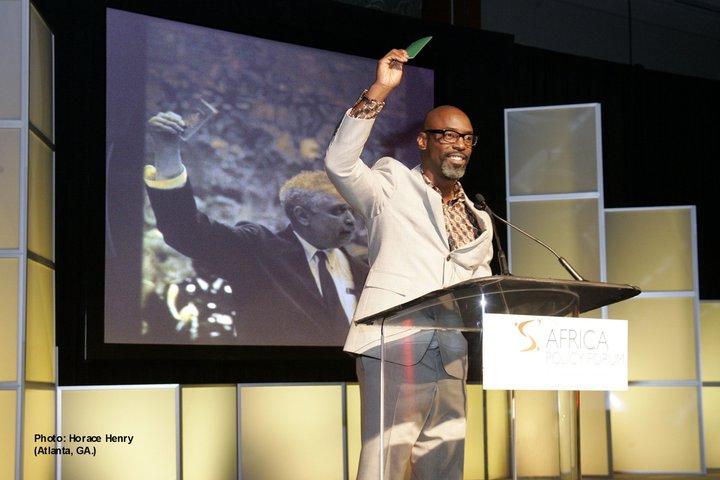
To many it was surprising when Sierra Leone’s President Ernest Bai Koroma decided to give citizenship to the 25 year acting veteran Isaiah Washington after he traced his ancestral roots through DNA to the Mende and Temne people of Sierra Leone. (Isaiah Washington at The Africa Policy Forum)
The ‘Grey’s Anatomy’ star became the first African American to get citizenship through DNA, and President Koroma became the first African leader to award citizenship based on DNA. It is not surprising when a few days ago Africa’s most populated nation, Nigeria, decided to follow the footsteps of Sierra Leone by granting citizenship to Mrs. Hope Sullivan Masters, an African American woman who also traced her roots to the Yoruba people of Nigeria.
In an interview earlier for Holland based www.africanews.com, Washington recalled on one occasion when he was travelling with President Koroma in New York for the United Nation General Assembly meeting as a Special Adviser: “As the train pulled out of the station I could see that Minister (Zainab) Bangura and President Koroma were tired. I knew I had to make my case, and quick. Before I could finish my spiel on the importance and historical significance of obtaining my dual citizenship, President Koroma smiled at me and said: ‘I understand what it is that you are trying to do and I support it. I am aware of W.E.B. Dubois’s teachings and I am of the same school of thought. I have had many ask me, ‘Why are you giving this man citizenship?’ and I say to them, ‘What are you all so afraid of?’ I sat there silent for several seconds and then said, ‘My sentiments exactly sir. Thank you for your time. I will shut up and let you rest.”

Inspired by this discovery Washington decided to set up an elementary school through his Gondobay Manga Foundation in Sierra Leone. He uses his personal resources and commits himself to make a better life for the people of Sierra Leone.
I first met Washington on his last visit to Sierra Leone. By then he was in the country to take oath as a Sierra Leonean and collect his passport. We had a three hour meeting at Hotel Barmoi in Aberdeen. We shared our dreams and aspirations and how we intend to make Sierra Leone a better place. During the conversation, I noticed Washington had bigger plans, but what I could not comprehend was how is he was going to make these plans come through. It was after I arrived in the United States for The Africa Policy Forum that I understand what the father of three was actually talking about.
Washington has been criss-crossing the United States all in the name of Sierra Leone. He has had over dozens of interviews on high profile TV networks and making statements as guest speaker at over 100 events for Sierra Leone. During the five days Africa Policy Forum he introduced me to several people including investors, philanthropists and celebrities, who will soon visit the former war-torn nation to contribute their quota to the development of Sierra Leone.
Furthermore, a US$2 million dollars worth of medical equipment, which was made possible by him, is on its way to the Bo Government Hospital in Southern Sierra Leone. He has also negotiated for two other companies that will provide prosthetics for amputees, clean water from rain catching systems and also garbage collection for communities in Sierra Leone.
Whether in his professional life as an actor, producer, writer, motivational speaker or activist Washington has passionately committed himself for the development of Sierra Leone. His new documentary film – ‘Passport to Sierra Leone’ produced by The Africa Channel is now playing on cable. He recently appeared as Coach Brian “Buddy” Simmons in ‘Hurricane Season’ starring Forest Whitaker. He will produce and star in the upcoming Brazilian film ‘Area Q’, which is expected to be in theaters in March 2011. ‘A MAN FROM ANOTHER LAND: How Finding My Roots Changed My Life’ is also expected on stands in April 2011.
Washington has and continues to work as a Goodwill Ambassador for the people of Sierra Leone.
“Making history as an African American accomplishing my “dual citizenship” based on DNA is a great thing. Finally, I have a people and a nation to connect with on the African continent to learn from and grow with as I have learned and grown in America. I will not let the people of Sierra Leone down,” he said.
By Murtala Mohamed Kamara
About the Author: Murtala Mohamed Kamara is the Founder and Chief Executive for www.salonejamboree.com . He is a specialist on West Africa and has written over one thousand articles for major publications including www.africanews.com
Kamara is presently in Atlanta , Georgia for an official visit
Stay with Sierra Express Media, for your trusted place in news!

Journey Back to Africa [VHS]Africa-Back To Roots/Woman 24 Adult Sweatshirt / Ash size Adult Large