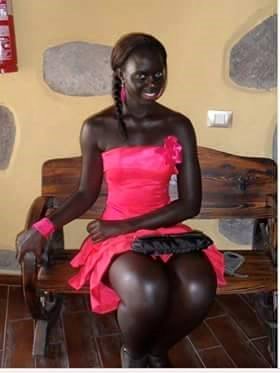
"THE BLACKER THE BERRY THE SWEETER THE JUICE/
I SAY THE DARKER THE FLESH,THEN THE DEEPER THE ROOTS!"
TUPAC SAYS

BLACK SKINNED BEAUTY SUPREME!

BLACK SKINNED BEAUTY SUPREME!

"BLACK IS BEAUTIFUL" -NEW YORK CITY STREET SAYING

"BLACK IS BEAUTIFUL!
BROWN IS HIP,
PUERTO RICAN IS OKAY
BUT white AIN'T S___T!"

BLACK SKINNED BEAUTY OOO!

BLACK SKINNED BEAUTY OOO!

BLACK SKINNED BEAUTY OOO!

BLACK SKINNED BEAUTY OOO!

BLACK SKINNED BEAUTY SUPREME

BLACK SKINNED BEAUTY SUPREME
BLACK SKINNED BEAUTY SUPREME!

BLACK SKINNED BEAUTY SUPREME

BLACK SKINNED BEAUTY SUPREME

BLACK SKINNED BEAUTY

BLACK SKINNED BEAUTY

Search This Blog

Pages

WE MUST HAVE A BLACK STANDARD OF BEAUTY BASED ON THE BLACK SKINNED BLACKEST WOMAN
Showing posts with label YORUBA IS DYING. Show all posts

Thursday, March 15, 2012

SAVE YORUBA LANGUAGE! AND ALL NIGERIAN AND AFRICAN LANGUAGES THIS WAY! -NOW YOU CAN SEND TEXT AND THEY WILL GET IT BY VOICE IN YORUBA AND ALL OTHER AFRICAN LANGUAGES!

Ife researchers unveil local language text-to-voice application – 234next

Move over twitter. Nigerian texters unhappy that their messages can only be accessed by people able to read in English Language can now breathe easier as local researchers have concluded work on an application that renders texts in local languages in audio.
To help secure, protect, and bring back most of the local languages that are going into extinction, Information and Communication Technology researchers at the Obafemi Awolowo University, Ile-Ife, last week unveiled the technology through which texts are converted into voice messages in Nigerian indigenous languages by the recipient’s handset.
The research work is led by Tunji Odejobi, a local computer expert in constraint satisfaction and programming and Rick Wallace, a professor at the Cork University, Ireland.
“Even if you don’t even know how to read and write in the formal sense of it, the technology can leverage that,” Mr Odejobi said.
“So technology has redefined what we call literacy now. But the key item in this is the use of language. If you want to a local language that doesn’t speak your language, then you can use technology to get your mind across to such people. That is what we have done. You can use what we are doing today to achieve such communication in various languages between the sender and receivers of a message. If we don’t do this, we are just going to kill our languages silently. It can help smoothen the culture by having common language of communication and giving other languages a place to showcase their values and culture too,” he added.
test
Source: 234next news

Monday, September 26, 2011

SAVE YORUBA LANGUAGE!- OJOGBON ADEBOYE BABALOLA(LATE) GIVES US THE BEST WAY WE EACH CAN SAVE IT!-EACH ONE CORRECT ONE-EVERYTIME A PERSON MIXES YOU SUPPLY THE CORRECT YORUBA PHRASE SO THAT THEY KNOW NOT TO MIX!

That the Yoruba language may not die
SIR: The article of Yeye Olade published in your issue of August 8, 2005, treads on familiar ground. Her suggestions are most welcome. It will surprise her to hear that as far back as 1926 (when I was born) letters and articles have appeared in the Yoruba weekly AKEDE EKO on the pollution of the Yoruba language through admixture with English words. Past copies of AKEDE EKO available in the African Section of the University of Lagos Library are my source of information on this.


advertisement
I hold that the Inspectorate Divisions of Federal and State Ministries of Education are to blame for the non-implementation of the decreed government policy on the use of the mother tongue or local language as the medium of instruction at the very start of primary school education. We continue to give kudos to Prof. Babs Fafunwa for the research on mother tongue education done at the University of Ife in the 1960s. One thing those who turn up their noses upon this research fail to note is that the students taught other subjects in Yoruba were taught the English language in English by specialist teachers, in view of the importance of English language in the Nigerian political, social and economic system.
Yeye Olade's appeal to all Yoruba parents to speak undiluted Yoruba at home in bringing up the children as lovers of the mother tongue is well taken. For her information I go down memory lane and recall that in 1957, a society named Egbe Ijinle Yoruba was founded in London by Yoruba students studying and living in London. The motive force was their desire to keep their secret . All meetings of the society were conducted in Yoruba and a standing rule was that undiluted Yoruba should be spoken. Should any member admix his contribution with an English word or phrase, someone else present would supply the correct Yoruba equivalent in correction.
As the students successfully completed their studies and brought home to Nigeria the golden fleece, an Ibadan branch of the society was inaugurated. Dr. Esan and Dr. (now Prof. Emeritus) Akinjogbin were in the vanguard of the inauguration. My humble self and the late Chief Folahan Odunjo among others became members of the society. When I moved from the University of Ife at Ibadan to the University of Lagos, I spoke with the late Pa Sobande, Mr. Oladipupo Yemiitan and others with a view to starting the Lagos branch of the society which was launched in 1965.
Our desire is to see a branch or more than one branch of the society flourishing in every Yoruba town or village. However, this desire is yet to be achieved. We declared over and over again that Egbe Ijinle Yoruba is not a secret society. What 'Ijinle' refers to in its name is deep Yoruba, idiomatic Yoruba.
Prof. Olugboyega Alaba of the University of Lagos, in his article on the Yoruba language published in the March 1995 issue of the B.B.C. Focus on Africa magazine, merely regards the admixture of English words with the spoken Yoruba of many a Yoruba person as interesting. Says he: "Another interesting by-product of the contact between English and Yoruba is code-mixing. To show that they speak some English, which is the more prestigious language, many speakers of Yoruba often put English lexical terms into Yoruba phrases".
Yeye Olade calls for research on modernising Yoruba. Inadequate supply of funding for such research has been a bane, but in the 1980-1983 period, the Yoruba Studies Association of Nigeria spearheaded a research project funded by the Nigerian Educational and Research Council for the production of suitable terminology for legislative purposes in the three major Nigerian languages. An outcome is A Quadrilingual Glossary of Legislative Terms (English, Hausa, Igbo, Yoruba) published by the Council in 1991. The onus is on the National Assembly and the state Houses of Assembly to make use of this Glossary after the production of a core of trained, simultaneous interpretation experts for each language.
Prior to this research on legislative terms, the Yoruba Studies Association of Nigeria had succeeded in reaching consensus on appropriate meta language for teaching Yoruba language and literature in Yoruba at the tertiary level of education. The terms were published in two volumes to start with.
To round off this response of mine, I want to bring to Yeye Olade's attention the laudable enterprise commenced by Dr. & Mrs. Onayemi in Canada starting a Yoruba literacy (reading and writing) club with well-illustrated bilingual publications: Mo on ko, mo on ka primarily to acculturate their own children as Omo Oduduwa. I believe there is a web-site for the club on the Internet.
Adeboye Babalola, Lagos


© 2003 - 2005 @ Guardian Newspapers Limited (All Rights Reserved).
 Powered by dnetsystems


7&&&&&&&&&&&&&&&&&&&&&&&&&&&&&&&&&&&&&&&&&&&&&&&&&&&&&&&&&&&&&&&&&&&&&&&&&&&&&&&&&&&&&&&

LETTER TO THE EDITOR:
SAVING YORUBA LANGUAGE
Oloogbon Adeboye Babalola's response to my article "The Death of Yoruba Language?" in Guardian,August 8th,was enlightening. It is the tiredless efforts of such Yoruba Scholars that has academically placed Yoruba on the World map. Now we have Google in Yoruba as a result of such hardworking scholars! We want to build on this solid foundation that Oloogbon Babalola,Akinwunmi Isola, Oladipupo Yemitan, Adebayo Faleti and so many others have laid. In an ammended version of the same article I have advanced that all State legislatures in Yorubaland must declare Yoruba as their lst language of discourse. Here the legislative terms already worked out in Yoruba,Ibo and Hausa will come into use! Also it should be noted that Yoruba on the World Wide Web is booming. Tiwantiwa,(uk.groups.yahoo.com/group/tiwantiwa), created by Sister Molara Wood in London is protecting the purity of the Yoruba Language and should be supported by clicking on and joining its growing membership.
The response to the article has been tremendous from all over the Yoruba World, so look forward to a soon to be announced Conference on "Saving Yoruba Language" to be held both in Nigeria and the USA. I have talked on the web and in workplaces where I go in Nigeria to many people as a result and have received many suggestions on how we will save Yoruba and other Nigerian languages. One female security guard, after reading the article prompltly declared that from that day forward all Yoruba speakers on the staff would be corrected and fined by her to make sure they stopped polluting Yoruba! The she proudly correct herself and addressed me as "Iya" instead of the "Mama" she had minutes before been calling me! One large Lagos company I visited and took time to pass copies of my articles around to read, had the Female receptionist orgtanizing staff there to a meeting where"ogas" of each section would be convinced to stop mixing and to issue fines for any mixture to be collected and used for charitable donations!
On the Net I was written to about the heavy assault of "born-again" churches on Yoruba speaking in the church and outside. I replied ,as a Christian myself that "righteous " members should organize "Yoruba Services" and evangelize so much in the community that these services would become the most attended, a feat which I am embarking on in my own church.
Keep the suggestions flowing and act on solutions that occur to you O Great Nigerians and Yoruba, Urohbo, Ogoja,Ibo,Gwari and all other endanged Nigerian languages will be saved!
 ^^^^^^^^^^^^^^^^^^^^^^^^^^^^^^^^^^^^^^^^^^^^^^^^^^^^^^^^^^^^^^^^^^^^^^^^^^^^^^^^^^^^^^^^^^^^^^^^^^^^^^^^^^^^^^^^

EDITORIAL/OPINION
Monday, August 08, 2005                        HOME       ABOUT US       SUBSCRIBE       MEMBERS       CONTACT US  
NEWS
National
Metro
Africa
World
Business
OPINION
Editorial
Columnists
Contributors
Letters
Cartoons
Discussions
Outlook
SPORTS
Home
Abroad
Golf Weekly
Results
FEATURES
Focus
Policy & Politics
Arts
Media
Science
Natural Health
Law
Education
Weekend
Friday Review
Executive Briefs
Fashion
Food & Drink
Auto Wheels
Friday Worship
Saturday Magazine
Sunday Magazine
Ibru Ecumenical Centre
Agro Care

The death of Yoruba language?
By Yeye Akilimali Olade "Kilo happen? Ma worry. Mo understand. Kosi problem. Mo sorry gan. Ma expect me. Ke e nice day" - (a GSM conversation)
Surely this is not Yoruba that this man is speaking? Definitely not! Yet everyday Yoruba speaking people are killing Yoruba like this. Is this the new (English) pidgin for Yorubaland, joining other sections of the country, who have specialised in killing their own Nigerian language by using mainly "pidgin" in the name of "communicating" with other groups? Oyibo culture has brought Nigerian culture to its knees in so many ways - now a foreign language seeks to kill our own God-given languages, using Nigerians as the executioners! Eewo!
That English, the ready-made weapon of British-American cultural imperialism, is not just trying to destroy African languages, but is attacking all other languages worldwide, I agree. Ojoogbon Akinwunmi Isola, the newly-appointed Chair of Oyo State Arts and Culture Board, related to me during a discussion with Ojoogbon Babatunde Fafunwa, the problem the French are having with English. He stated that the French government had recently warned all French broadcasters to stop polluting French with English, as is now popular in general French conversation, or face dismissal. But I doubt whether the French would think of slaughtering their language to the extent that Yorubas daily have begun to do.
The greatest tragedy in Yorubaland today however regarding language is the dominating trend to speak only English to their children, making it their first language, then sending them to private nursery school, who only teach in English and causing Yoruba children to value English above all other languages! (After all their WAEC will not be in Yoruba, one highly-educated Yoruba man told me!) And see the result! These English-speaking children will rudely use English to disrespect all and sundry (after all English does not have pronouns of respect for anybody). Hear them saying "Shut up Daddy! - Give me back my candy!" in an authoritative way. And hear this one told by Oloogbon Ishola - an semi-literate (in English)) parent says to his child, "Say hello to Daddy". The child replies "Ye 'llo Daddy". Olodumare! Yoruba children now do not know proper Yoruba and even as a result of this mixture do not know the real Yoruba words for "ma worry", "check result" etc.. Ask them or some of their parents and they will tell you they don't know the original Yoruba for the popular phrases that many literate and non-literate leaders and followers commonly use throughout Yorubaland.
As a Black-American, who has come back to her Yoruba roots these past 26 years in Nigeria, I want to break down in tears over this "iyonu"! How can Yorubas kill their own language? What sort of curse is this? Obviously the curse of european-american imperialism/colonialism/slavery! As a result I have declared "War Against Destroying Our Nigerian Languages" from today. And it must start from Yorubaland. Are not the Yorubas the "wisest and the greatest"? As everything good seems to start from Yorubaland in Nigeria, "let it be so".
I am appealing to all full-blooded Yoruba, as of today to consciously seek not to mix English with their Yoruba. Yoruba leaders must slowly speak, watching their tongues, not to include any English words inside their Yoruba. It has gotten to a state where such leaders cannot avoid mixing English as they speak Yoruba and their every sentence includes whole English phrases! The late Yoruba leader, Oloye Bola Ige was a pure Yoruba language speaker and other Yoruba leaders should follow his example. This is a "War Against English words entering Yoruba"!
All clubs and organisations in Yorubaland should hold bi-annual and annual Yoruba Speaking Competitions for the "Best Yoruba Speaker", with heavy monetary prizes (N20,000 plus) to get Yorubas to consciously practice speaking Yoruba without any English mixture. Yoruba broadcasters are guilty of promoting this deadly trend. Yoruba stations must have quarterly courses in Correct Yoruba Speaking for they are one of the biggest offenders of mixing heavily English into Yoruba. In schools Yoruba teachers must stress the importance of not mixing Yoruba. All private schools in Yorubaland must be required to have classes in Yoruba language from nursery through secondary school levels. There is a "famous" private school in Lagos, owned by Lebanese (or is it Syrians), which does not teach Yoruba on the secondary school level, as required by law. Law enforcement is necessary with frequent unannounced inspections on this crucial issue. And any student who fails to pass Yoruba in Yorubaland must not be allowed to graduate!
The Yoruba Press must be commended for indeed holding the banner high and not polluting Yoruba with English, especially Alaroye, Alalaye, Ajoro, Iroyin Yoruba, Akede must also continue the struggle to save Yoruba language. More effort however must be made to eliminate "pasito", professor "dokita" words as most of them have genuine Yoruba words that can be enlisted and popularised among their readers. Aworen must be resurrected by Alaroye, for use in all schools in Yorubaland as it was in the '50s to inculcate love of Yoruba language among children. Yoruba departments in Nigerian and foreign universities must start churning out more research on modernising Yoruba for technical, scientific and other vocabulary and making it available through special courses for the media and the general Yoruba public.
Yoruba writers must begin to write and publish bilingual publications. For any publication they publish in English, its Yoruba equivalent must be done. In the same book (Yoruba-from the front, turn upside down, English from the back) is one way to do it or in a title simultaneously released. More books, magazines, other publications like club histories, year books must be published in Yoruba. (Do you know that Alaroye sells many more copies than English newspapers in Yorubaland?) For example why is a prominent Yoruba Club issuing their history in English? If they must have English, then it must be a bilingual edition, in Yoruba from the back. Who but Yoruba should promote publications in Yoruba? We must stop promoting a foreign language over our own God-given language.
Yoruba music too, has been assaulted by Yoruba artists, unknowingly killing Yoruba language. The mixture of English has reached a new high in Fuji, Yoruba Gospel has started mixing English inside Yoruba songs within Yoruba cassettes, adding along side complete English songs! Olodumare! Such artists must be warned - no more killing of the language in this manner. If it is English you want then put that on an English cassette. Do not replace our God-given Yoruba in a Yoruba music cassette!
Yoruba movie practitioners are perhaps the biggest offenders and must take up this challenge to save Yoruba language. English mixing should absolutely be banned in all Yoruba films. I have not researched the topic but I suspect that Hausa, is probably the most unpolluted language in Nigeria, and in all their films that I have seen no English there at all.
The beauty of the Yoruba language must be showcased by having more Yoruba Cultural Festivals to be held by all clubs and organisations in Yorubaland annually. Odua's People Congress and other enforcers of law and order in Yorubaland must be in the vanguard, not only by stressing among its members that Yoruba should not be polluted but by holding bi-Annual Yoruba Speaking competitions for the "Best Yoruba Speaker". They must lead the way in correct Yoruba speaking and have literacy classes for all their members to learn to read in Yoruba and encourage them to speak Yoruba in the home to their children: Yoruba must become again the first language of Yorubas at home and abroad.
Finally a private, Yoruba school system must be set up. These schools will teach all subjects in Yoruba from nursery up to the university eventually. If it must be like a "mushroom school", starting with nursery school first and adding class by class this must be done. This Yoruba Academy can be supported extensively by Yorubas abroad, eventually having board houses were Yoruba children from abroad can join their counterparts here, including all "classes of children, street children etc.) This Yoruba Academy will inculcate Yoruba culture into our children also. With the help of our Yoruba scholars we can build on Ojoogbon Babatunde Fafunwa's successful "Mother-tongue Education" at University of Ife in the 60s. Afterall, even UNESCO has proven that Mother-tongue Education is the best for all children.
Let Yoruba Language not die! God has given the Yoruba race a language to be proud of, anywhere in the world (there are at least 60 million or more Yoruba speakers throughout the world). Let's not destroy it with our own mouths! Let us pass it on in its richness to our children, daily in our home. Let us proudly speak it daily, read it daily, champion it daily. Yorubas cannot remain great without our language. And let us be in the vanguard of saving all Nigerian/African languages.
Biu, Ogoni, Urhorbo, Igele, Ogoja, Ebira, Idoma, Efik, Tiv, Langale, Tangale, Kagona, Kutep, Oron, Legdo, Bubiaro, Esan, Afima, Isekiri, Ijaw, Edo, Ikenne, Joba, Gwari, Ibo, Igala, Hausa, speakers are you listening?
*Mrs Olade is the Chief Librarian of African Heritage Research Library, Adeyipo Village via Ibadan.

 
BUSINESS SERVICES
Property
Appointments
Money Watch
Market Report
Capital Market
Business Travels
Maritime Watch
Industry Watch
Energy Report
Insurance
Compulife
© 2003 - 2005 @ Guardian Newspapers Limited (All Rights Reserved).
 Powereddnetsystems.net dnet®

Wednesday, February 09, 2011

YORUBA KEYBOARDS AVAILABLE ON THE NET AND OTHER PLACES AS WE FIND THEM-LEARN/TYPE/USE YORUBA IN EVERY THING YOU DO SO THAT YORUBA WILL NOT DIE AS IT IS DYING!

FROM learnyoruba.com

http://www.naijablog.co.uk/2006/11/yoruba-keyboard.html


A B D E Ç F G GB H I J K


Home Readers' Club Member's Login Disclaimer


Yoruba Language capable font with incorporated


simple keyboard input software program


A major objective of Bis Bus International

is the promotion, growth and use of the Yoruba


language in a multimedia format on the World

Wide Web. In pursuance of this goal, Mr. James


Kass in a cooperative effort with Dr. Adebusola

Onayemi released a freeware font -


YorubaOK.ttf sometime ago.


Yoruba School


L M N O Ô P R S ß T U W Y


Yoruba translation of the English

text on the right to follow.

This font, designed for typing Yoruba text on the computer keyboard, makes it possible to render Yoruba in its full acceptable orthographic form - complete with all the characters of its alphabet, accent/diacritic marks inclusive. This font is available for download on our web site - www.learnyoruba.com .


Unlike the regular English language alphabet, typing accented characters or the letter of other languages is usually a tedious process requiring multiple keystroke combinations to produce a single character. This usually involves depressing the Ctrl, Alt and Shift keys in combination with a letter character or a series of numbers which are the assigned ASCII code numbers for that particular "foreign" letter. Moreover, it is also necessary to have a chart of the ASCII code numbers handy or memorize the numbers to type in to produce each special character.


Mr. Kass has recently written a keyboard reconfiguration file for the YorubaOK font. We are delighted to present you with this simple keyboard input program which when used in conjunction with YorubaOK.ttf facilitates the typing process. This does not require the use of cumbersome multiple keystroke combinations, neither does it entail manual remapping of the keyboard or the need to memorize any numbers. On installation of the Yoruba font (YorubaOk.ttf), the keyboard reconfiguration file (YorubaOK.kmx) and the freeware keyboard input software (keyman6-0-164-0.exe), all that is required is to remember the characters of the English alphabet that are not present in the Yoruba alphabet i.e. z, x, c, v and q. ( Incidentally, the letters z, x, c and v are conveniently located contiguously on the keyboard.) These five letters have been programmed with the YorubaOK.kmx file to insert the accent/diacritic marks required to produce the complete character repertoire of the Yoruba language in any text document. You can now type directly into any text editor including your e-mail with this program and input the accent/diacritic marks on the fly.


Here is a summary of how to proceed.


1. Download the YorubaOK.ttf font into a specified folder on your computer.


Go to the Home page of www.learnyoruba.com and Download the YorubaOK.ttf by clicking on YorubaOK font.


Save it to the a folder of your choice.


(The next step to install the file can be done when you go off-line or immediately as you wish)


To do this:

Go to the bottom Task bar of your computer

Click on Start, Control Panel, Fonts

then go to Files

Install New Font


Select the Folder where you saved the font and you will see that there is a file

"YorubaOK (True Type)" in the folder.

Select it and Click "OK"

The YorubaOK Font will be added to the numerous fonts that are already in your computer's Fonts folder.


2. Install it from the folder, so that it now appears as on of the numerous like Arial, Times New Roman, etc.

fonts in your fonts folder


Also, from the Learn Yoruba home page, click on the link: Keyboard

This will bring you to the page that provides the links and explains the steps required to enable you type Yoruba text on your computer.


This is what you need to do


1. Go to http://www.tavultesoft.com/keyman/downloads and

download the file keyman6-0-164-0.exe to a specified folder on your computer


2. Go to http://www.tavultesoft.com/keyman/dowloads/keyboards/ and from the list of languages, select Yoruba you will be prompted to download yorubaok.kmx

Go to the folders where you have downloaded the 2 files and install them.

You are now Ready to Type Yoruba Text!!!!


TYPING INSTRUCTION


Load the Tavultesoft keyboard program. (It may be preprogrammed to launch automatically at startup.


Toggle the keyboard profile to "ON"


Set the "Font" to yorubaOK and select the desired font size. You are now ready to begin typing.


To input the accent/diacritics


Type


"c" after the vowels (and m or n ) to input the acute sign ( ' )


"z" to input the grave sign ( ` )


"x" for macron (sometimes required on letters "m" and "n"


"v" for the underbar (preferable to the under dot used when required with the letters "e", "o" and "s".


"q" for the low-rising tone mark ( v )


Use ' Shift + ^ ' for the Naira symbol


Thus


(you need to have installed YorubaOK.ttf to view the following Yoruba text correctly)


Type "e", see an "e"

Type "c" immediately after, see an " é "

Type Ade and then "c" get Adé

Type O "v" ba get Ôba

Type E "zv" ko "cv" get Êkö

Type Is "v" e"cv" get Iÿë


Note: You have to type the "c" or "z" first to insert the accent mark then followed by the "v" for letters requiring the underbar to obtain the desired composite character (i.e type the letter "e" or "o" then "cv" or "zv" as indicated. Putting the "v" first will not work)


English (or other) keyboard can be clicked on or off for entering non-Yoruba passages to the text. For one or two words, in case the user does not want to take the time to toggle, the letters c,q,v,x and z appear correctly if they have a dash typed in first. Thus "Victoria" could be entered as "Vi-ctoria" at the keyboard and it will be stored in the document correctly.


FINALLY


This package, with the exception of the keyboard program (keyman32) from SIL International, was developed by Mr.James Kass with a little help from my humble self. If you find it useful and feel inclined to you may send a short ( or long) thank you note to Mr. Kass at jameskass@worldnet.att.net and visit his web page http://home.att.net/~jameskass/


As for me, A kìí dúpë ara çni

or in our trade mark color code to enhance

recognition of the changing tone in pronounciation

A kìí dúpë ara çni


Visit our website often, e-mail suggestions for improvement, and buy our book and CD –


www.learnyoruba.com/products.htm


Yorùbá


Mõ ön kô, Mõ ön kà


Ìwé Kïnní 1 Book One


Fún àwôn ômôdé Children’s Edition


Please feel free to distribute this program as long as the html sheet – YorubaOK.htm is included.


In summary, the three important download files you need to install are:


1. YorubaOK.ttf

2. YorubaOK.kmx and


3. keyman6-0-164-0.exe


....... and you are in business. You can go ahead and publish your Yoruba book or novel.


Best regards,


Adébùsölá Ônäbàjò Ônäyçmí

GO THERE AND INSTALL!

&&&&&&&&&&&&&&&&&&&&&&&&&&&&&&&&&&&&&&&&&&&&&&&&&&&&&&&&&&&&&&&&&

from africanportal.com

africanPortal


"ABD Yoruba" Keyboard Layout


Created On: Oct 27th, 2004


Created By: Bomi Olamijulo-Oki


Now with accented N and Japanese Yen


ABD YORUBA KEYBOARD


Features


Free, Easy Download


Extremely Easy to Use


Unicode Compatible


Send pure Yoruba email to family and friends with Hotmail, Yahoo, MS Outlook


Create MS Word documents in Yoruba, Transfer Yoruba documents via internet, Publish your Yoruba work online


Create, Present, Transfer Yoruba MS Office documents - Works with MS Word, PowerPoint, Excel, Publisher, etc


Type both Yoruba and English with the same keyboard, no need for keyboard switches


Preserves conventional English keyboard use – No need to learn any new key strokes for English characters


Reduced keystrokes by using the Alt Key only to replace AltGr (or Alt + Ctrl)


Right Alt key reserved for most Yoruba functions, Left Alt key remains for English functions


Variations of each character are very close to each other


Can use with a variety of Unicode Compatible fonts, including Arial Unicode MS, Tahoma, Code 2001 and more


- Currently works best with Arial Unicode MS


ENTER ABD YORUBA TUTORIAL


africanPortal........The World's Portal to Africa!


Comments, Articles or Suggestions? Contact: publisher@africanPortal.net


africanPortal© 2004 Terms of Use


Last Updated: Nov. 7th, 2004

77777777777777777777777777777777777777777777777777777777777777777777777777777777777777777777777777777777777777777

Find Yoruba Keyboard E-mail Editor on AppStoreHQ.
Apps at AppStoreHQ


at appstorehq.com


Home Productivity Yoruba Keyboard E-mail Editor Widgets


Widgets and Badges

Write Your Own Review Using Our Widget

Do you have a review of Yoruba Keyboard E-mail Editor on your blog? If you include the AppStoreHQ badge (shown below) in your post, we'll automatically link to your review from the application page on our site. The badge will also update itself as the app information and rating changes. Here's how it works:

1.Copy the HTML below for our Yoruba Keyboard E-mail Editor widget.

2.Paste the HTML into your post.

3.AppStoreHQ will notice that you're linking to one of our pages. We'll index your blog.

4.We'll show a link to your post from the Yoruba Keyboard E-mail Editor page on AppStoreHQ.

Our blog widgets are free and easy to use. Read our FAQ for details.

HTML to embed (copy this into your post)


Find Yoruba Keyboard E-mail Editor on AppStoreHQ.
Apps at AppStoreHQ


Preview


Apps at AppStoreHQ


HTML to embed (copy this into your post)

Find Yoruba Keyboard E-mail Editor on AppStoreHQ.
Best iPhone apps at AppStoreHQ


Preview


Best iPhone apps at AppStoreHQ


HTML to embed (copy this into your post)


Find Yoruba Keyboard E-mail Editor on AppStoreHQ.
Best iPhone apps at AppStoreHQ


Preview


Best iPhone apps at AppStoreHQ FAQ

What is a badge?

An AppStoreHQ badge is an automatic link from an app page on our site to your blog post. You review an app on your blog, we'll link to your post.


Why would I want to use it?

AppStoreHQ bases its app ratings in part on the reviews and commentary of leading bloggers. If you use our app badge, AppStoreHQ users will be able to read the first few words of your review, and many of them will click through to your blog.


How long will it take for my blog link to appear on AppStoreHQ?

It can take a few days for your blog to complete our approval process. Don't expect your posts to appear immediately on AppStoreHQ.


How does AppStoreHQ prevent spam?

There is a manual approval process for each new blog and regular screening of all submitted posts.


I don't think it's working, what should I do?

Here are a few things to check:


•It can take a few days for your blog to complete our approval process. Don't expect your posts to appear immediately on AppStoreHQ.

•Did you remember to include our badge in your post? We can't find the post if the badge isn't present


4444444444444444444444444444444444444444444444444444444444444444444444444444444444444444444444444444444444

http://www.naijablog.co.uk/2006/11/yoruba-keyboard.html


naijablog


My flickr

My stuff

■My twitter feed

■Cassava Republic

■Facefcuk

■Films

■Flickr

My Blog List

AFRICA IS A COUNTRY

Jeffrey Wright Reads Walt Whitman

53 minutes ago Authorsoundsbetterthanwriter

Commonwealth Short Story Competition

1 day ago Timbuktu Chronicles

Wilkins Engineering

1 day ago Adun Okupe

Conversations with Feyi F. on Marxism

1 day ago ! F e i s t y P e n !

My Ynaija Post: My Mess, My Growth

1 day ago YORUBA GIRL DANCING

PLUG!

2 days ago Brittle Paper
A Fun Blog on Literature and Philosophy

A Strange New Fiction: Ben Okri and His Stokus

2 days ago Akin about things too concerning to ignore

Africa: China in the minds of impressionable African kids

2 days ago Chxta's World

We are in trouble!

4 days ago Texas in Africa

um...

6 days ago Dark Matters

Books that have influenced me

6 days ago Suleiman's Blog

Pastors, Imams and Politicians

1 week ago Method to the Madness

There Goes That VJ....

2 weeks ago Wetin Dey Happen?

Mo' Cheddar

4 weeks ago Guerilla Basment

THE FARCE THAT IS NETWORKING

1 month ago Lexistrix

On Nigeria at 50: Is this rock bottom?

4 months ago Black Looks

dsc_0331

5 months ago wolesgirl

In my defence......

7 months ago Twitter / jeremyweate

■jeremyweate: Random question: does someone remove all the prayers from the Wailing Wall late at night, when no one is looking?

■jeremyweate: Tomorrow, beachism...

■jeremyweate: Trouble sleep, yanga wake am..

■jeremyweate: @ema4u Bom dia...

■jeremyweate: On mothers and sons in Nigeria - powerful writing! http://bit.ly/h3pIXa


About Me


Jeremy Weate

nobodadi at hotmail dot com

View my complete profile

This Blog Linked From Here My Blog List

This Blog

Linked From Here

.My Blog List

.

Monday, November 13, 2006

Yoruba keyboard

Click on the image to get a good look.


Posted by Jeremy at 10:00 AM

13 comments:

Anonymous, 11:46 AM

I thought you would be interested in this.

http://www.bbc.co.uk/blogs/theeditors/2006/11/african_image.html Note the comment from a certain Andrew Fowler who worked in Naija


Anonymous, 1:18 PM

How many websites and indeed documents are out there written in Yoruba to really justify this keyboard?


Anonymous, 2:32 PM

dumb ass statement from chxta. the only way to get more documents in yorubas to provide people with the tools to be able to make them


St Antonym, 2:39 PM

Punds, dollars, euros. Sorted for the Yoruba.


The rest is sauce.


Marin, 2:46 PM

Are you sure this is really a Yoruba keyboard? I do not see a gb or sh, written as an s with a dot underneath.


Anonymous, 4:02 PM

marin,


umm, to type gb you press g and then b... :P


The S with a dot is there, using the S key with the Ng modifier key.


I would love to grab one of these, if they're not made with rubbish keyboards. I remember a few years ago, hearing about a Nigerian PC Assembly company supplying Nigerian keyboards, but I thought at the time this was just a keyboard with a ₦ on it. This is much better.


You would also need a Yoruba Font


Soul, 4:06 PM

ohh I would buy this sharpish..


Considering that Yoruba is spoken in many countries and that the it's such a pain to try inserting symbols into names and documents.

this would be great!


I was actually thinking of this as a pet project for myself.. I'm actually a bit bummed that someone has already come up with it. but happy at the same time.


Marin, 6:09 PM

This post has been removed by a blog administrator.

naijajams, 7:29 PM

I have this keyboard. As some have pointed out, the gb & sh are not there. You also find unicode support in the popular word processors to be somewhat shaky and most of the popular typefaces to not have the complete unicode character. To make an (S.) I have to make an S & then use the . as a combining character. Microsoft Word has problems rendering this properly...


Here is the link to the actual site:

http://www.konyin.com/


Overwhelmed Naija Babe, 11:00 PM

oh whao.. thats sooo cool


Anonymous, 12:12 AM

Sorry Marin, I hope you realise my remark was facetious.


I know gb is a separate single letter, but is it really necessary to create a single key for the task when the two latin characters are already there? The language of my people uses two latin characters to represent one letter too.


And Naijajams, thanks for the link, I assumed that some sort of driver would be provided with the keyboard in order to make it operate with Windows apps and the Characters/Fonts. Is that not the case?


The method you are describing sounds like a microsoft hack for people with regular keyboards to enter Yoruba characters, making the extra features on this keyboard redundant.


As a linux user I will probably have to get keyboard maps from wazobia linux to use this. It will take more than a fancy keyboard to move me from Debian.


Marin, 12:34 AM

aaron,


you got me there with the gb. I guess that is what happens when one is trying to sneak a comment onto a blog from work 0).


I will not read blogs at work.

I will not read blogs at work.

I will not read blogs at work..........................


learningyoruba, 4:24 PM

So can I ask...how can I get access to such a keyboard? I've been looking for ages!


Tuesday, October 19, 2010

YORUBA!-LET'S SAVE IT BY USING IT-IN OUR PLAYS,WRITINGS,SPEAKING,SPEAKING IT TO OUR CHILDREN ONLY AS THE LANGUAGE AT HOME!-FEMI OSOFISAN HAS TRANSLATED THIS PLAY INTO YORUBA SO THAT THE LANGUAGE WILL NOT DIE!

FROM speakyoruba.blogspot.com

originally published at
thenationonlineng.net

Tuesday, October 19, 2010

YORUBA LANGUAGE IS DYING SO WE MUST ALL USE IT EVERYTIME WE CAN,SPEAK IT TO OUR CHILDREN AT HOME ONLY,WRITE IT,TRANSLATE PLAYS INTO IT,CLEAN UP OUR YORUBA FILMS WITH NO MIXTURE OF ENGLISH IN THEM!-FEMI OSOFISAN HAS TRANSLATED THIS PLAY INTO YORUBA AND THAT IS WHAT WE MUST DO TO BRING BACK THE MOTHER TONGUE AS NUMBER ONE IN OUR LIVES!

from thenationonlineng.net


Old play, new language

Font size: Edozie Udeze 17/10/2010 00:00:00

Who is Afraid of Solarin? a play by Professor Femi Osofisan, has always been a symbolic one. It is so because it is a comic treatise on what makes Nigeria and Nigerians unique. In the play, Osofisan uses plenty of comic scenes and statements to portray the story of a society where things work upside down. The name Solarin is used symbolically because of his role in trying to give a better direction to Nigerians and to the Nigerian state. The play chronicles Nigeria’s many socio-political problems in such a way that the audience are made to feel the impact while the play is on stage. You can’t help but laugh and hiss and then wonder the sort of society Nigeria is and why the people are what they are.


This was why it was selected as the independence play this year by the trio of Mufu Onifade, Tunde Kelani and the Lagos State government. However, the play which was translated into the Yoruba language by Dotun Ogundeji as Yeepa! Solaarin Nbo!!, is meant to send home the message to the larger Yoruba theatre audience.


In this new experiment, the message is supposed to sink deeper, so that people who love to see the lighter side of Nigerian myriad of problems dramatized on stage, would have a better view of it. The few days the play was on stage in Lagos last week proved that a lot of people were really eager to laugh away the problems of the society. Not only that the artistes led by Ropo Ewenla were on top of their game on stage, the large turnout of theatre lovers showed that the choice of the play was apt and appropriate.


To make the play appeal more to the audience, the producers introduced an opening glee. This marriage of convenience between opening glee and full-length drama presentation was Mainframe and National Association of Nigerian Theatre Arts Practitioners (NANTAP) Lagos chapter’s synergetic way of joining the Lagos State government in celebrating the 50th independence anniversary of Nigeria. This way, there was no moment of boredom. The artistes were able to appeal to the audience to wake up to the realities of the moment; to make Nigeria great.


Is this Nigeria of our dreams in 1960? That seemed to be the question raised on stage by the actors. Ewenla, the lead character was able to convince the audience that we need to do more; we need to work harder and be more honest to make Nigeria a better place for all and sundry.

Yeepa! Is an exclamation that something hilarious or ominous is about to happen and that people should sit up to welcome it. This situation calls for an acclaim, calling the Nigerian people that there are more than meet the eye. Solarin was an enigma of some sort when he was alive. Although the name is hyperbolic in a way, it goes to portray a visionary leader who saw long before now what the Nigerian society portended. Now the play in his name says it all.


Anywhere this play goes on stage, the euphoric appeal it gives leaves much to be desired. The Yoruba version of it also did much more; the message seeped deeper into the fabric of the audience whose laughter and hisses tore deep into the night. And so, it is kudos to Onifade for his sense of humour and wisdom. The play truly helped to embellish the mood of the moment and bring Nigerians back to that moment of reflection.


Share this Article: del.icio.us Digg Technorati Facebook

Comments (0 posted):


MY COMMENT I AM TRYING TO POST BUT IT'S NOT GOING!
Your name: Your e-mail address: Your website: Add your comments: YORUBA LANGUAGE IS DYING ALONG WITH OTHER NIGERIAN/AFRICAN LANGUAGES SO WE MUST DO AS MUCH OF THIS AS POSSIBLE-USE THE MOTHER TONGUE FOR ALL PLAYS,EVENTS,PUBLICATIONS THAT YOU CAN AND SAVE AFRICAN LANGUAGES! TAKE CARE OF YOUR MOTHER TONGUE LIKE OTHER SELF-RESPECTING PEOPLE IN THE WORLD DO-IT IS YOUR FIRST LANGUAGE, NOT YOUR SECOND AND GOD GAVE IT TO YOU SO CHERISH IT,SPEAK IT ONLY IN YOUR HOME TO YOUR CHILDREN AND LET OUR MOTHER TONGUE LIVE!