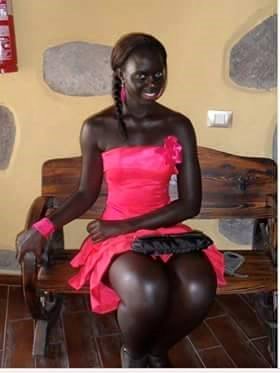
"THE BLACKER THE BERRY THE SWEETER THE JUICE/
I SAY THE DARKER THE FLESH,THEN THE DEEPER THE ROOTS!"
TUPAC SAYS

BLACK SKINNED BEAUTY SUPREME!

BLACK SKINNED BEAUTY SUPREME!

"BLACK IS BEAUTIFUL" -NEW YORK CITY STREET SAYING

"BLACK IS BEAUTIFUL!
BROWN IS HIP,
PUERTO RICAN IS OKAY
BUT white AIN'T S___T!"

BLACK SKINNED BEAUTY OOO!

BLACK SKINNED BEAUTY OOO!

BLACK SKINNED BEAUTY OOO!

BLACK SKINNED BEAUTY OOO!

BLACK SKINNED BEAUTY SUPREME

BLACK SKINNED BEAUTY SUPREME
BLACK SKINNED BEAUTY SUPREME!

BLACK SKINNED BEAUTY SUPREME

BLACK SKINNED BEAUTY SUPREME

BLACK SKINNED BEAUTY

BLACK SKINNED BEAUTY

Search This Blog

Pages

WE MUST HAVE A BLACK STANDARD OF BEAUTY BASED ON THE BLACK SKINNED BLACKEST WOMAN
Showing posts with label YORUBA CULTURE. Show all posts

Thursday, January 21, 2016

YORUBA RELIGION! IN AMERIKKKA!-OBA EFUNTOL OSEIJEMAN ADEFUNMI I FOUNDED OYOTUNJI VILLAGE,IN SOUTH CAROLINA!-FROM ILUVJETNOISE.BLOGSPOT.COM

FROM ILUVJETNOISE.BLOGSPOT.COM

Monday, 24 February 2014

Follow the historical timeline of the Oyotunji African Village located near Sheldon, Beaufort County, South Carolina, USA

His Roya Highness Oba (King) Ofuntola Oseijeman Adelabu Adefunmi I was born Walter Eugene King on October 5, 1928 in Detroit, Michigan, USA. He graduated from Cass Technical High School.

He was originally baptized into Christianity at Hartford Avenue Baptist Church at age 12.  
He began the serious persuit of art and dance at Cass Tech. and at the Detroit Urban League. He began African studies at age 16 to begin his great quest for the gods of Africa. 

His Exposure to African religion with the association with the Katherine Dunham Dance Troupe at the age of 20.
He traveled to Haiti the same year.
He founded the order of Damballah Whedo, Ancestor Priest in Harlem the following year.
On Aguat 26, 1959, he became the first African American to become fully initiated into the Orisa-Vodun African priesthood, by African Cubans in Matanzas, Cuba. This marked the beginning of the spread of Yoruba religion and culture among the African Americans.
With a few followers, and after dissolution of the Order of Damballah Whedo, he founded the Sango temple in New York city. He incorporated the African Theological Archministry in 1960.
The Sango Temple was relocated and remnamed the Yoruba Temple the same year
He introduced the Danshiki and began small scale manufacture of African attire in the summer of 1960.
He founded the Yoruba Academy for the academic study of Yoruba history, religion and language in 1961.
He opened the Ujamaa Market in 1961 beginning tword African boutiques which, like the Danshiki, spread throughout African American communities. Photo courtesy of jakukonbit.com
He published pamthlets ; The Yoruba Religion, The Yoruba state and the tribal origins of The African American. He participated in the Black Nationalist rallies of the 1960's
during that time he formed the African Nationalist Independence Partition Party aimed at establishing "an African state in America by 1972! :Actual photo of RNA Baba Oseijeman in rear.
He designed A flag with red, gold and green bars; the gold emblazoned with a black ancient Egyptian ankh. The Yoruba temple would march thru the streets with flag and drums headed to the 67 Worlds Fair.
In the fall of 1970, he founded the Yoruba Village of Oyotunji in Beaufort County South Carolina, and began the careful reorganization of the Orisa vodu priesthood along the traditional Nigerian lines.
Add captHe was initiated to the Ifa priesthood by Oluwa of Ijeun at Abeokuta, Nigeria, in Agust of 1972.ion
He opened the first official Ogboni Parliament of Oyotunji Chiefs and land owners in 1973, and later that year founded the Igbimolosa ( Priest Council) to organize laws and rules and to adjudicate disputes among Orisa-Vodun priest.
Later in 1973 Oba Oseijeman commenced the construction of the Osagiyan Palace at Oyotunji.
HRM. Oba Oseijeman Adefunmi I has been called The Father of the Cultural Restoration Movement in N.America.
In 1981 Oba Efuntola was sponsored by the Caribbean Visual Arts and Research Center to present a paper at a conference of Orisa-Vodu priests at the Univeristy of Ile-Ife,Nigeria.
Oba ofuntola was presented to His Divine Royal Majesty King Okunade Sijuwade Olubuse II the "Ooni" of the ancient city of Ife, who ordered the Ife chiefs to perform coronation rights on him.
Thus Oba Ofuntola Oseijeman Adefunmi became the first of the line of Yoruba Kings consecrated by the Ooni of Ife.
In the summer of 1993 Oba Ofuntola was recognized as the oldest living Babalawo in the USA and became the Araba of Ijo Orunmila Igbo Mimo.
Later in 1993 Oba Ofuntola became the only Official representative of traditional African religion to address the Parliament of World Religions in the 100 yrs of the organization. African delagation pictured in rear right corner.
Oba Adefunmi's Oyotunji Village has fostered the establishment of Yoruba temples in New York, Connecticut,Philadelphia, Indiana,Florida,Los Angeles, North Carolina ,Texas,Georgia,Milwaukee.
Oba Ofuntola and the Oyotunji village have initiated over 300 priest into the ministries of Orisa-Vodu.
In doing so, he has restored to the African American the ancient sacred priesthood of Orunmila,Esu,Ogun,Oya,Obatala,,Sango and Olokun.
Oyotunji has restored to the African American the anciet right of Gelede ( recognized by UNESCO) and Egungun Ancestor worship.

Photo Credits: www.oyotunji.org/

4 comments:

  1. Thank U,this is helpful info. We give thanks.
    Reply
  2. Iba ara torun Oba Ofuntola Oseijeman Adefunmi I...
    Reply
  3. What a man does for himself... Dies with him, what he does for others remains...and is Eternal!
    Reply
  4. What a man does for himself... Dies with him, what he does for others remains...and is Eternal!
    Reply

Monday, October 13, 2014

YORUBAS!-SAVE YORUBA LANGUAGE! -THE DEATH OF YORUBA LANGUAGE ? FROM YORUBALAND.ORG

from yorubaland.org


Sister Yeye Akilimali Funua Olade:
The death of Yoruba language?
By Yeye Akilimali Funua Olade
“Kilo happen? Ma worry. Mo understand. Kosi problem. Mo sorry gan. Ma expect me. Ke e nice day” - (a GSM conversation)
Surely this is not Yoruba that this man is speaking? Definitely not! Yet everyday Yoruba speaking people are killing Yoruba like this. Is this the new (English) pidgin for Yorubaland, joining other sections of the country, who have spespamed in killing their own Nigerian language by using mainly “pidgin” in the name of “communicating” with other groups? Oyinbo culture has brought Nigerian culture to its knees in so many ways - now a foreign language seeks to kill our own God-given languages, using Nigerians as the executioners! Eewo!
That English, the ready-made weapon of British-American cultural imperialism, is not just trying to destroy African languages, but is attacking all other languages worldwide, I agree. Ojoogbon Akinwunmi Isola, the newly-appointed Chair of Oyo State Arts and Culture Board, related to me during a discussion with Ojoogbon Babatunde Fafunwa, the problem the French are having with English. He stated that the French government had recently warned all French broadcasters to stop polluting French with English, as is now popular in general French conversation, or face dismissal. But I doubt whether the French would think of slaughtering their language to the extent that Yorubas daily have begun to do.
The greatest tragedy in Yorubaland today however regarding language is the dominating trend to speak only English to their children, making it their first language, then sending them to private nursery school, who only teach in English and causing Yoruba children to value English above all other languages! (After all their WAEC will not be in Yoruba, one highly-educated Yoruba man told me!) And see the result! In effect,that child has become an Oyinbo child and no longer a Yoruba child.What are the grim onsequences of this disturbing trend? The first problem that will result is a change in that child’s behavior with respect to discipline and respect for his parents and others.. The English-speaking child will never become great in creativity nor in leadership in the Nigerian context; he or she can never become the President of Nigeria for example. Is it possible to have a Nigerian President who cannot speak his Mother-Tongue effectively? These English-speaking children will rudely use English to disrespect all and sundry (after all English does not have pronouns of respect for anybody). Hear them saying “Shut up Daddy! - Give me back my candy!” in an authoritative way. And hear this one told by Oloogbon Ishola - an semi-literate (in English)) parent says to his child, “Say hello to Daddy”. The child replies “Ye ‘llo Daddy”. Olodumare! Yoruba children now do not know proper Yoruba and even as a result of this mixture do not know the real Yoruba words for “ma worry”, “check result” etc.. Ask them or some of their parents and they will tell you they don’t know the original Yoruba for the popular phrases that many literate and non-literate leaders and followers commonly use throughout Yorubaland.
As a Black-American, who has come back to her Yoruba roots these past 26 years in Nigeria, I want to break down in tears over this “iyonu”! How can Yorubas kill their own language? What sort of curse is this? Obviously the curse of european-american imperialism/colonialism/slavery! As a result I have declared “War Against Destroying Our Nigerian Languages” from today. And it must start from Yorubaland. Are not the Yorubas the “wisest and the greatest”? As everything good seems to start from Yorubaland in Nigeria, “let it be so”.
I am appealing to all full-blooded Yoruba, as of today to consciously seek not to mix English with their Yoruba. Yoruba leaders must slowly speak, watching their tongues, not to include any English words inside their Yoruba. It has gotten to a state where such leaders cannot avoid mixing English as they speak Yoruba and their every sentence includes whole English phrases! The late Yoruba leader, Oloye Bola Ige was a pure Yoruba language speaker and other Yoruba leaders should follow his example. This is a “War Against English words entering Yoruba”!
All clubs and organisations in Yorubaland should hold bi-annual and annual Yoruba Speaking Competitions for the “Best Yoruba Speaker”, with heavy monetary prizes (N20,000 plus) to get Yorubas to consciously practice speaking Yoruba without any English mixture. Yoruba broadcasters are guilty of promoting this deadly trend. Yoruba stations must have quarterly courses in Correct Yoruba Speaking for they are one of the biggest offenders of mixing heavily English into Yoruba. In schools Yoruba teachers must stress the importance of not mixing Yoruba. All private schools in Yorubaland must be required to have classes in Yoruba language from nursery through secondary school levels. There is a “famous” private school in Lagos, owned by Lebanese (or is it Syrians), which does not teach Yoruba on the secondary school level, as required by law. Law enforcement is necessary with frequent unannounced inspections on this crucial issue. And any student who fails to pass Yoruba in Yorubaland must not be allowed to graduate!
The Yoruba Press must be commended for indeed holding the banner high and not polluting Yoruba with English, especially Alaroye.Alalaye, Ajoro, Iroyin Yoruba, Akede must also continue the struggle to save Yoruba language. More effort however must be made to eliminate “pasito”, professor ,”dokita” words as most of them have genuine Yoruba words that can be enlisted and popularised among their readers. Aworerin must be resurrected by Alaroye, for use in all schools in Yorubaland as it was in the ’50s to inculcate love of Yoruba language among children. Yoruba departments in Nigerian and foreign universities must start churning out more research on modernising Yoruba for technical, scientific and other vocabulary and making it available through special courses for the media and the general Yoruba public.
Tiwantiwa(uk.groups.yahoo.com/group/tiwantiwa),created by Sister Molara Wood in London,must be commended for keeping the purity of the Yoruba Language intact.More Yoruba websites are needed on the worldwide web.
Yoruba writers must begin to write and publish bilingual publications.For any publication they publish in English, its Yoruba equivalent must be done. In the same book (Yoruba-from the front, turn upside down, English from the back) is one way to do it or in a title simultaneously released. More books, magazines, other publications like club histories, year books must be published in Yoruba. (Do you know that Alaroye sells many more copies than English newspapers in Yorubaland?) For example why is a prominent Yoruba Club issuing their history in English? If they must have English, then it must be a bilingual edition, in Yoruba from the back. Who but Yoruba should promote publications in Yoruba? We must stop promoting a foreign language over our own God-given language.
Yoruba music too, has been assaulted by Yoruba artists, unknowingly killing Yoruba language. The mixture of English has reached a new high in Fuji. Yoruba Gospel has started mixing English inside Yoruba songs within Yoruba cassettes, adding along side complete English songs! Olodumare! Such artists must be warned - no more killing of the language in this manner. If it is English you want then put that on an English cassette. Do not replace our God-given Yoruba in a Yoruba music cassette!
Yoruba movie practitioners are perhaps the biggest offenders and must take up this challenge to save Yoruba language. English mixing should absolutely be banned in all Yoruba films. I have not researched the topic but I suspect that Hausa, is probably the most unpolluted language in Nigeria, and in all their films that I have seen there is no English there at all.
The beauty of the Yoruba language must be showcased by having more Yoruba Cultural Festivals to be held by all clubs and organisations in Yorubaland annually. Odua’s People Congress and other enforcers of law and order in Yorubaland must be in the vanguard, not only by stressing among its members that Yoruba should not be polluted but by holding bi-Annual Yoruba Speaking competitions for the “Best Yoruba Speaker”. They must lead the way in correct Yoruba speaking and have literacy classes for all their members to learn to read in Yoruba and encourage them to speak Yoruba in the home to their children: Yoruba must become again the first language of Yorubas at home and abroad.
All legislatures in Yorubaland should switch to using Yoruba as the first language of communication for their deliberations. If English has to be listed at all it can be the second language of communication!
Finally a private, Yoruba school system must be set up. These schools will teach all subjects in Yoruba from nursery up to the university eventually. If it must be like a “mushroom school”, starting with nursery school first and adding class by class this must be done. This Yoruba Academy can be supported extensively by Yorubas abroad, eventually having board houses were Yoruba children from abroad can join their counterparts here, including all “classes of children, street children etc.) This Yoruba Academy will inculcate Yoruba culture into our children also. With the help of our Yoruba scholars we can build on Ojoogbon Babatunde Fafunwa’s successful “Mother-tongue Education” project at University of Ife in the 60s. Afterall, even UNESCO has proven that Mother-tongue Education is the best for all children.
Let Yoruba Language not die! God has given the Yoruba race a language to be proud of, anywhere in the world (there are at least 60 million or more Yoruba speakers throughout the world). Let’s not destroy it with our own mouths! Let us pass it on in its richness to our children, daily in our home. Let us proudly speak it daily, read it daily, champion it daily. Yorubas cannot remain great without our language. And let us be in the vanguard of saving all Nigerian/African languages.
Biu, Ogoni, Urhorbo, Igede, Ogoja, Ebira, Idoma, Efik, Tiv, Langale, Tangale,Ikwerre,Kagona, Kutep, Oron, Legdo, Bubiaro, Esan, Afima, Itsekiri, Ijaw, Edo, Ikenne, Joba, Gwari, Ibo, Igala, Hausa, speakers are you listening?
*Mrs Olade is the Chief Librarian of African Heritage Research Library, Adeyipo Village via Ibadan.


© 2003 - 2005 @ Guardian Newspapers Limited (All Rights Reserved).
Powered by dnetsystems.net dnet®
admin:
This is certainly a bold article Yeye Olade (I hope you don't mind me addressing you this way) . One thing that has greatly impressed me in London where I lived for a long time is that for most Chinese and Indians, their language remains the language of communication at home and this is enforced . Yet their children perform extremely well in schools and always  better than most other children. It struck me that if they are able to maintain this abroad ,they must certainly be more aggressive about protecting their culture at home. Unfortunately we have no such custom and it is now considered "progressive" to westernise everything that we do with the result that our children don't know who they are anymore - and this I submit is responsible for the high level of crime these days .

In traditional Yoruba life it is unthinkable for anyone to be jobless and a thief condemns his/her entire family to be ostracised almost forever.When a thief is caught , the questions go beyond the need to know whose child he/she is , but it must also be found out which town they came from - they are all publicly humiliated so much that they often leave their town to live very far away in  new places where they are not known.  In traditional Yoruba life if you couldn't get an easy white collar job  you go to the farms or commit yourself to the family crafts (blacksmith , drummer / drum maker, hunter etc.) or a variation of such, but nowadays we see young "graduates" decked up in faded suits and worn shoes searching all over for jobs that do not exist. But things have changed quite horribly these days.I know for certain that in Britain at least, these family crafts are protected from extinction by government patronage , but in our case the intention seems to be to bury them as "heathen" , or "savage" crafts on the persisting instructions of our colonial masters.

Though in these days  and especially when juxtaposed with the race to catch up with technology , efforts to recover our culture could  certainly  be a hard sell , it is still  a laudable project .  It will take a lot of commitment and also a lot of money which unfortunately is not at a premium these days .in the interim there is a lot that can be achieved through the efficient use of current technology and this is what this website (Yorubaland)  is all about. The objective is to gather interested parties from all over the world and make it possible to persuade them to commit into such projects as you have described; and it is my hope that this approach will succeed .

About 20 years ago, I read "The Water House" by Antonio Olinto -  and it completely blew me away.
http://www.amazon.com/gp/product/0881841374?ie=UTF8&tag=yorubaland-20&linkCode=as2&camp=1789&creative=9325&creativeASIN=0881841374
 This book, which I consider the Yoruba/Brazilian equivalent of Alex Haley's "Roots" tells the story of slaves sent to Brazil and then coming back to make their home in Lagos and environs . As a matter of fact the book told me more about Lagos than I ever knew , and it was originally written in Portuguese (Geesi).  Therefore, as much as we need to preserve and generate literature in the Yoruba language , it is also essential to be able to issue translations of such books into other languages  - especially English , Spanish and Portuguese which are the major languages of Yoruba people in the Diaspora. In our race to preserve our culture at home, we must also not alienate our brothers and sisters abroad ; they also need to share of the gains. 

My intelligence report presently shows me that twice as much people visit this web site from Eastern Europe, where there isn't a lot of Yoruba presence, than from any other country in the world - which shows that we are on a good start. If there is anyone who also wishes to assist in the efforts of taking Yoruba to the front stage in world cultures do contact me as follows :
Olurotimi Ogunjobi , Director
Center for Exposition Of Yoruba Arts And Culture (Yorubaland)
mail@yorubaland.org
Telephone : 234- 7028777368

Friday, July 25, 2014

YORUBA LANGUAGE IS DYING!-THIS OMOWE SAYS STOP MIXING YORUBA WITH ENGLISH!-ADALU YORUBA KO DA! -FROM GLOBAL EXCELLENCE MAGAZINE,NIGERIA

YORUBAS! - THIS OMOWE SAYS WE MUST STOP MIXING YORUBA WITH ENGLISH,DESTROYING IT- FROM GLOBAL EXCELLENCE MAGAZINE,NIGERIA

OMOWE MOSES MABAYOJE   FIRST IN DASHIKI

Moses Mabayoje, a Nigerian from Ibadan, Oyo State, is a teacher of Yoruba Language in one of the universities in America. He studied at University of Ibadan to Master’s level and was pursuing his Phd before he left for America. In this Interview with AKIN SOKOYA, Mabayoje speaks on his passion for the Yoruba tradition, his family and many more. Excerpt.

Please, introduce yourself.
My name is Moses Mabayoje. I’m from Ibadan, Oyo State in Nigeria but I live in the United States of America. I am a teacher of Yoruba Language in one of the Universities in America. I’m teaching at Rodgas University; a State University of New Jersey. I’m also into study abroad programmes. I bring American Students once to learn the Yoruba language or who want to perfect their knowledge of the Yoruba language in Nigeria precisely to The University of Ibadan where we started the Yoruba language centre in 2010 with five students who have been studying Yoruba at the University of Winscon Madisson in America. They’ve been in Yoruba Class for about three years but they came for what we called immersion; to know more about the language and the culture of Yoruba and they were in Nigeria for nine months. And after that, they became better speakers of the language and they appreciate the Yoruba language more. I studied at University of Ibadan to master’s level I was pursuing my Phd before I left for America.

To what extent has the students been cooperating in learning in a simple way?
They are very serious and are putting all efforts and attention. We have a three months programme called African Language Initiative. The two months programme is called Yoruba Good Study Abroad. The one year programme is called Yoruba Language Flagship. We bring them to Nigeria and pair them with Yoruba host parents. The students will mix-up with them. At times, they would even be bearing their names. At the end of the programme, we see a great improvement. Language is not learnt in the classroom. Though, we introduced it in the classroom but we learn it in the society.

In spite of Yoruba language being taught in our schools in Nigeria from primary schools, yet the students don’t seem to understand it deeply, what do you think is wrong?
I was a teacher in Nigerian secondary schools for about 30 years and I’m an author. I have a book jointly written with some scholars for the students but our students have two major problems, one has been corrected.

What are the problems?
The problem is that when we separated the language with literature. What we are teaching in the language is more of applied linguistics. If you know about a language, you can explain the structure of the language, you can pick some words in the language and write up but that doesn’t mean you can speak it. That is what has been happening since 1984. Now we’ve brought the rhythm and the literature back into it and also the culture. That would help the students to learn the speaking right, and also write better than when it’s only language. That is why I say one of the problems is been solved. The second problem is that looking at English as a language that you must learn, speak at the detriment of your own language. In Nigeria, there are many families that their children don’t speak Yoruba language. The family came to America and we are living in the same house, it was my children who have being living in America who started teaching those children Yoruba, whereas they first came fresh from Nigeria. As parents we have to wake up. English is called a feeler language: Many nations are struggling not allow English to tell their own language but Yorubas are not conscious of that. You can see few of filmmakers are insisting on the language, but many of them don’t care we have to talk to this class of people too. We have to tell them the danger of what they are doing. You can do your Film in Yoruba language and subtitle in English or make it in English and subtitle in Yoruba. You don’t mix. Though you can switch from one language to another but it should not be too much. We are losing many other things but we must not lose our language, so our government has to wake up. In many Universities that offer Yoruba as a course, you hardly see students coming to study it. The students who are studying Russia, French are more than those studying Yoruba, why? If we abandon our heritage, it’s like we are uprooting ourselves from our source. Look at Japan, China, Korea and even the Arabs; they hold their language in esteem. If you are good in your languages you will be better in English, but if you are not good in your language, you will even speak quack English. In Nigeria, many of us speak bad English, imagine a parent who does not have a secondary education but wants to speak English to his/her kids.

What advice would you give to our filmmakers who muddle up English language with Yoruba?
It’s because the society they are producing for is an hybrid, they mix languages and they want to give them what they want. Few of the filmmakers are insisting on the language but many of them don’t care, but we have to wake them up and tell them the danger of what they are doing. You can subtitle but it should not be too much. When it is too much you are killing your language.


Friday, May 24, 2013

AFRICAN SCIENCE IS IFA!- WE MUST GO BACK TO OUR CULTURE AND BUILD ON IT TO OVERCOME ALL THE PROBLEMS THAT COLONIALISM HAS PRODUCED AND TO ADVANCE WE WILL!-GREAT GOMINA RAUF AREGBESOLA HAS STARTED IT IN THE STATE OF OSUN-BACK TO YORUBA CULTURE!-FROM THE SUN NEWSPAPER,NIGERIA

Osun students to study Ifa – Aregbesola

January 3, 2013 -FROM THE SUN NEWSPAPER,NIGERIA
Osun students to study Ifa – Aregbesola
…Says computer tablet has application for Ifa studies
From BAMIGBOLA GBOLAGUNTE, Osogbo
The Osun State Government has announced a comprehensive plan for the state’s secondary school students to study Ifa as one of their subjects.
The state Governor, Ogbeni Raufu Aregbesola, said the schools’ computer tablet had application for Ifa studies.
Aregbesola made the relevation yesterday during the special prayers session to usher in the New Year, organized with clerics from all religions praying for the peace and growth of the state.
Clerics who offered special prayers for the state included the President General, League of Imams and Alfas in the South-West, Alhaji Mustapha Ajisafe; the Chairman, Christian Association of Nigeria (CAN) in the state, Evangelist Abraham Aladeseye; and frontline Ifa priest, Chief Ifayemi Elebuibon, among others.
The special prayer affected official functions in the state secretariat and other government offices, as top civil servants across all parastatal agencies graced the occasion held in the premises of the Bola Ige House, state secretariat, Abere, Osogbo.
Bishop of Osogbo Diocese of the Methodist Church, Bishop John Bamigboye, advised the government to compensate those whose property were demolished as a result of the ongoing road dualization in the state.
Bamigboye enjoined the government to return Christian and Islamic Religious Studies to all primary and secondary schools in the state.
Governor Aregbesola, in his remarks at the ceremony, declared that 2013 would be a year of total freedom for the state, stressing that the year would be for the people of the state a year of total turn-around and liberty.
According to the governor, the government’s major desire for the state in 2013 is to ensure the fulfillment of the desires of the state’s founding fathers, stressing: “Osun State will be freed in 2013 from hunger, mystery, poverty and under-development.”
He said his government has paid over N600 million as compensation to owners of demolished structures, even as he assured that those who were yet to receive their compensation would get theirs soon.
Aregbesola also disclosed that his government had returned religious studies to all public primary and secondary schools in the state, adding that the free computer tablet tagged ‘opon Imon’, which the government would present to secondary school students had an application for Ifa studies.
He also prayed for peace and development of the state in 2013 and urged all the people to support his government and the country with prayers, saying: “Nigeria needs prayers for an end to come to the security problem confronting the northern part of the country.”
Aregbesola added that his desire for the year was to make the state the envy of other states in the country, saying he had come to the state to do the works of God.


Sunday, March 04, 2012

YORUBA CULTURE IS SO BEAUTIFUL!


90 million people in Argentina, Benin Republic, Brazil, Cuba, France, Germany, Ghana, Haiti, Jamaica, Mexico, Nigeria, Sierra Leone, Togo, Trinidad and Tobago, UK, USA, Venezuela, and other places, practice this culture.


I'll be posting what I know, so stay tuned to learn about one of the lovely and fabulous cultures/traditions of one of the largest group in Nigeria, situated in the SW part of Nigeria!
oludashmi (f)
Re: Yoruba Cultures - What You Want To Know! And What You Do Know!
« #1 on: November 04, 2010, 12:25 PM »

Ileke-Idi, ba wo ni o . . .se gbogbo e n se jom jom?

Post yours and some us to will join you . . .I wish the lady (bammkake) that said she is related to yoruba in the tribalism/racism section would come in and learn. brb.
Obiagu1 (m)
Ileke-IdI
Re: Yoruba Cultures - What You Want To Know! And What You Do Know!
« #3 on: November 05, 2010, 04:03 AM »

Quote from: Obiagu1 on November 04, 2010, 03:29 PM
90 million people Huh Na u biko!
Na now I know say u be coconut head.

You do know that I am not only talking abt Yorubas as in Nigeria, right? Did you see those countries listed? Okay.
So if you have nothing else to add, move on.

Quote from: oludashmi on November 04, 2010, 12:25 PM
Ileke-Idi, ba wo ni o . . .se gbogbo e n se jom jom?

Post yours and some us to will join you . . .I wish the lady (bammkake) that said she is related to yoruba in the tribalism/racism section would come in and learn. brb.
ahh mo wa jare. o kan re mi die die na ni.

I will post am this weekend, def. Lol if she reads it, o daa na, sugbon emi kan fe test nkan ti mo moh nipa awon Yoruba ni.
Obiagu1 (m)
Re: Yoruba Cultures - What You Want To Know! And What You Do Know!
« #4 on: November 06, 2010, 02:05 AM »

Quote from: Ileke-IdI on November 05, 2010, 04:03 AM
You do know that I am not only talking abt Yorubas as in Nigeria, right? Did you see those countries listed? Okay.
So if you have nothing else to add, move on.

That even makes you a bigger coconut head.
How could there be more Yoruba outside Yorubaland when they didn’t colonize any country and moved there in droves  Huh


Obiagu1 (m)
Re: Yoruba Cultures - What You Want To Know! And What You Do Know!
« #6 on: November 06, 2010, 02:43 AM »

. . . and that makes you a very very big coconut head.

Yorubas in Nigeria, < 30 million; Yorubas outside Nigeria, > 60 million, like WTF!
Ileke-IdI
Re: Yoruba Cultures - What You Want To Know! And What You Do Know!
« #7 on: November 06, 2010, 06:29 PM »

A nation of 90 million STRONG, the Yoruba ppl of West Africa Presents. . . .


EXPOSURE TO ONE OF AFRICA'S MOST WELL PRESERVED CULTURE.


Ileke-IdI
Re: Yoruba Cultures - What You Want To Know! And What You Do Know!
« #8 on: November 06, 2010, 06:33 PM »

The name "Yoruba" is of more recent origin than the concept. It was originally the Hausa name for the Oyo kingdom , meaning "the people of the state of Oyo", and was given a wider use by missionaries only in the 1840s. Oyo was the pre-eminent city-state of the Yoruba between the 16th and 18th centuries, but it was not the only one. The people of the City of Benin speak a closely related language. They also trace the ancestry of the institution of kingship to Ife.

Yorubaland is not a country, although the number of people now calling themselves Yoruba is greater than the population of many with a seat in the United Nations. No one really knows how many Yoruba there are [Could be more or less than 90 millions]. There may be as many as 20 million speaking a dialect of the Yoruba language.

The vast majority live in the south west of Nigeria, but a considerable number make up one of the major cultural groups in the neighbouring Republic of Benin (not to be confused with the City of Benin). There are also enclaves in Togo, particularly around the town of Atakpame. A considerable number of people around the world can also claim Yoruba ancestry.

WHERE ARE YORUBA PPL FOUND?


Map showing the greatest concentrations of Yoruba around the globe
Ileke-IdI
Re: Yoruba Cultures - What You Want To Know! And What You Do Know!
« #9 on: November 06, 2010, 06:40 PM »

Subgroups of the Yoruba in Nigeria include the Awori, the Ijesha, the Oyo, the Ife, the Egba, the Egbado, the Ketu, the Ijebu, the Ondo, the Ekiti     Kiss Kiss, the Yagba, and the Igbomina. These subgroups have been described as belonging to a distinct cultural category because of such binding factors as a generally intelligible language, myth of common origin, and basically similar political structures.
Ileke-IdI
Yoruba Families - Yoruba Culture And The Meaning Of Marriage
« #10 on: November 06, 2010, 06:53 PM »

Yoruba marriage forms have been influenced by Christian and Muslim marriage practices in all the three phases even as the steps to Yoruba marriage project a decidedly traditional outer form. In marriages in contemporary Yoruba society, the modernized Yoruba cling tenaciously to this outer form as a proof of loyalty to the original culture. Traditional Yoruba courtship and marriage must be understood in the context of the impact of the precolonial, colonial, and post-colonial periods.

The family is the most sacred and significant institution to the Yoruba, who are child-centered, ruled by the elderly, and controlled by adults. The family is an effective unit of political control, religious affiliation, resource allocation, and assurance of safety. It is also the most effective agent of socialization. The family teaches the first lessons in  discipline, personal gratitude, and affection.

The family is where young people are exposed to their first preferences and prejudices. In the family, the lessons in honor and shame are learned, just as are the first lessons in dissembling to avoid the truth that may injure the well-being of the community. More poignantly, it is in and through the copious lessons in religious symbolism learned in the family that one comes to understand the cyclical and connected way of life in the here and now, the future, and the hereafter. Many Yoruba proverbs reiterate the view that the dead gave birth to the living, and the living ought to give birth to and nurture the children who represent the future.


BEAUTIFUL BRIDE.

Ileke-IdI
Yoruba Families - Yoruba Culture And The Meaning Of Marriage
« #11 on: November 06, 2010, 07:14 PM »

Respect is so embedded in our culture, that in every move we make, we must not neglect is. During a wedding, Respect is a must!
During the ceremony, both the bride and the groom must acknowledge the family they're marrying into. Respect for an in-law's blessing is such an important aspect of our culture that we cherish it on our wedding day.

Below are the pictures of bride and groom prostrating to receive their in-law's blessing. The bride's parent bless their children goodbye because from them on, she must cleave on to her new family [husband's family]. No, it does not mean she must neglect her own family, just means that she now has a new family she must treat as her own. She is expected to respect her in-laws, she's expected to treat them as their own.


HUSBAND and his men greeting the bride's parents and receiving their blessing.


BRIDE and mother In-Law  [If happiness and respect can be achieved between the two, the marriage will flourish without war  Wink]

Ileke-IdI
Yoruba Families - Yoruba Culture And The Meaning Of Marriage
« #12 on: November 06, 2010, 07:29 PM »

What is significant about a yoruba bride putting on the fila [hat] on her man?

Same as saying "I Do, I Will".

It's not a must tho

Ileke-IdI
Yoruba Families - Yoruba Culture And The Meaning Of Marriage
« #13 on: November 06, 2010, 07:39 PM »

The study of the Yoruba marriage is verse and deeply cultural.
Yorubas do not just bring home any man/woman and just expect to get married.


Traditional marriage consists of two parts. The Introduction & The Engagement. It is now common for these two to flow into each other as they are held on the same day while the wedding ceremony for a Christian couple takes place the following day in the church. This is akin to the practice in the Biblical times when a bride is betrothed to her husband but the wedding celebration is at a future time.

The Introduction is the part of the ceremony where the groom’s family introduces themselves to the bride’s family and also makes known their intention to ask for the hand of the bride (from the bride’s family) in marriage to their son. This is done through the help of a spokesperson on both sides of the families. The spokesperson on the groom’s side is referred to as The Standing Chairman (“alaga iduro” in the Yoruba language). The spokesperson on the bride’s side is referred to as The Sitting Chairman (“alaga ijoko” in the Yoruba language). Most of the exchanges will be between The Standing Chairman and The Sitting Chairman.
A proposal letter written by the groom is presented to the bride’s family and in return, an acceptance letter is given to the groom’s family and the engagement follows.

The Engagement is the part where the groom’s family is expected to bring the items listed in the engagement list given to them. This list is often agreed upon ahead of time and may include some of the following items: yams, honey, salt, fish, drinks, a suitcase of clothes for the bride, The Bible, an engagement ring, etc. Each of these items has its own significant symbolism which serves as the spring board for prayers during the ceremony. The groom will present the bride with her engagement ring. Both the bride and groom are then prayed for by the heads of both families including their parents and others appointed on each family’s behalf.
After prayers, families and friends of the bride and groom are invited to eat and dance.
Ileke-IdI
Yoruba Families - Yoruba Culture And The Meaning Of Marriage
« #14 on: November 06, 2010, 07:59 PM »

As you all know, dancing is a VERY VERY important part of the Yoruba culture [ lol my mom is always chiding me when I refuse to dance  Tongue Tongue].
So dancing is an important factor in our wedding ceremony, especially when the bride is being "danced" down the aisle lol.
Some prefer to walk, others prefer to dance. Makes it more joyous


COMPARE THESE PIXS. Which one is more joyous, dance or without the dance  Tongue Tongue


DANCING THE BRIDE TO THE WEDDING CEREMONY ---> In the Yoruba culture, it is usually expected to dance the bride from her house to the wedding location [if the distance is not that far]. This is to showcase to the people of that location that she is getting married, and to also showcase her beauty  Wink
During this, the people amongst her will dance and sing.


EzeUche0 (m)
Re: Yoruba Cultures - What You Want To Know! And What You Do Know!
« #15 on: November 06, 2010, 08:31 PM »

Very beautiful pictures Ileke-Idi!
EzeUche0 (m)
Re: Yoruba Cultures - What You Want To Know! And What You Do Know!
« #16 on: November 06, 2010, 08:32 PM »

And very beautiful Yoruba women. Lord have mercy!  Shocked
Ileke-IdI
Re: Yoruba Cultures - What You Want To Know! And What You Do Know!
« #17 on: November 06, 2010, 08:39 PM »

Quote from: EzeUche0 on November 06, 2010, 08:31 PM
Very beautiful pictures Ileke-Idi!
Quote from: EzeUche0 on November 06, 2010, 08:32 PM
And very beautiful Yoruba women. Lord have mercy!  Shocked

awww, thanks.

@post
will be back for more Yoruba culture.
Oluwadashmi, I expect some info from you.
Ileke-IdI
R.E.S.P.E.C.T, A Major Part of the Yoruba Culture!
« #18 on: November 06, 2010, 09:05 PM »

A Lil Story:

Yoruba sayings goes like this "It takes a village to raise a child" and " Two eyes gave birth to a child, but 200 eyes will raise the child". These sayings emphasize how important RESPECT is regarded in our culture. With every move we make and every breath we take, one's elder must be respected.
Even in our language, the words we use to address our mates MUST NOT be used to address our elders. If a child misbehaves outside, a Yoruba elder can correct the child. The parent of the child will thank the elder in shame and ofcourse punish the child at home.

For example;
When we greet our mates good morning, we say " kaaro". When we greet our elders, we prostrate and say "E Kaaro" The "E" signifies respect and acknowledgment of age difference. This does not only apply to children, but also to adults greeting their elders.

It's not uncommon for a sibling to use the prefixes "uncle" and "aunty" while mentioning her elder sibling's name.

We prostrate for our elders when we greet them, we smile and greet enthusiastically. Below illustrates how we greet our elders in YORUBALAND.

EzeUche0 (m)
Re: Yoruba Cultures - What You Want To Know! And What You Do Know!
« #19 on: November 06, 2010, 09:07 PM »

Quote from: Ileke-IdI on November 06, 2010, 08:39 PM
awww, thanks.

@post
will be back for more Yoruba culture.

Your welcome.  Cheesy

Yoruba culture is so beautiful!

From the clothing and cultural practices. Wonderful indeed.
Ileke-IdI
Re: Yoruba Cultures - What You Want To Know! And What You Do Know!
« #20 on: November 06, 2010, 09:13 PM »

Quote from: EzeUche0 on November 06, 2010, 09:07 PM
Your welcome.  Cheesy

Yoruba culture is so beautiful!

From the clothing and cultural practices. Wonderful indeed.

 Kiss Kiss Kiss
Ileke-IdI
Re: Yoruba Cultures - What You Want To Know! And What You Do Know!
« #21 on: November 06, 2010, 09:21 PM »

MORE ON RESPECT

When I was younger, I've been beaten by my neighbors for misbehaving. As I grew up, it became clear to me that the more an outsider corrects my action, the more shame I bring unto my parents. Anytime I go to a family or neighbor's house, when asked to eat, I'd often respond with "No". I look unto my parent's face to decide my answers. If my grandma winks her nose or move her lips somehow, it means she wants me to say "no". Sometime when I get in trouble in the midst of a crowd, I'd be secretly pinched right away to let me know I'm in trouble.

Every move I made was not only a reflection on my character, but also on my HOUSE [How we were disciplined]. Even till now, when I greet, I knee down on BOTH of my knees.

In Yorubaland, the best achievement for a parent is to hear another person commend them on how well they've trained their children. Therefore, we spend most of our time being harsh on our children to train them up. So a child who was not trained at home will be trained outside of the home.
EzeUche0 (m)
Re: Yoruba Cultures - What You Want To Know! And What You Do Know!
« #22 on: November 06, 2010, 09:42 PM »

Quote from: Ileke-IdI on November 06, 2010, 09:13 PM
Kiss Kiss Kiss


Maybe you can teach me personally some aspects about your culture and I can do the same.  Wink
Ileke-IdI
Re: Yoruba Cultures - What You Want To Know! And What You Do Know!
« #23 on: November 06, 2010, 09:55 PM »

Quote from: EzeUche0 on November 06, 2010, 09:42 PM
Maybe you can teach me personally some aspects about your culture and I can do the same.  Wink
My dear, no problem.
But I'd need ya to tell your crush [bk.babe97y] to step off my back Wink
EzeUche0 (m)
Re: Yoruba Cultures - What You Want To Know! And What You Do Know!
« #24 on: November 06, 2010, 09:56 PM »

Quote from: Ileke-IdI on November 06, 2010, 09:55 PM
My dear, no problem.
But I'd need ya to tell your crush [bk.babe97y] to step off my back Wink

I thought he was your crush?  Shocked Handle the wayward Yoruba boy. He only wants to fit in.
Ileke-IdI
Re: Yoruba Cultures - What You Want To Know! And What You Do Know!
« #25 on: November 06, 2010, 09:59 PM »

Quote from: EzeUche0 on November 06, 2010, 09:56 PM
I thought he was your crush?  Shocked Handle the wayward Yoruba boy. He only wants to fit in.
You thought wrong, homie.
Ask him why he always mentions your name then come back and gimme me the answer.
EzeUche0 (m)
Re: Yoruba Cultures - What You Want To Know! And What You Do Know!
« #26 on: November 06, 2010, 10:14 PM »

Quote from: Ileke-IdI on November 06, 2010, 09:59 PM
You thought wrong, homie.
Ask him why he always mentions your name then come back and gimme me the answer.

You always mention my name as well cutie.  Wink

E bu ndum, ifunanyam and akarakam.  Smiley
Ileke-IdI
Re: Yoruba Cultures - What You Want To Know! And What You Do Know!
« #27 on: November 06, 2010, 10:41 PM »

Quote from: EzeUche0 on November 06, 2010, 10:14 PM
You always mention my name as well cutie.  Wink

E bu ndum, ifunanyam and akarakam.  Smiley
I do? Oh really.

Translate.
EzeUche0 (m)
Re: Yoruba Cultures - What You Want To Know! And What You Do Know!
« #28 on: November 07, 2010, 12:44 AM »

Quote from: Ileke-IdI on November 06, 2010, 10:41 PM
I do? Oh really.

Translate.

I am actually speaking sweeting nothing. Feeling a little lovey dovey. Just keep on uploading those beautiful Yoruba pictures.
Ileke-IdI
Re: Yoruba Cultures - What You Want To Know! And What You Do Know!
« #29 on: November 07, 2010, 01:12 AM »

hmmmm
EzeUche0 (m)
Re: Yoruba Cultures - What You Want To Know! And What You Do Know!
« #30 on: November 07, 2010, 02:43 AM »

Quote from: Ileke-IdI on November 07, 2010, 01:12 AM
hmmmm

Cute face. . .

Cute lips. . .

Voluptuous body! Hmmmm  Cheesy
Ileke-IdI
Re: Yoruba Cultures - What You Want To Know! And What You Do Know!
« #31 on: November 07, 2010, 02:46 AM »

Quote from: EzeUche0 on November 07, 2010, 02:43 AM
Cute face. . .

Cute lips. . .

Voluptuous body! Hmmmm  Cheesy

Yes, those women are beautiful lol. But they're married.