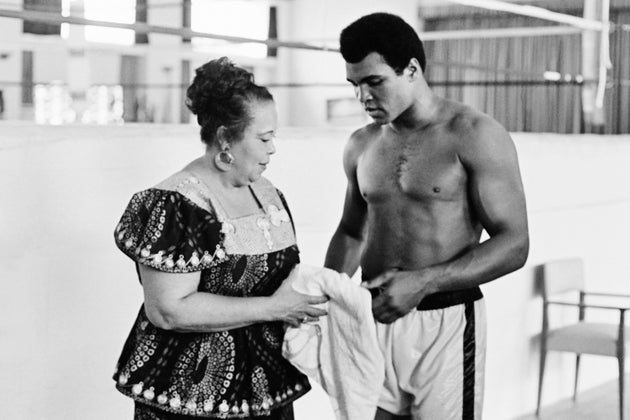
Muhammad Ali with his mother, Odessa Grady Clay, in Kinshasa, Zaire ahead of his championship fight in 1974.
Footage of Muhammad Ali from the 2009 documentary “Soul Power” captures intimate moments when the legendary boxer expressed his pride in Africa while visiting Zaire in 1974.
Ali was in Kinshasa, the capital of what is now the Democratic
Republic of Congo, weeks ahead of a heavyweight world championship fight
with George Foreman — an encounter famously nicknamed the “Rumble in
the Jungle.”
Foreman was injured and the fight delayed six weeks, but “Zaire ‘74,”
a three-day music festival intended to accompany it, went on as planned
— and Ali attended. The festival brought African-American stars like
James Brown, Bill Withers and the Spinners on the same stage with
African sensations like Miriam Makeba.
In 2009, filmmaker Jeffrey Kusama-Hinte turned hours of previously
unseen video of the concert and the days leading up to it into “Soul
Power.”
Ali, with his trademark charisma and lyricism, had some of the most
memorable moments in the film. He shares his appreciation of Africa
while connecting his presence there to the broader struggle of black
people the world over to achieve justice and freedom.
“This is our homeland, this is our civilization,” Ali declares in a passionate speech. “Africa’s the cradle of civilization. Original man’s from Africa. All civilizations started in Africa.”
“This fight is for the freedom, justice and equality of the black man
in America so that I may take my take my title and my fame and go out
there and uplift little black people in the ghettos,” he concludes.
“Black people is catching hell. Black people who entertainers won’t
speak for.”
At another point, Ali seems to appreciate the relatively quiet pace
of life in Kinshasa. He mocks Americans who are supposedly afraid to
attend the fight or the concert because they worry that Africa is too
dangerous.
“No kidding, New York is more of a jungle than here,” he quips.
He then recites a litany of criminal incidents and scenes of urban
chaos. The description is comically over-the-top, but has a realistic
ring.
“Always something in America,” he finishes. “They’re so peaceful over here. And really, the savages in America.”
I’ve never felt so free in my life.
Ali embraced the music
festival as a celebration of shared heritage between black Americans
forcibly removed from Africa generations prior and native Africans who
remained on the continent. It was, as the promoter Don King put it, “a
family gathering, a welcoming back home.”
We see Ali on the first day of the festival sitting at a table eating
alongside King, Bill Withers and another friend. The camera zooms in on Ali adding spoonful after spoonful of sugar to his coffee.
“I’ve never felt so free in my life,” Ali says. “Free from America where I’m not really free.” A young girl from the area goes up to
introduce herself while Ali is sitting at the table. Ali just hugs the
girl close and kisses her repeatedly as she smiles broadly. The girl does not say anything, presumably since she cannot speak English.
(The DRC was a Belgian colony until 1960; French remains one of the official languages.) “She was ruled by the French and I
was ruled by the English, so we both done lost our language,” he said.
“But one day we are going to talk to each other in our own language.”
Arts & Review 'Yorubas must ensure the survival of their language'
Written by Adewale Oshodi Tuesday, 22 February 2011
Yeye Akilimali Funua Olade, a Black American, left the United States in 1978 for Nigeria to embrace the Yoruba way of life. In this interview with Adewale Oshodi, the Chief Librarian of African Heritage Research Library (AHRC) at Adeyipo village, Ibadan, speaks on what made her to leave the United States, why she embraced the Yoruba culture, and why she has not visited America but once since she left 33 years ago. Excerpts:
You are a Black American who relocated to Nigeria in 1978, but don't you think that it is rather ironic that you chose to come to Africa, when Africans themselves are struggling to migrate to America? Any black person who is in the white man's country is a slave to white people, and by the time I was 19, I said my children would never be slaves to white people, because in reality, we were their slaves, and that is how they still treat black people till today. There is no freedom for black people, and the way they treat us is just so bad, and I decided that my children would grow up in Africa. So, by 19, I had decided that I was coming to Yorubaland because I was told by Black Americans who were practising Yoruba religion that Yoruba is the best culture in the world, as well as the best language. So that was when I decided that my children were going to grow up with the culture and speak the language, and they would never be slaves to white people.
So, in 1978, I arrived in Nigeria. Then, my children were very young and I told them they must stop speaking English in the house and speak only the Yoruba language. So they spoke Yoruba. They call me Iya mi (my mother) because I told them I didn't want to hear any word of English in the house, like mummy, and all other words that Yorubas are using to mix and destroy the language. I didn't allow it. Now, my children are grateful for being brought up in the Yoruba culture. Even though they are back in America, they said the culture has really helped them. It has given them a sense of belonging. Now, I am confident that one day, they will also return to Yorubaland.
You are in Nigeria now, but how often do you visit America? I have not gone back but once,when Iya mi was sick to pray for her, because I don't want to be anybody's slave. I just want to be me. I love my freedom here. The racism is still very strong in the white man's country, especially in America. So, since 1978, I have been here. I have been enjoying Yorubaland. I have never suffered for once here like I suffered while in America. I am respected by the people around me.
You speak the Yoruba language fairly well.. I don't speak it fairly well; I must tell you the truth, and that is the only problem I have with Yoruba people. If you don't learn to speak the languagequickly,they stop trying to teach you,say you never can learn it and speak to you in english! So in that regards, they are yet to cooperate with me but I am pledging to speak only Yoruba by
Now, one of the problems we are having with the language is that Yoruba parents encourage their children to speak only the English language. What do you have to say to this? That is how they are destroying the language, and they will be slave to English and white people forever. Once you take up another man's language, you will become a slave to the real owners of the language.
What do you find interesting in the Yoruba culture? Yoruba culture is the best in the world. Yorubas were in Egypt. The culture is the most developed in Africa, and that means it is the best in the world; I must tell you that the white culture is not developed. The Asian culture is also developed, but nothing compares with the African culture.
Do you still maintain contacts with your friends in America despite leaving there 33 years ago? Of course, we are still very much in contact. I tell them everyday why they should return home to Africa. Africa is home to blacks all over the world. I tell them I am ready to help get them settled, and a lot of them are ready to come now because the racism is just so bad, and because I have coped really well here for 33 years, they say it means the place is not that terrible.Since you came, was there a day you regretted your decision to relocate to Africa? Not even once. The black man should be in the black man's land. There is no way a black person can be happy in a white country. No matter how rich the black man is; no matter how successful he is, he is still not respected. They can pick him up anytime and say he robbed a bank, and then get him jailed without any evidence of him committing any crime. Those Nigerians who are abroad, majority of them are only working for the money, so after a while, they will raise some money, put up a structure back at home and then return when they feel they have achieved a degree of financial success.
And you were not discouraged by the lack of infrastructure, the lack of electricity, among other things, coming from a country that has everything? First of all, freedom is the most important thing in life. If you have never been free, like the blacks in America, and you come to a place where you are free, will you be talking about electricity? Although there are some Black Americans who come here, and they dwell on the lack of infrastructure, but that is not for me. I want my children to be free. Everything is here for me. I cherish the culture, the language, and the respect people give me. Everywhere I go, I am respected. A black is not respected in America. Some people even wonder how I can be living in the village. But for me, freedom comes first.
Fugitive Reflects On Another Era, Another Country Black Panther Pete O'neal Fled To Avoid Prison. That Was 30 Years Ago.
By Andrew Maykuth, INQUIRER STAFF WRITER
Posted: February 11, 2000
IMBASENI,
Tanzania — The night before he slipped out of the United States in
1970, fugitive Pete O'Neal gazed out of a New York apartment and
absorbed the ordinary street scene below.
"I told myself: You have
to etch this scene in your memory because it may be the last thing you
see in America for two or three years," said O'Neal, the former head of
the radical Black Panther Party's chapter in Kansas City.
Three
years became three decades, and the vision of a Lower East Side
delicatessen is still O'Neal's last memory of America. Now approaching
his 60th birthday, his dreadlocks and beard gone gray, O'Neal has lived
for 28 years in Tanzania, one of the last American exiles from an era
when black militants were virtually at war with the U.S. government.
O'Neal
has mellowed with age and toned down the threatening rhetoric of the
1960s, but he is still an outlaw. He fled a four-year federal prison
sentence for transporting a gun across state lines. He said he was
convicted unjustly and feared for his safety, but the U.S. government
does not take bail-jumping lightly. He said he has been told that the
Justice Department is unlikely to set aside his case unless he first
expresses contrition.
"They want some sort of mea culpa," said
O'Neal, who escaped with his wife, Charlotte Hill O'Neal, also a member
of the Black Panther Party. "We absolutely refuse to do that. We feel
the things we were involved in were justified and correct. We have
nothing to apologize for."
His wife is free to return to the
United States, but O'Neal rarely ventures far from their four-acre farm
in this village 15 miles from Arusha, near the Kenyan border. His father
died last year, and O'Neal was unable to attend the funeral in
Missouri. He has not seen a daughter from his first marriage for 30
years.
He is a relic from another America, another era. Old allies
have become part of the system that once aroused his ire. His distant
cousin Emmanuel Cleaver was Kansas City's mayor in the '90s. O'Neal's
sister now lives in a Kansas City suburb that was off-limits to African
Americans in the 1960s.
Sometimes he dreams of returning to his
old neighborhood near 12th Street and the Paseo, but the landscape has
changed since his youth. "The Kansas City I knew doesn't exist," he
said. "The America I knew doesn't exist."
Paul J. Magnarella, a
University of Florida anthropology professor and lawyer, filed an appeal
two years ago on O'Neal's behalf, but it was denied. Democratic
politicians have petitioned the Clinton administration to grant him
clemency, to no avail.
'Last of the last'
O'Neal says it is unlikely the standoff will ever be resolved. "No one yields power without a struggle," he said.
"I
am the last of the last," he said. Other Black Panthers died, some are
still imprisoned, and others made their apologies. "Everybody else
worked out their deal."
Although he has grown disenchanted with
Marxism and now thinks a violent overthrow of the government is
"ridiculous," he is unashamed of his Panther past and is no fan of
capitalism. He displays framed photos of himself and Charlotte posing
with .30-caliber carbines, along with shots of him wearing the Panthers'
signature black beret and leather jacket.
He may be in exile, but
he is not isolated from the modern world. He stays in contact with
friends by cellular telephone and electronic mail. The home
entertainment center at the foot of his bed is his window onto the
world: The television is connected to a satellite dish that pulls down
CNN and the BBC. The book shelves are filled with an eclectic collection
of videotapes sent by friends: Malcolm X, Jungle Fever, The Sound of
Music.
The walled compound where the O'Neals live is the most
elaborate residence in Imbaseni. He helped bring water and electricity
into this place a few miles from Mount Kilimanjaro, and is now a
respected elder of the Wameru people.
"We are pioneers here," said Charlotte O'Neal, an artist who was 19 when she left Kansas City.
At
first Pete O'Neal made a living making sausage and selling mustard. Ten
years ago the O'Neals founded the United African American Community
Center, which operates development and education projects in the
surrounding villages.
He built the Malcolm X Theater beside his
house, where rural youths are introduced to the electronic age on three
personal computers O'Neal assembled from old parts.
"We're doing
something positive," he said. "We're continuing the work of the Black
Panther Party, uplifting the community. We're doing it without political
motives, and we're doing it without guns."
He makes his living
now by hosting tour groups from the United States and arranging exchange
programs for Tanzania and American students. The visitors include
middle-class university students as well as teenagers who attend a
Kansas City school for troubled youths. Part of their training is a
five-day climb up Kilimanjaro.
He said he was struck by how many
American youths come from single-parent families, so he tries to teach
them about the strength of African families.
"We believe that a
solid family structure is the foundation of a strong community," O'Neal
said. "We bring young people out and expose them to this. In essence, we
say there are alternatives to what you've known."
Many young
Americans have little knowledge of the Black Panthers, O'Neal said.
"Charlotte has had people ask her: 'The Black Panthers - they were like
the Crips and the Bloods, right?' "
He said he understood the
young people because he was a street hustler and petty criminal in
Kansas City in the 1960s when he was introduced to the Black Panthers.
The party, modeled on Marxist ideology of a class struggle, advocated
confrontation and violence to end racial inequality.
The Kansas
City Panthers organized school breakfast programs and other projects
modeled on Malcolm X's teachings of self-reliance. But the militants
managed to enrage the established order by demanding that businesses in
black areas pay for the programs and by barging into churches to solicit
contributions.
He said the Black Panthers also tried to provoke
confrontation with the police by shadowing police patrol cars. The
Panthers accused Kansas City's police chief, Clarence Kelley, of giving
arms to a white-supremacist group, and they disrupted Senate hearings
when Kelley was named head of the FBI.
In 1969, federal agents
charged O'Neal with transporting a single-shot shotgun across state
lines. A year before, he had bought the gun in Kansas City, Kan. The
police found the weapon in Kansas City, Mo., in the car of another Black
Panther. There was no contention that the gun had been used in the
commission of a crime.
"We had guns galore," O'Neal said. "Maybe I touched that one. But I didn't bring that gun across the state line."
He was convicted and sentenced in October 1970 to four years in prison.
'I'm not a criminal'
"I
was convinced and continue to be convinced that I would have been
killed in prison," he said. "I didn't want to gamble with my life."
"I
am not a criminal," he said. "I haven't robbed anybody. I haven't hurt
anybody. I spoke out very strongly for the things I believed, but I
don't feel I have to go to prison for that."
While he was out on
bail awaiting appeal, the O'Neals bolted to New York, where members of
the Communist Party helped them to flee to Sweden. He later went to
Algeria, then a safe haven for leftist liberation groups and terrorists.
The Black Panthers had an "embassy" in Algiers.
After a
falling-out with the Algerian government, O'Neal moved in 1972 to
Tanzania, where President Julius Nyerere had set up a socialist
government.
Tanzania in the early 1970s was a sanctuary for
hundreds of African Americans disaffected by life in the United States,
but their euphoria over their new home was short-lived. Nyerere's
government jailed several hundred Americans on suspicion they were a
"fifth column" against socialism. Only a few dozen Americans still live
in Tanzania today, O'Neal said.
"A lot of us couldn't make the transition to the African way of life," he said.
He
and Charlotte raised their son and daughter in Tanzania, and both
children went back to America - they live in the Kansas City area. But
O'Neal remains.
He would like to visit America, but only on his terms.
But
he knows he will never live in America again. He does not find the
images he sees of the United States attractive: the obsession with
wealth, the violence of youth.
"I think I would probably be terrified of the place, everything moving so fast, people all whizzing by."
77777777777777777777777777777777777777777777777777777777777777777777777777
http://www.latimes.com/world/la-fg-black-panther-20120129-html-htmlstory.html
Elmer 'Geronimo' Pratt, a former Black Panther leader, dies in Tanzania
June 2, 2011 | 7:36
pm
Elmer
G. "Geronimo" Pratt, a former Los Angeles Black Panther Party leader
who spent 27 years in prison for a murder he says he did not commit and
whose case became a symbol of racial injustice during the turbulent
1960s, has died. He was 63.
Pratt died at his home in a small
village in Tanzania, where he had been living with his wife and child,
according to Stuart Hanlon, a San Francisco attorney who helped overturn
Pratt's murder conviction. Hanlon said he was informed of the death by
Pratt's sister.
Pratt's case became a cause celebre for elected
officials, Amnesty International, clergy and celebrities who believed he
was framed by the government because he was African American and a
member of the Black Panthers.
"Geronimo was a powerful leader," Hanlon told The Times. "For that reason he was targeted."
Pratt was
convicted in 1972 and sentenced to life in prison for the 1968 fatal
shooting of Caroline Olsen and the serious wounding of her husband,
Kenneth, in a robbery that netted $18. The case was overturned in 1997
by an Orange County Superior Court judge who ruled that prosecutors at
Pratt's murder trial had concealed evidence that could have led to his
acquittal.
Elmer
G. Pratt, a Black Panther leader who was imprisoned for 27 years for
murder and whose marathon fight to prove he had been framed attracted
support from civil rights groups and led to the overturning of his
conviction, died on Thursday in a village in Tanzania, where he was
living. He was 63.
Mr.
Pratt, who was widely known by his Panther name, Geronimo ji-Jaga, had
high blood pressure and other ailments, his longtime lawyer, Stuart
Hanlon, said. Mr. Hanlon said he did not know the exact cause of death.
To
his supporters — among them Amnesty International, the N.A.A.C.P. and
the American Civil Liberties Union — Mr. Pratt came to symbolize a
politically motivated attack on the Black Panther Party for Self Defense
and other radical groups. But from the start, the grisly facts of the
murder of a 27-year-old teacher dominated discussions of the case,
including those of the parole board that denied parole to Mr. Pratt 16
times.
The
teacher, Caroline Olsen, and her husband, Kenneth, were accosted by two
young black men with guns on Dec. 18, 1968, in Santa Monica, Calif.
They took $18 from Mrs. Olsen’s purse. “This ain’t enough,” one said,
according to the police, and ordered the couple to “lie down and pray.”
Photo
Elmer Pratt, known as Geronimo, in court in California in 1997.Credit
Haywood Galbreath/Associated Press
Shots were fired, hitting Mr. Olsen five times and his wife twice. Mrs. Olsen died 11 days later. Mr. Pratt was arrested.
The
case against Mr. Pratt included evidence that both the pistol used as
the murder weapon and the red-and-white GTO convertible used as the
getaway car belonged to him. An informant wrote an eight-page letter
asserting Mr. Pratt had bragged to him that he committed the murder.
Fellow
Panthers did not support Mr. Pratt’s alibi that he was in Oakland, more
than 300 miles away, at the time of the killing. A witness identified
Mr. Pratt as one of two men who tried to rob a store shortly before the
murder. And Mr. Olsen identified Mr. Pratt as the assailant.
Mr. Pratt was convicted of first-degree murder on July 28, 1972, and sentenced to life imprisonment a month later.
Information
gradually surfaced that the jury had not known about when it reached
its verdict. Mr. Olsen had identified someone else before he identified
Mr. Pratt. Documents showed that the informant who said that Mr. Pratt
had confessed to him had lied about himself. Wiretap evidence that might
have supported Mr. Pratt’s alibi mysteriously vanished from F.B.I.
files.
A
public debate erupted over the extent to which Mr. Pratt and the Black
Panthers had been singled out by law enforcement agencies. J. Edgar
Hoover, director of the F.B.I., called the Panthers a threat to national
security, and an F.B.I. report spoke of “neutralizing” Mr. Pratt.
Others saw the Panthers and their leaders as a voice of black
empowerment and as a service group that provided free breakfasts to the
poor.
In
an interview with The New York Times in 1997, John Mack, president of
the Los Angeles Urban League, said, “The Geronimo Pratt case is one of
the most compelling and painful examples of a political assassination on
an African-American activist.”
As
Mr. Pratt languished in solitary confinement, his supporters shed light
on his case by hanging a banner from the Statue of Liberty. His
lawyers, led by Johnnie L. Cochran Jr. — famed for defending O.J.
Simpson — assembled ammunition for an appeal.
In 1997 a California Superior Court judge, Everett W. Dickey, vacated Mr. Pratt’s conviction
on the grounds that the government informant, Julius C. Butler, had
lied about being one. Moreover, it was learned that the Los Angeles
Police Department, the F.B.I. and prosecutors had not shared with the
defense their knowledge that Mr. Butler was an informant.
A
juror, Jeanne Rook Hamilton, told The Times: “If we had known about
Butler’s background, there’s no way Pratt would have been convicted.”
California
lost its appeal to nullify Judge Dickey’s decision in 1999, and the Los
Angeles County district attorney ruled out a new trial. In 2000, Mr.
Pratt received $4.5 million from the federal and local governments as
settlement in a wrongful-imprisonment suit.
Mr.
Pratt said he would have preferred to press the matter in a trial so he
could air the government’s “evil scheme,” but decided to accept his
lawyers’ advice and take the settlement.
Elmer
Gerard Pratt, the name he rejected at 20 as that of a “dirty dog” slave
master, was born on Sept. 13, 1947, in Morgan City, La. His father was
in the scrap-metal business. Elmer liked to shoot rabbits and sell them.
He was a high school quarterback, then joined the Army, serving two
tours in Vietnam, earning two Purple Hearts and emerging a sergeant.
Mr.
Pratt attended the University of California, Los Angeles, where he
studied political science and joined the Panthers. He rose to lead the
Los Angeles branch. He moved to Tanzania because he had friends there
and had always wanted to live in Africa.
He is survived by a daughter, three sons, two sisters and two brothers. He was godfather to the slain rapper Tupac Shakur.
A version of this article appears in print on June 4, 2011, on page A19 of the New York edition with the headline: Elmer G. Pratt, 63, Jailed Panther Leader. Order Reprints|Today's Paper|Subscribe
By
virtue of their exalted positions, political leaders are invariably
famous! We see their faces on television and in newspapers and we also
listen to their voices on radio. The notorious ones among them
intimidate us with their posters or statues, palaces and the exclusive
streets they name after themselves. They would rather celebrate their
own lives than be patient with history!
However, these fellows in positions of
power are reduced to ordinariness as soon as they are relieved of
political power. The most mischievous of them (the Samuel Does, the
Nicolae Ceausescus, the Saddam Husseins and the Muammar Gaddafis) get
consumed by the anger of the oppressed, begging in vain for their lives
to be spared!
Fame or notoriety is transient, while
greatness endures. Political greatness is about doing deeds whose
consequences endure in history. Great political leaders do not come in
rapid succession; they come once in a while.
The magnitude of political greatness is
determined by the magnitude of crises or challenges a political leader
is confronted with. It is not by choice that the political leaders whose
names ring through history and in our subconscious memories have been
those who were great nation builders, or great managers of wars, or
great heralds of economic prosperity. The great nations of the world
have their Abraham Lincolns, Winston Churchills, Mao Tse-tungs, Mahatma
Gandhis and Otto von Bismarks, to mention just a few. Even in death,
great political leaders inspire generations of would-be leaders.
The Black world, in the modern era, has
donated two great names to the world of political mythology. Both
Martin Luther King Jnr and Nelson Mandela were products of similar as
well as contrasting historical circumstances. They were members of
multi-racial societies in which their own peoples were at the receiving
end of injustice and degradation. The majority white group meted out
injustice to the minority black in one instance, while the minority
white also meted out injustice to the majority black in another. Both
King Jnr and Mandela were historical characters in the crusade to bring
sanity to what was a hopeless situation.
They were men of exceptional courage,
intelligence, eloquence, vision and character. King Jnr paid the
ultimate price in his crusade for racial equality and justice, while
Mandela had his freedom curtailed in an incredible 27 years of
imprisonment. Today, we celebrate the fact that both men and their
apostles have been vindicated.
The world mourns Mandela who died on
Thursday, December 5, at the ripe old age of 95. His death has captured
the imagination of the entire world. Of course, the role he played in
ending the obnoxious apartheid system in South Africa is monumental;
what, however, the rest of the world is celebrating today is the
exceptional character of one individual. One doubts if he would have
been that revered if he were vengeful, or had exhibited political greed
by wanting to die in office. Neither was he obsessed with personal
wealth and the perquisites that appeal to ordinary human beings. In
suffering and forgiving his tormentors, Mandela, according to Prof.
Ladipo Adamolekun, is the nearest we have to Jesus Christ in Christian
mythology.
It is noteworthy that President Goodluck
Jonathan declared three days of mourning in memory of Africa’s most
illustrious son. This gesture is not enough. What can we learn from
Mandela in terms of personal contentment and spirit of reconciliation?
What can Jonathan himself learn from this global icon as he ponders his
own political future amidst fierce disagreements and possible chaos?
When one’s political right conflicts with the national interest, which
one should prevail over the other?
For our nation, one urges that we
reflect on the struggles of our racial compatriots in the United States
of America and South Africa. They had more vicious experiences to
contend with than many of us could imagine. With purposeful
leadership, we should prevail and ours be counted among the most
important nations of the world. Great leaders like Mandela and King Jnr
re-write history because their dreams transcend big mansions and
private jets! Great leaders live their lives for the sake of others.
Mandela foundation pays tribute to late Kenyan Nobel winner
ON SEPTEMBER 26 2011, Nomzamo Winifred Madikizela-Mandela celebrated her 75th birthday. A good vintage, blessed with unparalleled beauty, charisma, a great sense of humour and generally good health too.
U'Mama Wethu, translated, the "Mother of the Nation", is one of South Africa's as well as Africa's most popular heroines, who kept the Struggle fires burning while the now ruling African National Congress was exiled.
Among other things, she was a leading light of the 1976 Soweto uprisings, despite certain political interests and distorted media reports.
Madikizela-Mandela was banished from 1977 to 1986 when she unbanned herself from Brandfort in Free State. She was the longest banned woman during apartheid. Another Struggle icon, Helen Joseph, served the second-longest term.
Mama Winnie was arrested in 1969 under the apartheid regime's notorious Terrorism Act and she spent 18 months in solitary confinement at Pretoria Central Prison. She was severely tortured and lost a lot of weight.
She once described herself as "the most unmarried of married women", referring to the 27 years of her former husband Nelson Mandela's incarceration on Robben Island and Pollsmoor Prison. The former president was finally transferred to Victor Verster Prison near Paarl in Western Cape .
Among other things, Mama Winnie contributed towards the negotiated peace settlement thatushered the ANC into power in 1994.
It is said that in 1980 she was approached by the then minister of justice Kobie Coetzee during one of her visits to Robben Island. He is said to have asked her if Nelson Mandela would agree to talk to his government.
She told him to meet her husband. Coetzee did and the talks between the ANC and the National Party started.
Madikizela-Mandela was persecuted by the former security police and the Civil Cooperation Bureau (CCB), the notorious covert arm of the former SADF Military Intelligence , planting numerous agents and informers around her. Senior members of the then dismantled CCB, including Paul Erasmus, told the Truth and Reconciliation Commission chaired by Bishop Desmond Tutu that they had a series of projects to frame Winnie Mandela. She was framed to tarnish Mandela and undermine the moral high ground of the ANC.
Meanwhile, the international and local media had their field day. Madikizela-Mandela could do nothing right.
She was, for example, ostracised for her public address in Munsieville, where she publicly stated that the oppressed majority had no weapons and no means to bring the racist regime down.
In that context, she considered "necklacing" with tyres and matches as part of the struggle against colonial-apartheid.
A feisty Madikizela-Mandela addressed a large assembly of ANC supporters in KwaZulu-Natal during the troubled period between 1992 and 1994, calling on them to keep their arms and ammunition to fight the marauding Inkatha impis off.
Just before that, then ANC president Nelson Mandela had called on the same constituency to throw their weapons into the Indian Ocean.
The media, having coined the urban war as "black-on-black violence", and the colonial-apartheid regime hailed Nelson Mandela as "peace maker" and criticised Madikizela-Mandela as a "warmonger".
It was later revealed at the TRC hearings in Johannesburg that the popular media description of the racist "black-on-black violence" was in reality a covert operation strategy of urban warfare, orchestrated by the dismantled CCB, also referred to as a "covert third force".
The "Stompie Seipei case" came up and fortunately her husband Nelson stood by her. He was convinced that she was not guilty of the charges of kidnapping and an accessory to the assault of young Stompie. She received a fine of R15000 on appeal.
After 27 years apart, Winnie and Nelson Mandela eventually divorced in 1996.
On her visit to South Africa, US First Lady Michelle Obama attended a special service at the famous Soweto Regina Mundi Church on June 16. Mandela's wife Graça Machel was guest of honour and she delivered the keynote address about the history of June 16.
Madikizela-Mandela was not invited. She was at home in Orlando West.
At the funeral service of the late ANC stalwart Albertina Sisulu at Orlando Stadium, former president Mandela's wife Machel from Mozambique was asked to read her husband's message.
While Machel read the message, Madikezela-Mandela's face was shown on the big television screen above the VIP stage.
The soldiers of the South African National Defence Force, the guard of honour and the women of the ANC Women's League burst into song and dance, praising Madikizela-Mandela and defied attempts to crown the late Sisulu as the "Mother of the Nation".
Those close to her know U'Mama is a good woman. She is intelligent, a woman still to be reckoned with and a woman loved and respected by her family, friends and Africans not only at home, but throughout the world.
ANC MP Madikizela-Mandela is the first woman in the ANC to receive the National Heritage Council's Ubuntu Award. She joins the prestigious list of awardees who include her former husband, former Zambian president Kenneth Kaunda and retired Cuban president Fidel Castro, as well as former UN secretary-general Boutros Boutros Ghali from Egypt.
Madikizela-Mandela is indeed a woman in her own league. We salute you, Nomzamo!
- Froese is an independent political and socio-economic analyst based in Johannesburg.
Sep 30, 2011
jolas
I will always respect, love and cherish Mama Winnie Mandela. Thank you for all the things you have done for me, and the things you have done for us.
Report Abuse

Sep 30, 2011
Ndese1
What happened to Stompie and why Mandela divorced Winnie? South Africa loves you, you are such an true inspiration to us the youth.
Report Abuse

Sep 30, 2011
1tsotsi
@Ndese1
u out of oder, its not yet 8 am, r u gonna make it today? keep ur comments to urself.
Report Abuse

Sep 30, 2011
NDA
Mama i will pass there by your place tomorrow to say hi, as i will be at sakhumzi.
Report Abuse

Sep 30, 2011
boyabatho
when we speak about bomme ba go swara thipa ka bogaleng re ra mother of the nation(mma winnie mandela).
youth of today,especialy girls must read about this old lady`s life in oder to become good mothers.
happy birthday to you old lady (mother of the nation)
Report Abuse

Sep 30, 2011
takoskonvict
stop all the make-ups, you are a granny now.
Report Abuse

Sep 30, 2011
Shredder
Magrizen o wa khinya. I don't know why people worship her so much.
Report Abuse
I AM A BLACK AMERIKKKAN WHO 32 YEARS AGO WENT BACK TO AFRICA/YORUBALAND/NIGERIA TO RAISE 4 OF MY 5 CHILDREN AS CULTURALLY BASED YORUBA CHILDREN WITH THE LANGUAGE AS THEIR MOTHER TONGUE.


 Posts
Posts