https://www.facebook.com/photo.php?fbid=10204406958150598&l=d9041122a5
OOOOO! E KU JO META O! E JOOOO AM HAVING OJO IBI MI OCT. 31ST! WILL BE
70 YEARS! EGBA ME O TO CELEBRATE IT WITH !1.SPONSORING :"BEST YORUBA
SPEAKER CONTEST" IN THE VILLAGE WHERE THE LIBRARY IS LOCATED!SINCE
YORUBA IS DYING THIS ONE EFFECTIVE MAY TO BRIBE YORUBAS TO SPEAK
UNDILUTED YORUBA!OR 2.GIVING ME CLAY BLOCKS FOR EBUN MI SO I CAN START
OUR FAMILY HOUSE IN THAT ADEYIPO VILLAGE SINCE THEY HAVE GIVEN ME LAND
TO DO SO! OR 3, A SUB FOR THE LIBRARY! (www.africanheritageresearch.net ) OR 4.A HAMPER WHICH I HAVE NEVER
GOTTEN SINCE I HAVE BEEN IN NIGERIA O! E SE O OMO YORUBA ATATA O! OMO DUDU AMERIKKKA! OMO DUDU EVERYWHERE!(BLACK PEOPLE EVERYWHERE!)
Declaring that a tribute to Elombe Brath is long overdue, state
Sen. Bill Perkins is calling for all the hero's friends, colleagues and
comrades to join him and members of Brath's family on Saturday, May 11,
at 4 p.m. at Harriet Tubman School in Harlem.
And for that tiny minority of folks who may not know who Brath is,
let the following words provide you with at least a sketch of his
remarkable life in the service of the downtrodden and oppressed.
In his autobiography, "Ready for Revolution," the acclaimed
revolutionary Stokely Carmichael, aka Kwame Ture, referred to Brath as
the "dean of Harlem nationalists." While such a tribute from Ture is
admirable, Brath's Black Nationalism and his Pan-African thoughts, as
many will attest, extend well beyond Harlem, possessing a special
resonance among freedom fighters around the globe.
Brath's political commitment evolved in the late 1950s almost
simultaneously with the struggle to eliminate "Negro" as the
nomenclature of African-American people. From this moment of Black
consciousness, it was an easy and logical step for him to lead the way
in the "Black is Beautiful" campaign and the subsequent creation of the
African Jazz-Arts Society and Studios with his brother Kwame and a cadre
of other local activists.
Removing "Negro" from the lexicon, insisting on the beauty of
Blackness and refusing to accept the Eurocentric worldview, Brath and
his cohorts were in the vanguard of change as they launched the
Grandassa Models, featuring Black women in all their natural-born
loveliness.
All of these activities were the foundation for his total involvement
in African affairs, including his association with the Federation of
Pan-African Nationalist Organizations, which eventually set the stage
for African Liberation Day and the development of the African Liberation
Support Committee that played such a critical role in educating and
organizing thousands in the fight against imperialism, colonialism and
neo-colonialism on the African continent.
One of the pivotal moments in Brath's constantly evolving political
philosophy, an outlook grounded in the ideas and actions promoted by
Marcus Garvey and Carlos Cooks, was the formation of the Patrice Lumumba
Coalition (PLC) in 1975. The PLC came at a most propitious time when
there was much confusion about which liberation movement to support in
the war against colonial domination in Africa. It was a matter of
separating the truly progressive organizations from the reactionary
ones, and Brath and members of the PLC were indispensable in providing
the correct guidance and understanding of the often fractious and
contentious forces vying for hegemony.
For more than a generation, Brath, as the chairman of PLC, helped to
coordinate hundreds of forums with the purpose of educating the masses,
not only about the struggle in Africa, but also about the conditions
oppressed people faced all over the world. To list just a few of the
revolutionary leaders who found the PLC a refuge of political
camaraderie and a platform to express the challenges they faced would
require a book.
Despite his total immersion on the international front as well as
countless battles against racism at home, Brath was employed at WABC-TV,
where as a graphic artist--using skills he had acquired in high school
and at the School of Visual Arts--he was a vital consultant,
particularly on African affairs, to Gil Noble, the esteemed host of
"Like It Is." "Elombe was instrumental in facilitating the presence of
many of the African leaders on the show," said Robert Van Lierop, an
attorney and filmmaker formerly affiliated with the show.
None of these activities, however, detracted Brath from taking care
of his family, and along with his wife, Nomsa, they raised six very
successful young men, all of whom are endowed with their parents' spirit
for freedom and justice.
Many of Brath's followers and comrades admit missing their leader,
who was always burdened with the books, magazines and newspapers, always
ready to dispense with the latest information on social and political
matters, both at home and abroad, and always ready to stand his ground
against backwards, counterproductive theory and practice.
Harriet Tubman School is located at 250 W. 127th St., between
Frederick Douglass and Adam Clayton Powell Jr. boulevards. For more
information on the tribute, call Perkins' office at 212-222-7315,
attention Cordell Cleare. Admission is free.
7777777777777777777777777777777777777777777777777777777777777777777777777777777777777777777777777777777777777777777
FROM ELDHUGHES.COM
“Black is Beautiful” 50-year Anniversary: A Movement that went Viral Before Digital Technology
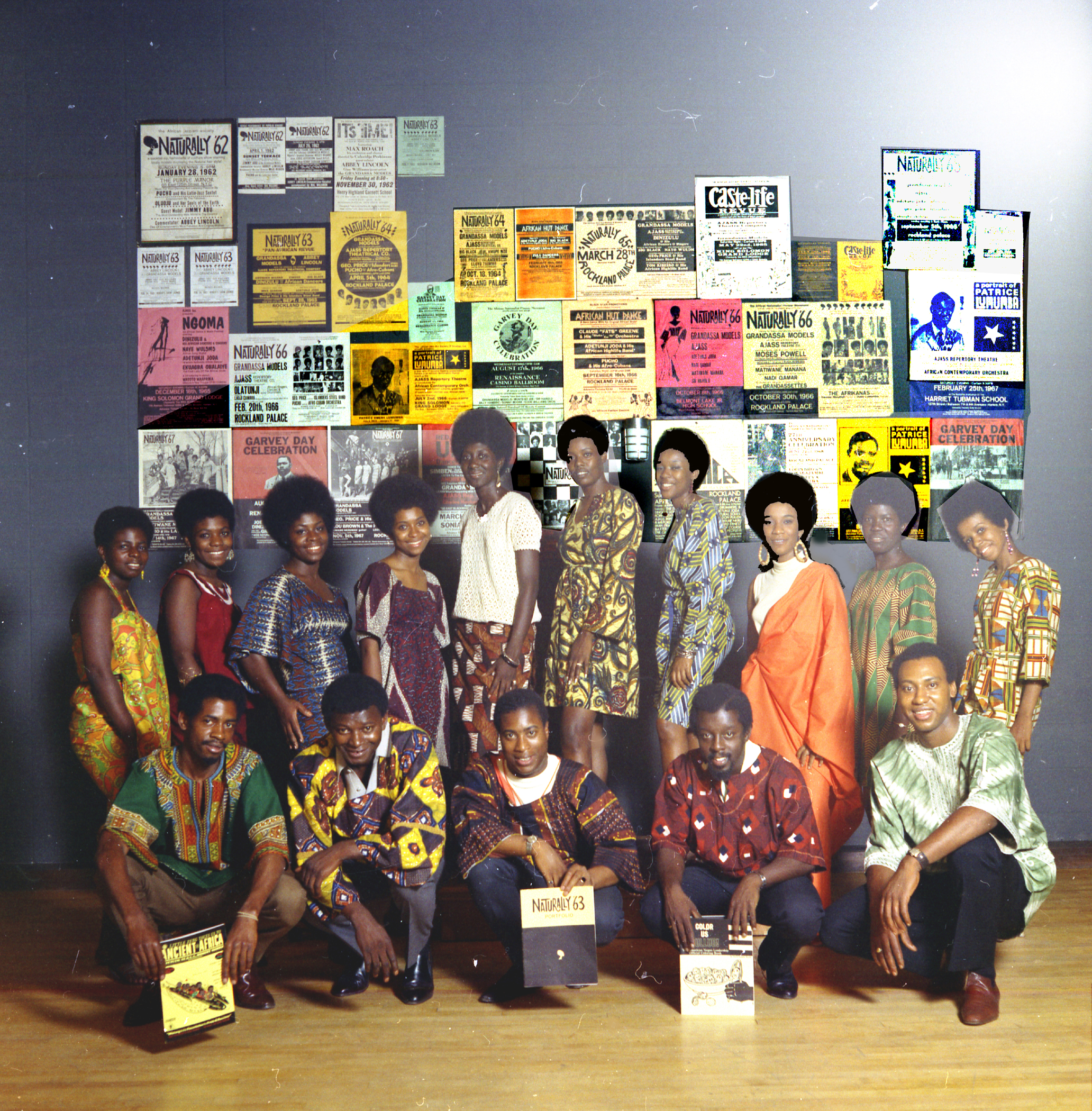
AJASS with Grandessa Models, 1968
As we end Black History Month, I want to pay homage to the Black is Beautiful
movement that began 50 years ago this year. The belief in many world
cultures that black people’s contributions are insignificant and their
physical features inherently unattractive, was challenged over a half
century ago by South African author/activist Steven Biko in his Black Consciousness testament. A groundbreaking event that reinforced this consciousness soon became the catalyst for change in the Black Power Movement. Black is Beautiful
steadily built momentum until it became the proud cry of blacks
throughout the diaspora, especially in the United States. And it was
achieved decades before Facebook or Twitter. Challenging European Aesthetics In 1962, a group of designers, musicians, artists and
writers called The African Jazz-Art Society & Studios (AJASS)
collaborated on an unprecedented fashion event that fueled change in the
perception of black imagery around the world, The Grandessa Models
Naturally ’62 debuted January 28 at Harlem’s Purple Manor. The theme: Black is Beautiful, a provocative statement of its time, with the subtitle, “The Original African Coiffure and Fashion Extravaganza Designed to Restore Our Racial Pride & Standards. Among
those responsible for this event was Kwami Braithwaite, President of
the National Council of Artists (NCA) New York Chapter; Carlos A. Cooks
of the African Nationalist Pioneer Movement, models Jimmy Abu Williams
and Black Rose Nelms.
Black Rose and Jimmie Abu
Singer/actress Abbey Lincoln and musician Max Roach, were charter
members who performed at the events. The Grandessa models challenged
European aesthetics by showing off their natural textured hair, full
features and no makeup as they graced the runway in vibrant African
designs created by local fashion designers. They took Harlem by storm.
It was the birth of what would be an international phenomenon.
Abby Lincoln
Black is Beautiful Reaches Tipping Point
By 1966, the Civil Rights Movement rose to a feverish pitch, which propelled the Black is Beautiful movement. Given the swell of Black unrest, this was the year the Black is Beautiful event
reached a tipping point. Negroes and coloreds throughout America were
proclaiming their blackness without shame or apology. It’s interesting
to note how it trended without digital technology. AJASS designed books,
magazines, and pamphlets touting the Black is Beautiful experience. It spread quickly by automobile, train, airplane and ship via travelers determined to shift paradigms. The Naturally extravaganzas toured such cities as Chicago and Detroit. The Black is Beautiful
movement soon became part of the radical mainstream. Brothers and
sisters of a darker hue were now in demand for TV and advertising.
Nadinola Skin cream abandoned fairer skinned models for natural sisters.
African inspired clothing and jewelry were the rage. Blacks
abandoned hair chemicals and conks for naturals and afros. Black people
not only said they were beautiful, they believed it. New Movement Reclaiming the Beauty of Blackness
The Black is Beautiful movement lasted nearly two decades but faded in the 80′s. Why did it
go out of style? Did the natural hair backlash in corporate America
have anything to do with it, or the Jheri curl and designer labels?
Did integration, assimilation, or emerging multiculturalism contribute
to its demise?
P&G's My Black is Beautiful campaign
Black pride and standards have regressed since the 60’s. Though the
current generation have held on to the “Black”, not all see it as
beautiful; hence the upsurge in weaves and bleaching creams. But
despite the backsliding, there is a black light at the end of the
tunnel. The spirit of Black is Beautiful is making a comeback through the growing number of black women who are forsaking chemically treated hair for natural styles. Black is Beautiful today speaks to women of many hues and hair textures as evidenced in P & G’s My Black is Beautiful campaign. I have the feeling that this quiet resurgence will have a more lasting impact.
Resources: http://www.demarketplace.com/blog/2010/01/sankofa-grandassa-and-calabar-magazine/ http://yeyeolade.wordpress.com/2006/12/15/black-is-beautiful-2/ http://groups.yahoo.com/group/SmaiTawi/message/21000
pennylibertygbow
I really enjoyed your article, kindly Penny
Please feel fee to follow me, I have just created an African American
history page that I’ll think you’ll like. I would love to follow you
on twitter if you don’t mind, but that’s up to you.
kindly, penny
Edwina@FASHION+ART
When I hear young people in 2012 still talking in terms of good
hair vs. bad hair and light skin being more valued and appreciated than
darker skin, I have to wonder if the whole Black is Beautiful movement
was anything more than just another fad, no different than bell-bottoms
and lovebeads. Because the parents of adults today were supposed to be
the enlightened young people of the 70′s. Yet, our kids and their kids
are still talking and thinking in this archaic and divisive way.
Somebody seriously dropped the ball somewhere.
Ronnell
As Black people its integral that we foster Black pride by being
more connected and inclusive as a whole. A catalyst of the movement was
the unity among brothers and sisters of all hues and hair textures and
AGES. I think the division among our people and our future generations
is the product of neglect, disrespect, general ignorance of those who
followed. I agree someone dropped the ball so let’s pick it back up.
eldhughes
We are very divisive today – in all aspects, especially age. I’m
glad you emphasized that. Thank you Ronnell for your eloquent comment.
This post is one way I’m picking up the ball.
eldhughes
Edwina, it drives me absolutely MAD to hear that kind of talk. But
they got it from their family. I remember moving to Chicago from racist
Virginia in the 70s and kids my age were still saying “colored”. I had
already been indoctrinated in the Black is Beautiful/Black Power
ideology. I was mortified to hear inner-city black kids talking like
that and generally not feeling the pride of being black. Some parents
dropped the ball. But some parents never had the ball to begin with.
skip bennett
Dearest Edye, U R always on the cutting edge & are a fine
example of the magnificence & timelessness of Black beauty. Thanks
for enabling me to return vicariously to the good times my friends &
I enjoyed at Carver Hi in marvelous Bombingham (aka Birmingham) :-)
AL. At the time we didn’t realize how history making our decade would
be. Hi to your guys. May your blessings overflow in each area of your
lives.
eldhughes
Hi Skip. Thank you for the compliment. I try to find the relevance
of things, past and present. As I look back, the 60′s was very much a
history making decade. Though I was just a kid, I felt its impact
profoundly. Those times shaped my perspective of how I see things today.
Have a Godtastic day!
Sulay
I enjoyed reading this. It seems we have regressed from the
togetherness of earlier times. We were united before, now it seems we
are split between light and dark skin…short hair or long hair. Wish
there was a way to bring back that togetherness.
Bonnie Sandy
Today is the 52nd anniversay of that .. . and so many who take
the right to wear their hair natural still have no idea of this. Thanks
for picking up this … The original link from DeMarketplace no
longer exist You can find info and links to other research http://www.bonniesandy.com/blackisbeautiful2013/ , or at http://www.bkfff.com/article-category/black-is-beautiful-50th/ copy of my original 1997 post on the Wayback Machine .http://goo.gl/sWbMJ …
The conversation with Kwame On the 50th anniversary has stuck
with me – as has my committment to finding long term solutions.
DeMarketplace has now Launched Shopping guide to help those in the
Black fashion Niche and an online database with plans to use
technology to achive some of those goals … http://catalog.DeMarketplace.com
and we will be working with artist and designers on all areas –
Sourcing | Designing | Production/Manufacturing | Marketing | Retail-
{Sales -Fulfillment} | Sport/Entertainment | Innovation | Education |
Archiving | Communication and media development.
Bonnie Sandy
@BadasseBS http://www.BonnieSandy.com/blog
Melanin rules...
I'm no longer a slave to the body I'm in I'm no longer a slave to his pale skin I'm no longer a slave to Satan's sin
I'm no longer afraid to compete I'm no longer afraid of defeat I know I can stand on my feet
I'm no longer a slave to the past that Had me walking on glass and forced To be the joke... or end up on a rope
Now whenever I win...I put it down to My skin and a body they're envying Because of my melanin
(c) Menelik Charles.
The image above is an Iplehouse Ashanti photographed by Flickr user CustomLovers. The photographer captioned the picture “Dressed as my mother used to.” I found that caption to be quite interesting as the doll as picture strongly resembles a Himba woman.
The Himba are an ethnic group of about 20,000 to 50,000 people living in northern Namibia, in the Kunene region (Wikipedia). I have included an image of a Himba woman after the jump. If pictures of real, live, naked women offend you, you might not want to proceed.
I AM A BLACK AMERIKKKAN WHO 32 YEARS AGO WENT BACK TO AFRICA/YORUBALAND/NIGERIA TO RAISE 4 OF MY 5 CHILDREN AS CULTURALLY BASED YORUBA CHILDREN WITH THE LANGUAGE AS THEIR MOTHER TONGUE.


 Posts
Posts




 A groundbreaking event that reinforced this consciousness soon became the catalyst for change in the Black Power Movement. Black is Beautiful
steadily built momentum until it became the proud cry of blacks
throughout the diaspora, especially in the United States. And it was
achieved decades before Facebook or Twitter.
A groundbreaking event that reinforced this consciousness soon became the catalyst for change in the Black Power Movement. Black is Beautiful
steadily built momentum until it became the proud cry of blacks
throughout the diaspora, especially in the United States. And it was
achieved decades before Facebook or Twitter.


 admin says:




Please feel fee to follow me, I have just created an African American history page that I’ll think you’ll like. I would love to follow you on twitter if you don’t mind, but that’s up to you.
kindly, penny
The conversation with Kwame On the 50th anniversary has stuck with me – as has my committment to finding long term solutions. DeMarketplace has now Launched Shopping guide to help those in the Black fashion Niche and an online database with plans to use technology to achive some of those goals …
http://catalog.DeMarketplace.com and we will be working with artist and designers on all areas – Sourcing | Designing | Production/Manufacturing | Marketing | Retail- {Sales -Fulfillment} | Sport/Entertainment | Innovation | Education | Archiving | Communication and media development.
Bonnie Sandy
@BadasseBS
http://www.BonnieSandy.com/blog