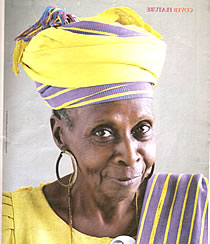
"THE BLACKER THE BERRY THE SWEETER THE JUICE/
I SAY THE DARKER THE FLESH,THEN THE DEEPER THE ROOTS!"
TUPAC SAYS

BLACK SKINNED BEAUTY SUPREME!

BLACK SKINNED BEAUTY SUPREME!

"BLACK IS BEAUTIFUL" -NEW YORK CITY STREET SAYING

"BLACK IS BEAUTIFUL!
BROWN IS HIP,
PUERTO RICAN IS OKAY
BUT white AIN'T S___T!"

BLACK SKINNED BEAUTY OOO!

BLACK SKINNED BEAUTY OOO!

BLACK SKINNED BEAUTY OOO!

BLACK SKINNED BEAUTY OOO!

BLACK SKINNED BEAUTY SUPREME

BLACK SKINNED BEAUTY SUPREME
BLACK SKINNED BEAUTY SUPREME!

BLACK SKINNED BEAUTY SUPREME

BLACK SKINNED BEAUTY SUPREME

BLACK SKINNED BEAUTY

BLACK SKINNED BEAUTY

Search This Blog

Pages

WE MUST HAVE A BLACK STANDARD OF BEAUTY BASED ON THE BLACK SKINNED BLACKEST WOMAN
Showing posts with label AFRICAN LANGUAGES. Show all posts

Thursday, March 15, 2012

SAVE YORUBA LANGUAGE! AND ALL NIGERIAN AND AFRICAN LANGUAGES THIS WAY! -NOW YOU CAN SEND TEXT AND THEY WILL GET IT BY VOICE IN YORUBA AND ALL OTHER AFRICAN LANGUAGES!

Ife researchers unveil local language text-to-voice application – 234next

Move over twitter. Nigerian texters unhappy that their messages can only be accessed by people able to read in English Language can now breathe easier as local researchers have concluded work on an application that renders texts in local languages in audio.
To help secure, protect, and bring back most of the local languages that are going into extinction, Information and Communication Technology researchers at the Obafemi Awolowo University, Ile-Ife, last week unveiled the technology through which texts are converted into voice messages in Nigerian indigenous languages by the recipient’s handset.
The research work is led by Tunji Odejobi, a local computer expert in constraint satisfaction and programming and Rick Wallace, a professor at the Cork University, Ireland.
“Even if you don’t even know how to read and write in the formal sense of it, the technology can leverage that,” Mr Odejobi said.
“So technology has redefined what we call literacy now. But the key item in this is the use of language. If you want to a local language that doesn’t speak your language, then you can use technology to get your mind across to such people. That is what we have done. You can use what we are doing today to achieve such communication in various languages between the sender and receivers of a message. If we don’t do this, we are just going to kill our languages silently. It can help smoothen the culture by having common language of communication and giving other languages a place to showcase their values and culture too,” he added.
test
Source: 234next news

Friday, November 11, 2011

AFRICAN LANGUAGES ARE DYING! DO YOUR PART TO SAVE THEM!-HAVE BEST SPEAKER CONTESTS BY ALL CLUBS,ETC. AND OFFER CASH PRIZES-BRIBE AFRICANS TO SPEAK THEIR LANGUAGE WITHOUT MIXING IT WITH ENGLISH AND DESTROYING IT!


In June 2010, I was requested by the United Nations Educational, Scientific and Cultural Organisation (UNESCO) head office in Paris, France, to ualtndertake a study of public service broadcasting and language development in five countries selected from five regions across the world. Part of the brief was that the project had to be completed three months from the date the contract was signed. Given my teaching, research and service commitments in my university, the assignment, in particular the deadline for submission of the final report appeared daunting. It was not just the final report that proved to be a challenge. I was also required to include two separate reports (in addition to the final report), namely a critical summary of the situation in the five countries and key recommendations based on the final report.
Five countries were selected for the study, after consultations with UNESCO. The countries were South Africa (representing the African region), India (representing Asia and the Pacific), Canada (representing North America and Europe), Jamaica (representing the Caribbean and Latin America) and Lebanon (representing the Arab states). Unfortunately, Nigeria did not make the list because she has mostly state broadcasting organisations, apart from privately owned commercial broadcasting institutions. None of the broadcasting organisations in Nigeria could be strictly regarded as a public service broadcaster. To be clear, the study did not include public service broadcasting undertaken by non-governmental organisations, civil society groups or community organisations.
The project represented UNESCO’s commitment to the promotion of multilingualism and the protection of minority or lesser used languages that are facing extinction. Part of the terms of reference stated that the “the main objective of the paper is to analyse how public-service broadcasters (PSB) deal with linguistic issues in selected five countries (two major criteria: (i) any language revitalisation initiatives identified in a country (from vulnerable to severely endangered); and (ii) any practice in a country including a language previously not used by the public service media in the programming…”
Eleven key questions were identified by UNESCO to be investigated in the study. Three of the questions included an investigation of how public service broadcasters “cover linguistic communities as target audience and reflect its subjects, ensure diversity of genres of programming”; and an examination of how the public service broadcasters “make decisions on which of the languages should be included, in case of presence of several (official-national) languages”. The third question was to explore how “public service broadcasters enable linguistic communities to be informed, educated and entertained”.
The project appealed to me essentially because public service broadcasting is one important vehicle for the development, promotion and sustenance of lesser used languages in the world. As various scholars have pointed out, public service broadcasting is a very important institution that serves different objectives in different societies. In its ideal form, public service broadcasting caters for the diverse needs of audiences of different socioeconomic backgrounds. It is founded on the principle of universal access to information. Public service broadcasting is seen as essential for the development of a strong and participatory democracy.
Today, I provide just a brief account of the situation in South Africa and Canada. A summary report concerning the other three countries will be provided in subsequent essays. In general, the study found that some countries have different policy or legal or constitutional frameworks that support the use of public service broadcasting for the promotion of lesser used languages (e.g. South Africa and Canada), while some countries (e.g. India) have policy guidelines with no enforcement mechanisms to ensure the public service broadcaster actually engages in the development of lesser used languages.
Still, there are countries (such as Jamaica) that have a public service broadcaster but with no clear guidelines in terms of policy or legal framework that will compel the public service broadcaster to promote lesser used languages. Paradoxically, it is in this environment that public service broadcasting is seen as offering universal access to information and as an important institution for the growth of participatory communication and civic deliberation in the public sphere.
Of the five countries, South Africa stands out as an interesting case because it is pursuing a deliberate policy of using public service broadcasting to develop and promote its official languages. In South Africa, there are 11 officially recognised languages. South Africa’s proactive approach to the use of public service broadcasting to promote languages in the country is backed up by two major instruments — constitutional recognition of 11 official languages; and the existence of policy frameworks that mandate the South African Broadcasting Corporation (SABC) in its charter to reflect all 11 official languages in its programming in an equitable manner. These imply that, unlike many countries across the world, South Africa’s constitution acknowledges the multilingual and multicultural composition of the country’s population.
There are various strategies that are adopted by the SABC to reflect the country’s official languages in its programming. However, owing to space constraints, these cannot be outlined here. But there are also several challenges that arise from the SABC’s broadcasting in multiple languages in South Africa. First, the recognition of 11 official languages in the South African constitution underplays the fact that there are more than 24 languages that are spoken in the country. The constitution is silent on the status of these other languages. What, for example, will happen to the unofficial languages of South Africa? What about the people who speak those languages? Are they no longer the citizens of South Africa? Should their languages be allowed to disappear?
The recognition of 11 official languages in South Africa is based on the principle that they are the languages spoken by a majority of South Africans. Fair enough! But minority languages should not be allowed to die simply because they are spoken by minority members of the population. Some kind of mechanism must be devised to protect minority or lesser used languages. Language is a symbol of identity and no language deserves to be allowed to go into extinction.
The situation in Canada is slightly different. The Canadian Broadcasting Corporation (CBC) is the leading public service broadcaster. The Broadcasting Act of 1991 mandates the CBC to broadcast in English and French. However, the CBC runs a service that delivers native language programmes to people in the far North. Apart from the CBC and other public broadcasters, the Aboriginal People’s Television Network (APTN) also provides services in Indigenous languages.
The APTN, which was established in September 1999, broadcasts 56 per cent of its programmes in English, 16 per cent in French, and 28 per cent in 15 Aboriginal languages. This suggests that the APTN aims to reflect in its programming the diversity of languages inCanada. By broadcasting in Aboriginal languages, the APTN contributes to the development and sustenance of Canada’s Indigenous languages. However, for a television organisation that is committed to broadcasting to Indigenous people in Indigenous languages, the percentage of time devoted by the APTN to broadcasting in Aboriginal languages is grossly inadequate
One problem that confronts public service broadcasting both in South Africa and Canada is funding. In Canada, there are three main sources of funding available to the CBC. These are parliamentary appropriations, advertising and other sundry sources. In South Africa, the SABC’s mandate authorises the broadcaster to raise revenue through advertisements, subscription, sponsorship and licence fees. For this reason, South Africa’s Ruth Teer-Tomaselli points out that the SABC, as a public service broadcaster, “operates in a commercial environment, under commercial constraints”.
Concerns must be expressed about the impact that advertising and other market forces might have on the quality and diversity of programmes broadcast by the CBC and the SABC. Commercialisation of media is a sensitive subject of debate essentially because of concerns that a public service broadcaster that engages in the pursuit of advertising revenue would compromise its public service obligations. As Robert Picard, author of several works on media commercialisation has argued, when media organisations place greater emphasis on profit rather than on public interests, quality journalism is undermined.
The debate over an acceptable mechanism for funding public service broadcasting has raged for years and there is no indication the uproar is likely to end soon. While there is a general view that government should not be involved in the funding of public broadcasting in order to guarantee editorial independence, there is also the idea that public broadcasters must be shielded from market forces that tend to distract attention from quality journalism. It is a Catch-22 situation.
II
IN the first part of this article published on July 1, 2011 (see “Saving endangered languages through public service broadcasting”), I examined how public service broadcasting is being used to save endangered languages in South Africa and Canada. The article was a synopsis of a study commissioned by UNESCO in 2010, which required me to investigate public service broadcasting and language development in five countries. The five countries covered in the study were South Africa, Canada, India, Jamaica and Lebanon. The final report was submitted to UNESCO in January this year.
For over three days in May/June 2011, UNESCO hosted a meeting at its Paris headquarters in which a group of experts reflected on and examined how best to save endangered languages through public service broadcasting. The theme of the meeting was “Towards UNESCO guidelines on language policies: A tool for language assessment and planning.” More than 50 linguists, communication scholars and specialists in related disciplines attended the meeting.
Since the publication of the first part of the article in July, my attention has been distracted by a number of news events that prevented a follow up. Today, I focus on the second part of the report which analyses public service broadcasting and language development in India and Jamaica. I have included in this part some recommendations. The final part of the report, comprising mostly of suggestions, will be published as and when time and events permit.
There are two principal public service broadcasters in India. They are Doordashan and All India Radio (AIR). Statistics published by the All India Radio show that the broadcaster has 232 broadcasting centres, including domestic and external services. Its domestic services broadcast in 24 languages and 146 dialects while the external arm broadcasts in 27 languages. The broadcaster produces on a daily basis more than 500 news bulletins in 82 languages. These are broadcast from its head office in New Delhi as well as from 44 regional services. However, Doordarshan broadcasts from 24 regional news services at three levels, namely national, regional and local.
India presents an interesting scenario because it has a large number of languages. Usha Manchanda reports that India is not only the second most populous country in the world, its population is also diverse in terms of the composition of religious groups, social classes and language groups. According to Census of India 2001, India has 22 officially recognised languages and a large number of dialects, although Hindi is a widely spoken language. This situation makes public service broadcasting an important instrument for the promotion of minority languages in India.
In India, the only policy initiative that mandates the two public service broadcasters to promote minority or lesser-used languages in their programming is the Prasar Bharati Act 1990. However, there is no mechanism in this Act to ensure that Doordashan and AIR use, as a matter of policy, minority languages in their programming. There is also no clause in the Prasar Bharati Act 1990 that stipulates how the broadcasters would be sanctioned if they failed to uphold their public service obligations in regard to minority language promotion and development.
The Prasar Bharati Act 1990 sets out the basis for the recognition and development of diverse languages in the country. The Act states quite categorically the goals of the Prasar Bharati Board some of which include “providing adequate coverage to the diverse cultures and languages of the various regions of the country by broadcasting appropriate programmes; providing suitable programmes keeping in view the special needs of the minorities and tribal communities; promoting national integration by broadcasting in a manner that facilitates communication in the languages of India; and facilitating the distribution of regional broadcasting services in every State in the languages of that State” (Prasar Bharati Act 1990). The extent to which these goals have been met or are being implemented is contested.
In Jamaica, public service broadcasting is regarded as a tentative and emerging broadcast sector and this is seen in terms of inadequate funds provided to the public broadcaster – the Public Broadcasting Corporation of Jamaica (PBCJ) – and the Creative Production and Training Centre (CPTC), now mainly self-sustaining. There is no specific mandate or constitutional clause that requires the PBCJ to reflect lesser-used languages in its programming. This means the use of public service broadcasting for language development is not yet seen as a priority in Jamaica. For many years, public service broadcasting in Jamaica has been hampered by a range of problems such as under funding, importation of foreign programmes, lack of quality programmes, and political interference.
This is understandable because, following its independence in 1962, Jamaica was faced with a multitude of problems not least of which is a broadcast industry that relied essentially on imported programmes. Thus, in fashioning its public service broadcasting policy, Jamaica is confronted with the problem of how to promote and sustain its cultural identity through television programming. The impact of imported television programmes on the culture and people of the Caribbean is at the heart of the campaign to establish public service broadcasting in Jamaica. Thus, the institutionalisation of public service broadcasting is important to Jamaica because it will serve a variety of local cultural, economic, social and political interests. In particular, it will help to develop local performing artistes and local cultural programmes.
The question about how the Jamaican public service broadcaster enables linguistic communities to be informed, educated and entertained shows there are no clear distinctions among linguistic communities in the country, even though the PBCJ covers folk forms such as poetry and drama that involve use of the local language. There are some initiatives to expose and recognise the Jamaican language through broadcasting. One such scheme is the National Festival Movement. There are also other initiatives, originating mainly from the University of the West Indies, around recognition and respect for Jamaican, an extensively used combination of English, West African linguistic forms and Spanish.
In terms of recommendations aimed to initiate or advance the use of public service broadcasting for the development of minority languages in different countries, one important element is the establishment of an effective public service broadcaster (radio and television) that caters for the diverse needs of the citizens in any country in which such a service is either non-existent or is of limited use.
Public service broadcasters fulfil certain obligations to citizens such as provision of universal access, cultural preservation, promotion of national unity, democratisation of information and civic deliberation by citizens. The presence of public service broadcasters will offer a level playing field that provides everyone – the rich and the poor, majorities and minorities, women and men, the elderly and the young – equal access to broadcasting services.
The establishment of a public service broadcaster should be backed up by clear policy guidelines that mandate the broadcaster to fulfil a number of obligations, including the promotion and development of minority languages through a range of programmes. As discussed in the first part of this essay published in July, South Africa and Canada serve as good case studies of countries in which public service broadcasters are mandated through policy to promote and develop officially recognised languages as well as other minority languages. However, it is not enough to outline policy goals relating to public service broadcasting and language development. Clear, specific and achievable goals must be set, including how the goals should be assessed.
It is vital for each country to establish an official regulator of all forms of broadcasting. The key responsibility of this regulator is to ensure that broadcasting organisations meet certain mandates, such as an obligation to broadcast in minority languages for a specified number of hours per week during peak hours. Such broadcasts should not be limited to language programs but must also be reflected in news and current affairs programming, documentaries, educational broadcasts (especially educational programmes targeted at pre-school age children, as well as primary and secondary school children). Other programmes through which minority languages should be promoted include sports and other forms of entertainment (e.g. drama, soap operas, etc.).
To facilitate effective use of public service broadcasting for language development, one of the conditions for the issuance of broadcast licences must be that licence holders should be required to broadcast in minority languages for a specified number of hours per week during peak and off-peak hours.
In multiethnic and multilingual countries such as India, South Africa and Jamaica, a national language policy should be used to outline the official languages of communication in the public and private domains. Such a policy should recognise minority languages. It should map official channels (such as public service broadcast institutions) through which the minority languages should be promoted and developed. The development, preservation and maintenance of minority languages should be one of the key objectives of a national language policy.
For language policy initiatives to be effective, as in the case of South Africa, it may be necessary to consider whether there needs to be some kind of legal framework or constitutional clause that identifies officially recognised languages, as well as the lesser-used languages. The key question to be considered here is whether a legal framework is required to specify how minority or lesser-used languages should be supported and maintained through various public channels.
In essence, policy frameworks for public service broadcasting might be more effective if they have legal backing or, in some countries’ situations, constitutional backing and mandate. South Africa serves as an example of a country in which the public service broadcaster (SABC) is mandated in the constitution to promote 11 officially recognised languages.
Publicat a The Guardian Nigeria, els dies 1 de juliol i 11 de novembre del 2011.
Levi  Obijiofor is a Senior Lecturer in Journalism at the School of Journalism and Communication, The University of Queensland, Brisbane, Australia. He was at various times Sub-Editor, Production Editor and Night Editor of The Guardian newspapers in Lagos, Nigeria. Between March 1995 and May 1996, he worked in the Division of Studies and Programming (BPE/BP) at the Paris headquarters of UNESCO where he edited the bulletin FUTURESCO and also coordinated the future-oriented studies program.

Friday, October 07, 2011

LEARN IN YOUR MOTHER TONGUE AS ALL OTHER LANGUAGE GROUPS DO TO BE ABLE TO CREATE//INVENT!!-TEACH ALL SUBJECTS IN AFRICAN LANGUAGES!

CBAAC advocates teaching in mother tongue in Nigerian schools

Font size:  

MOJEED ALABI 16/06/2011 02:19:00

Prof. Tunde Babawale, CBAAC’s Director-General,

The Centre for Black and African Arts and Civilisation (CBAAC), is clamouring for the use of the nation’s numerous languages of immediate environment, otherwise called mother tongue, as languages of teaching in at least basic schools in the country.

The federal government agency is set up to preserve, promote and propagate African culture. According to CBAAC’s Director-General, Prof. Tunde Babawale, the problem of poor use and understanding of Nigeria’s indigenous languages by the country’s students has become evident in the overall performance of these students at most public examinations because in his words “proficiency in foreign languages is often helped by the competence displayed in the use of indigenous languages.” Prof. Babawale made this known at the recent inter-secondary school’s debate competition to mark this year’s International Children’s Day ceremony.


The competition, sponsored by prominent production and sales and services companies held at the Cinema Hall II of the National Theatre, Iganmu, Lagos, and featured several schools across the state. It was witnessed by many dignitaries including a representative of the immediate past Minister for Tourism, Culture and National Orientation, Alhaji Abubakar Sadiq Muhammed. The students debated on the theme; Should Mother tongue be used for teaching in Nigerian schools? According to the organiser of the event, the was to allow the pupils and their teachers to understand the thrust of the message and serve as the required weapons to spread the gospel. The competition was won by Top Grade Secondary school while the second and third p

Thursday, March 03, 2011

SPEAK YORUBA TO YOUR CHILDREN AND SAVE YORUBA LANGUAGE!


http://www.nigeriavillagesquare.com/articles/guest-articles/where-is-tunde-adegbola-our-linguistic-heritage-is-dying.html

05
Jan
2011
Where is Tunde Adegbola? Our linguistic heritage is dying!

I had my first child in 1999. The little boy was growing up in an English speaking Yoruba family. My elder brother one day said to me: e je ki omo yin gbo Yoruba a. His message was quite clear, but the vogue then in Lagos was (and still is) English language and it was a pride even if your child cannot say a word in Yoruba or any other mother tongue. I did not see anything wrong in that until sometimes back around 2003 (I do not remember precisely), a fine gentleman, Tunde Adegbola, was at the Science Lecture Theatre of our university (of Ilorin) with a campaign for the resurgence of African languages and their integration into modern ICTs. I cannot recall from his talk but have culled from his webpage that the “core objectives of the African Languages Technology Initiative (Alt-i) encompass the need to make modern ICTs relevant to African Languages. As we go further into the information age, more and more human communication will be mediated by machines, and this will raise the demand, not only for humans to communicate through machines but also to communicate with machines. There is no reason whatsoever why we should be made to do this in English. In order to achieve these modes of communication in African languages however, there is a need to supplement the present objectives of the study of linguistics in African universities. Within the contexts of the linguistics of African languages, we need to develop frameworks and theories that can be passed on to and used by practitioners in Human Language Technology (HLT). To this end, Alt-i is involved in developing the relevant human and other intellectual resources to facilitate this process.”
I however recall that Tunde noted that regrettably many African languages are creeping into extinction and are being replaced by the Oyinbo language of the poorest and most disgusting standards. While appreciating Tunde’s efforts and initiatives on the ICT issues, it is the possibility of the African languages going into extinction that is of great concern in this piece. Let me be particular about the Yoruba elites of today. These are a people gradually consigning their language to dustbin of history. Many homes, even at home in Nigeria, no longer know Yoruba as a medium of communication. In fact they do not feel anything wrong with saying “my son does not speak Yoruba”. Some of them will say “he understands but cannot speak it”. They pride not only in speaking English language but in not being able to speak Yoruba. Sad and indeed very sad! Pathetic and too damn shameful! I have patiently studied issues about this unwholesome trend. I have asked questions: why the drift towards English language (and consequent abandonment of the local language even at homes) and what gains there are (if any) in the drift. The objective is not to advocate a change of our lingua franca, but to call attention to issues needing awareness: the fact that our local languages must necessarily be preserved and valued.
I have discovered that the people’s thinking is that since English is our official language as a nation and that it must be passed at credit level at the WASCE/SSCE before admission into any higher institution in the country, then the better if parents begin to speak it to their children right from home, nay right from birth. I do not know and have not found any better justification for the trend. Maybe some others may think speaking English language makes you fashionable, I do not know. But the thinking that speaking a language affords an opportunity for a pass in an examination is too damn shallow, only driven by zeal and never by knowledge. Think about it: a language spoken to a growing child is acquired by the child as indigenous language. He does not understand the technicalities of the language – just like our forefathers speak their various dialects and were unable to even read their “i” if stood before them like the (Nigerian) electric pole. It is for this reason that village school children who never heard English language spoken in their homes but have the rare opportunity of being well trained in its structures, may often do well and better than their city counterparts, whose adopted first language is the Queen’s. And needless to say there is not any good result from this approach to learning our national language. And how can there be? When, unspeakably laughable, the English language being spoken in many Yoruba homes today is not the type that can pass anyone in any examination, not even the school leaving certificate examination as it is evident in our nation’s educational system today.
I remember Tunde seized the audience when he started reeling out versions of English language of his own tribe - the Yoruba people of Nigeria. The large theatre was rent with crackling laughter as he mentioned something like (I do not remember precisely): “go and open the door down”, “don’t play rough play o”, “it is two, two naira”, “be going o” and “go and work your work”. Even the uneducated are convinced they have to try. They are encouraged not to feel shy, to just try and speak English language even if heavens will fall. What about the half-educated? Ha! It is real drama if you have an opportunity to listen. Isn’t it funny how our people think? Should you have a chance to see the written English language of our students in the tertiary institutions, you would definitely wonder if anything has been achieved via this approach to learning, nay if more harm than good has not been done. Many can no longer write formal letters or what used to be known as “application letters”. In fact asking them to write a report is close to asking them to climb up the firmaments. This is in spite of the fact some of them speak the Queen’s language almost naturally, having been nurtured in an elite home.
That everyone is in so much romance with a foreign language (or English, in particular) has its connotations. One, we are losing our native language and, two; we may not be gaining any as a people. Maybe we are inventing a new English language is the best that can be said of us. And there shall be no thanks for that – not from the Queen, whose language is being bastardized by a people ashamed of their identity, nor the identity-conscious people of Yoruba origin. Even if perfection is attained in a foreign language, it shall not suffice for us to reduce our mother tongue to mere figments of history. So where is Tunde Adegbola? Let him speak out loud against this drift. Let him seize every opportunity to tell the people to identify with their own. Let him make use of all media and concerned individuals to carry on the campaign for the renaissance of the Yoruba language. Let the government support this cause. Let individuals also lend their hands in their little ways – speaking the language and encouraging it at least. I have joined in the cause. I talk to people about it. I speak it except when otherwise necessary – maybe officially. I remember particularly mentioning it in a mosque class, emphasizing that there should not be so much preference for a language over the other to the extent of almost strangulating one. The Qur’an mentions that difference in tongues of humankind is a sign from their Lord. So let no one language submerge or consume the other. A people whose language is lost is a people whose identity is lost.
For the sake of information, we must know that the mother-tongue preservation campaign transcends any race. Peoples of the world are becoming conscious of the danger of losing a heritage as important as the tongue. I had a privilege of visiting the Republic of Ireland and found the Irish complaining of losing their Irish language to the English during the colonial era – I never knew the Irish were also colonized by the English. They are also making serious effort at bringing back to life their lost heritage. We must also know that the many nations of the world which pass on knowledge by the medium of the native languages are not made backward by that. Or what can anyone say of China, Germany, Japan, Korea, Russia and others, who do scientific researches and communicate their results in their languages. These nations have not lagged a bit due to their choice of medium of communication. Rather, doing this has facilitated their processes of learning. We can do same if given proper consideration. I had a rare opportunity of seeing that there are scripts (the Japanese for example) that run vertically, top to down, simply because they are not lost. The diversity enables much more appreciation of our make as humans and the nature. I must repeat, however, that changing our national language is not what is being advocated in this article. Rather the advocacy is that, at the least, our local tongues must not be allowed to give way. We must encourage learning them in every way we can. I have however heard people complain about the content of Yoruba language as a discipline in our tertiary institutions – that those fetishes of the Yoruba culture are being taught as part of language training! I have seen students rejecting studies in Yoruba language for this singular reason. I think this should be discouraged to enable more and more individuals to pick interest in learning the language. Our policy makers should leave fetish to the its people and allow our language to be studied by all interested.
The Hausa people of northern Nigeria here deserve a commendation for their tenacity with their linguistic heritage. They demonstrate real affection for their language every place and every time.  How marvelous a people! They go even a step further, extending love and affection to aliens who speak their language. I am not sure, but I am disposed to believing the Hausa people will speak their native tongue, at least, in their homes even in foreign lands. This is an attitude that is commendable and preserving of the Hausa culture and tradition. It is in sharp contrast with the attitude of the Yoruba people to their own. They show grave disdain to tribesman who chooses to communicate with them in Yoruba! Sometimes they bully: “speak in English, please!” Sometimes you don’t need to be told you have to speak English language before them, their countenances tell you straight you have to change your language to English especially when you visit their offices. I remember a school friend said to me he cannot marry a woman whose English is not sound. Why? Everyone in his family speak English, even the grandparents, so could not imagine his woman not being able to communicate with family members (who are Yoruba) in fine English! What a people!
I should mention on the last note that the day Tunde gave his talk, I got home and said to my wife: “kosi oyinbo siso ninu ile yi mo”. She thought I was joking until I told her about Tunde’s campaign and reminded her of her own “don’t play rough play o”. She then surrendered. I made it a point of duty not to speak English language except officially so much so that people ordinarily assume, with my choice of language and cultural appearance, I am not likely to be educated. I am happy with that and I feel fulfilled, rather than wearing the emblem of a different people. Unfortunately, I must confess, I have not fully recovered from the loss of many years (until 2003) as I still struggle to find the choice words in my rich Yoruba language. As for “owe” (proverbs) and “asayan oro”, the creams of the Yoruba language, many would really need deliverance as the Pentecostals would say. This is the extent of the damage to our linguistic heritage! Yoruba ro o nu o.
Luqmaan K. O. Babalola teaches Pure Mathematics at the University of Ilorin, Ilorin, Nigeria.
kobabalola@gmail.com This e-mail address is being protected from spambots. You need JavaScript enabled to view it , babalola.ko@unilorin.edu.ng This e-mail address is being protected from spambots. You need JavaScript enabled to view it
070 5807 9297


1
posted on 01-07-2011, 11:58:39 AM
Prof penkelemess
Re: Where is Tunde Adegbola? Our linguistic heritage is dying!
Prof,

thought-provoking.

I hope we get a lively debate going on this.

will try to contribute my little bit later.

THANKS

gerd meuer
posted on 01-07-2011, 22:38:05 PM
Nigeria on my mind
Re: Where is Tunde Adegbola? Our linguistic heritage is dying!
The fact that English is a mandatory requirement for admission into institutions of higher learning is a travesty in our academic philosophy. I remember a school mate who was an engineering major in my school days decades ago, before the explosion of cultism, before the degradation of scholastic standards, whose inadequate score in English prevented him from securing admission to a University. His situation was noteworthy because he had passed the subjects most pertinent to his major (physics, chemistry and maths) with flying colors. Many other brilliant scholars of the time were equally victimized.
1
Please register before you can make new comment  

Monday, February 28, 2011

YORUBA LANGUAGE IS DYING!-STOP MIXING YORUBA WITH ENGLISH WORDS LIKE "MAMA",DADDY,KINI NICE DAY!-A DALU YORUBA KO DA!-SAVE YORUBA LANGUAGE BY SPEAKING PURE YORUBA AND SPEAKING ONLY YORUBA TO YOUR CHILDREN!

FROM yeyeolade.wordpress.com


YORUBAS MUST STOP MIXING YORUBA WITH ENGLISH WORDS AND DESTROYING IT! “MAMA”,”DADDY”,KINI NICE DAY,KO SI PROBLEM ,WITH EVERY SENTENCE FILLED WITH ENGLISH WORDS HAS MADE YORUBA NOW PIDGIN!! SAVE YORUBA LANGUAGE!-YORUBA IS DYING!-A DALU YORUBA KO DARA O!

By Yeye Akilimali Funua Olade http://www.tribune.com.ng/index.php/arts-a-review/17856-yorubas-must-ensure-the-survival-of-their-language
Arts & Review
‘Yorubas must ensure the survival of their language’
| Print | E-mail
Written by Adewale Oshodi Tuesday, 22 February 2011
Yeye Akilimali Funua Olade, a Black American, left the United States in 1978 for Nigeria to embrace the Yoruba way of life. In this interview with Adewale Oshodi, the Chief Librarian of African Heritage Research Library (AHRC) at Adeyipo village, Ibadan, speaks on what made her to leave the United States, why she embraced the Yoruba culture, and why she has not visited America since she left 33 years ago. Excerpts:
[Yeye Akilimali Funua Olade]
Yeye Akilimali Funua Olade
You are a Black American who relocated to Nigeria in 1978, but don’t you think that it is rather ironic that you chose to come to Africa, when Africans themselves are struggling to migrate to America?
Any black person who is in the white man’s country is a slave to white people, and by the time I was 19, I said my children would never be slaves to white people, because in reality, we were their slaves, and that is how they still treat black people till today. There is no freedom for black people, and the way they treat us is just so bad, and I decided that my children would grow up in Africa. So, by 19, I had decided that I was coming to Yorubaland because I was told by Black Americans who were practising Yoruba religion that Yoruba is the best culture in the world, as well as the best language. So that was when I decided that my children were going to grow up with the culture and speak the language, and they would never be slaves to white people.
So, in 1978, I arrived in Nigeria. Then, my children were very young and I told them they must stop speaking English in the house and speak only the Yoruba language. So they spoke Yoruba. They call me Iya mi (my mother) because I told them I didn’t want to hear any word of English in the house, like mummy, and all other words that Yorubas are using to mix and destroy the language. I didn’t allow it. Now, my children are grateful for being brought up in the Yoruba culture. Even though they are back in America, they said the culture has really helped them. It has given them a sense of belonging. Now, I am confident that one day, they will also return to Yorubaland.
You are in Nigeria now, but how often do you visit America?
I have not gone back for once because I don’t want to be anybody’s slave. I just want to be me. I love my freedom here. The racism is still very strong in the white man’s country, especially in America. So, since 1978, I have been here. I have been enjoying Yorubaland. I have never suffered for once here like I suffered while in America. I am respected by the people around me.
You speak the Yoruba language fairly well..
I don’t speak it fairly well; I must tell you the truth, and that is the only problem I have with Yoruba people. If you don’t learn to speak the languagequickly,they stop trying to teach you,say you never can learn it and speak to you in english! So in that regards, they are yet to cooperate with me but I am pledging to speak only Yoruba by Dec.!
Now, one of the problems we are having with the language is that Yoruba parents encourage their children to speak only the English language. What do you have to say to this?
That is how they are destroying the language, and they will be slave to English and white people forever. Once you take up another man’s language, you will become a slave to the real owners of the language.
What do you find interesting in the Yoruba culture?
Yoruba culture is the best in the world. Yorubas were in Egypt. The culture is the most developed in Africa, and that means it is the best in the world; I must tell you that the white culture is not developed. The Asian culture is also developed, but nothing compares with the African culture.
Do you still maintain contacts with your friends in America despite leaving there 33 years ago?
Of course, we are still very much in contact. I tell them everyday why they should return home to Africa. Africa is home to blacks all over the world. I tell them I am ready to help get them settled, and a lot of them are ready to come now because the racism is just so bad, and because I have coped really well here for 33 years, they say it means the place is not that terrible.
Since you came, was there a day you regretted your decision to relocate to Africa?
Not even once. The black man should be in the black man’s land. There is no way a black person can be happy in a white country. No matter how rich the black man is; no matter how successful he is, he is still not respected. They can pick him up anytime and say he robbed a bank, and then get him jailed without any evidence of him committing any crime. Those Nigerians who are abroad, majority of them are only working for the money, so after a while, they will raise some money, put up a structure back at home and then return when they feel they have achieved a degree of financial success.
And you were not discouraged by the lack of infrastructure, the lack of electricity, among other things, coming from a country that has everything?
First of all, freedom is the most important thing in life. If you have never been free, like the blacks in America, and you come to a place where you are free, will you be talking about electricity? Although there are some Black Americans who come here, and they dwell on the lack of infrastructure, but that is not for me. I want my children to be free. Everything is here for me. I cherish the culture, the language, and the respect people give me. Everywhere I go, I am respected. A black is not respected in America. Some people even wonder how I can be living in the village. But for me, freedom comes first.

Wednesday, February 09, 2011

YORUBA KEYBOARDS AVAILABLE ON THE NET AND OTHER PLACES AS WE FIND THEM-LEARN/TYPE/USE YORUBA IN EVERY THING YOU DO SO THAT YORUBA WILL NOT DIE AS IT IS DYING!

FROM learnyoruba.com

http://www.naijablog.co.uk/2006/11/yoruba-keyboard.html


A B D E Ç F G GB H I J K


Home Readers' Club Member's Login Disclaimer


Yoruba Language capable font with incorporated


simple keyboard input software program


A major objective of Bis Bus International

is the promotion, growth and use of the Yoruba


language in a multimedia format on the World

Wide Web. In pursuance of this goal, Mr. James


Kass in a cooperative effort with Dr. Adebusola

Onayemi released a freeware font -


YorubaOK.ttf sometime ago.


Yoruba School


L M N O Ô P R S ß T U W Y


Yoruba translation of the English

text on the right to follow.

This font, designed for typing Yoruba text on the computer keyboard, makes it possible to render Yoruba in its full acceptable orthographic form - complete with all the characters of its alphabet, accent/diacritic marks inclusive. This font is available for download on our web site - www.learnyoruba.com .


Unlike the regular English language alphabet, typing accented characters or the letter of other languages is usually a tedious process requiring multiple keystroke combinations to produce a single character. This usually involves depressing the Ctrl, Alt and Shift keys in combination with a letter character or a series of numbers which are the assigned ASCII code numbers for that particular "foreign" letter. Moreover, it is also necessary to have a chart of the ASCII code numbers handy or memorize the numbers to type in to produce each special character.


Mr. Kass has recently written a keyboard reconfiguration file for the YorubaOK font. We are delighted to present you with this simple keyboard input program which when used in conjunction with YorubaOK.ttf facilitates the typing process. This does not require the use of cumbersome multiple keystroke combinations, neither does it entail manual remapping of the keyboard or the need to memorize any numbers. On installation of the Yoruba font (YorubaOk.ttf), the keyboard reconfiguration file (YorubaOK.kmx) and the freeware keyboard input software (keyman6-0-164-0.exe), all that is required is to remember the characters of the English alphabet that are not present in the Yoruba alphabet i.e. z, x, c, v and q. ( Incidentally, the letters z, x, c and v are conveniently located contiguously on the keyboard.) These five letters have been programmed with the YorubaOK.kmx file to insert the accent/diacritic marks required to produce the complete character repertoire of the Yoruba language in any text document. You can now type directly into any text editor including your e-mail with this program and input the accent/diacritic marks on the fly.


Here is a summary of how to proceed.


1. Download the YorubaOK.ttf font into a specified folder on your computer.


Go to the Home page of www.learnyoruba.com and Download the YorubaOK.ttf by clicking on YorubaOK font.


Save it to the a folder of your choice.


(The next step to install the file can be done when you go off-line or immediately as you wish)


To do this:

Go to the bottom Task bar of your computer

Click on Start, Control Panel, Fonts

then go to Files

Install New Font


Select the Folder where you saved the font and you will see that there is a file

"YorubaOK (True Type)" in the folder.

Select it and Click "OK"

The YorubaOK Font will be added to the numerous fonts that are already in your computer's Fonts folder.


2. Install it from the folder, so that it now appears as on of the numerous like Arial, Times New Roman, etc.

fonts in your fonts folder


Also, from the Learn Yoruba home page, click on the link: Keyboard

This will bring you to the page that provides the links and explains the steps required to enable you type Yoruba text on your computer.


This is what you need to do


1. Go to http://www.tavultesoft.com/keyman/downloads and

download the file keyman6-0-164-0.exe to a specified folder on your computer


2. Go to http://www.tavultesoft.com/keyman/dowloads/keyboards/ and from the list of languages, select Yoruba you will be prompted to download yorubaok.kmx

Go to the folders where you have downloaded the 2 files and install them.

You are now Ready to Type Yoruba Text!!!!


TYPING INSTRUCTION


Load the Tavultesoft keyboard program. (It may be preprogrammed to launch automatically at startup.


Toggle the keyboard profile to "ON"


Set the "Font" to yorubaOK and select the desired font size. You are now ready to begin typing.


To input the accent/diacritics


Type


"c" after the vowels (and m or n ) to input the acute sign ( ' )


"z" to input the grave sign ( ` )


"x" for macron (sometimes required on letters "m" and "n"


"v" for the underbar (preferable to the under dot used when required with the letters "e", "o" and "s".


"q" for the low-rising tone mark ( v )


Use ' Shift + ^ ' for the Naira symbol


Thus


(you need to have installed YorubaOK.ttf to view the following Yoruba text correctly)


Type "e", see an "e"

Type "c" immediately after, see an " é "

Type Ade and then "c" get Adé

Type O "v" ba get Ôba

Type E "zv" ko "cv" get Êkö

Type Is "v" e"cv" get Iÿë


Note: You have to type the "c" or "z" first to insert the accent mark then followed by the "v" for letters requiring the underbar to obtain the desired composite character (i.e type the letter "e" or "o" then "cv" or "zv" as indicated. Putting the "v" first will not work)


English (or other) keyboard can be clicked on or off for entering non-Yoruba passages to the text. For one or two words, in case the user does not want to take the time to toggle, the letters c,q,v,x and z appear correctly if they have a dash typed in first. Thus "Victoria" could be entered as "Vi-ctoria" at the keyboard and it will be stored in the document correctly.


FINALLY


This package, with the exception of the keyboard program (keyman32) from SIL International, was developed by Mr.James Kass with a little help from my humble self. If you find it useful and feel inclined to you may send a short ( or long) thank you note to Mr. Kass at jameskass@worldnet.att.net and visit his web page http://home.att.net/~jameskass/


As for me, A kìí dúpë ara çni

or in our trade mark color code to enhance

recognition of the changing tone in pronounciation

A kìí dúpë ara çni


Visit our website often, e-mail suggestions for improvement, and buy our book and CD –


www.learnyoruba.com/products.htm


Yorùbá


Mõ ön kô, Mõ ön kà


Ìwé Kïnní 1 Book One


Fún àwôn ômôdé Children’s Edition


Please feel free to distribute this program as long as the html sheet – YorubaOK.htm is included.


In summary, the three important download files you need to install are:


1. YorubaOK.ttf

2. YorubaOK.kmx and


3. keyman6-0-164-0.exe


....... and you are in business. You can go ahead and publish your Yoruba book or novel.


Best regards,


Adébùsölá Ônäbàjò Ônäyçmí

GO THERE AND INSTALL!

&&&&&&&&&&&&&&&&&&&&&&&&&&&&&&&&&&&&&&&&&&&&&&&&&&&&&&&&&&&&&&&&&

from africanportal.com

africanPortal


"ABD Yoruba" Keyboard Layout


Created On: Oct 27th, 2004


Created By: Bomi Olamijulo-Oki


Now with accented N and Japanese Yen


ABD YORUBA KEYBOARD


Features


Free, Easy Download


Extremely Easy to Use


Unicode Compatible


Send pure Yoruba email to family and friends with Hotmail, Yahoo, MS Outlook


Create MS Word documents in Yoruba, Transfer Yoruba documents via internet, Publish your Yoruba work online


Create, Present, Transfer Yoruba MS Office documents - Works with MS Word, PowerPoint, Excel, Publisher, etc


Type both Yoruba and English with the same keyboard, no need for keyboard switches


Preserves conventional English keyboard use – No need to learn any new key strokes for English characters


Reduced keystrokes by using the Alt Key only to replace AltGr (or Alt + Ctrl)


Right Alt key reserved for most Yoruba functions, Left Alt key remains for English functions


Variations of each character are very close to each other


Can use with a variety of Unicode Compatible fonts, including Arial Unicode MS, Tahoma, Code 2001 and more


- Currently works best with Arial Unicode MS


ENTER ABD YORUBA TUTORIAL


africanPortal........The World's Portal to Africa!


Comments, Articles or Suggestions? Contact: publisher@africanPortal.net


africanPortal© 2004 Terms of Use


Last Updated: Nov. 7th, 2004

77777777777777777777777777777777777777777777777777777777777777777777777777777777777777777777777777777777777777777

Find Yoruba Keyboard E-mail Editor on AppStoreHQ.
Apps at AppStoreHQ


at appstorehq.com


Home Productivity Yoruba Keyboard E-mail Editor Widgets


Widgets and Badges

Write Your Own Review Using Our Widget

Do you have a review of Yoruba Keyboard E-mail Editor on your blog? If you include the AppStoreHQ badge (shown below) in your post, we'll automatically link to your review from the application page on our site. The badge will also update itself as the app information and rating changes. Here's how it works:

1.Copy the HTML below for our Yoruba Keyboard E-mail Editor widget.

2.Paste the HTML into your post.

3.AppStoreHQ will notice that you're linking to one of our pages. We'll index your blog.

4.We'll show a link to your post from the Yoruba Keyboard E-mail Editor page on AppStoreHQ.

Our blog widgets are free and easy to use. Read our FAQ for details.

HTML to embed (copy this into your post)


Find Yoruba Keyboard E-mail Editor on AppStoreHQ.
Apps at AppStoreHQ


Preview


Apps at AppStoreHQ


HTML to embed (copy this into your post)

Find Yoruba Keyboard E-mail Editor on AppStoreHQ.
Best iPhone apps at AppStoreHQ


Preview


Best iPhone apps at AppStoreHQ


HTML to embed (copy this into your post)


Find Yoruba Keyboard E-mail Editor on AppStoreHQ.
Best iPhone apps at AppStoreHQ


Preview


Best iPhone apps at AppStoreHQ FAQ

What is a badge?

An AppStoreHQ badge is an automatic link from an app page on our site to your blog post. You review an app on your blog, we'll link to your post.


Why would I want to use it?

AppStoreHQ bases its app ratings in part on the reviews and commentary of leading bloggers. If you use our app badge, AppStoreHQ users will be able to read the first few words of your review, and many of them will click through to your blog.


How long will it take for my blog link to appear on AppStoreHQ?

It can take a few days for your blog to complete our approval process. Don't expect your posts to appear immediately on AppStoreHQ.


How does AppStoreHQ prevent spam?

There is a manual approval process for each new blog and regular screening of all submitted posts.


I don't think it's working, what should I do?

Here are a few things to check:


•It can take a few days for your blog to complete our approval process. Don't expect your posts to appear immediately on AppStoreHQ.

•Did you remember to include our badge in your post? We can't find the post if the badge isn't present


4444444444444444444444444444444444444444444444444444444444444444444444444444444444444444444444444444444444

http://www.naijablog.co.uk/2006/11/yoruba-keyboard.html


naijablog


My flickr

My stuff

■My twitter feed

■Cassava Republic

■Facefcuk

■Films

■Flickr

My Blog List

AFRICA IS A COUNTRY

Jeffrey Wright Reads Walt Whitman

53 minutes ago Authorsoundsbetterthanwriter

Commonwealth Short Story Competition

1 day ago Timbuktu Chronicles

Wilkins Engineering

1 day ago Adun Okupe

Conversations with Feyi F. on Marxism

1 day ago ! F e i s t y P e n !

My Ynaija Post: My Mess, My Growth

1 day ago YORUBA GIRL DANCING

PLUG!

2 days ago Brittle Paper
A Fun Blog on Literature and Philosophy

A Strange New Fiction: Ben Okri and His Stokus

2 days ago Akin about things too concerning to ignore

Africa: China in the minds of impressionable African kids

2 days ago Chxta's World

We are in trouble!

4 days ago Texas in Africa

um...

6 days ago Dark Matters

Books that have influenced me

6 days ago Suleiman's Blog

Pastors, Imams and Politicians

1 week ago Method to the Madness

There Goes That VJ....

2 weeks ago Wetin Dey Happen?

Mo' Cheddar

4 weeks ago Guerilla Basment

THE FARCE THAT IS NETWORKING

1 month ago Lexistrix

On Nigeria at 50: Is this rock bottom?

4 months ago Black Looks

dsc_0331

5 months ago wolesgirl

In my defence......

7 months ago Twitter / jeremyweate

■jeremyweate: Random question: does someone remove all the prayers from the Wailing Wall late at night, when no one is looking?

■jeremyweate: Tomorrow, beachism...

■jeremyweate: Trouble sleep, yanga wake am..

■jeremyweate: @ema4u Bom dia...

■jeremyweate: On mothers and sons in Nigeria - powerful writing! http://bit.ly/h3pIXa


About Me


Jeremy Weate

nobodadi at hotmail dot com

View my complete profile

This Blog Linked From Here My Blog List

This Blog

Linked From Here

.My Blog List

.

Monday, November 13, 2006

Yoruba keyboard

Click on the image to get a good look.


Posted by Jeremy at 10:00 AM

13 comments:

Anonymous, 11:46 AM

I thought you would be interested in this.

http://www.bbc.co.uk/blogs/theeditors/2006/11/african_image.html Note the comment from a certain Andrew Fowler who worked in Naija


Anonymous, 1:18 PM

How many websites and indeed documents are out there written in Yoruba to really justify this keyboard?


Anonymous, 2:32 PM

dumb ass statement from chxta. the only way to get more documents in yorubas to provide people with the tools to be able to make them


St Antonym, 2:39 PM

Punds, dollars, euros. Sorted for the Yoruba.


The rest is sauce.


Marin, 2:46 PM

Are you sure this is really a Yoruba keyboard? I do not see a gb or sh, written as an s with a dot underneath.


Anonymous, 4:02 PM

marin,


umm, to type gb you press g and then b... :P


The S with a dot is there, using the S key with the Ng modifier key.


I would love to grab one of these, if they're not made with rubbish keyboards. I remember a few years ago, hearing about a Nigerian PC Assembly company supplying Nigerian keyboards, but I thought at the time this was just a keyboard with a ₦ on it. This is much better.


You would also need a Yoruba Font


Soul, 4:06 PM

ohh I would buy this sharpish..


Considering that Yoruba is spoken in many countries and that the it's such a pain to try inserting symbols into names and documents.

this would be great!


I was actually thinking of this as a pet project for myself.. I'm actually a bit bummed that someone has already come up with it. but happy at the same time.


Marin, 6:09 PM

This post has been removed by a blog administrator.

naijajams, 7:29 PM

I have this keyboard. As some have pointed out, the gb & sh are not there. You also find unicode support in the popular word processors to be somewhat shaky and most of the popular typefaces to not have the complete unicode character. To make an (S.) I have to make an S & then use the . as a combining character. Microsoft Word has problems rendering this properly...


Here is the link to the actual site:

http://www.konyin.com/


Overwhelmed Naija Babe, 11:00 PM

oh whao.. thats sooo cool


Anonymous, 12:12 AM

Sorry Marin, I hope you realise my remark was facetious.


I know gb is a separate single letter, but is it really necessary to create a single key for the task when the two latin characters are already there? The language of my people uses two latin characters to represent one letter too.


And Naijajams, thanks for the link, I assumed that some sort of driver would be provided with the keyboard in order to make it operate with Windows apps and the Characters/Fonts. Is that not the case?


The method you are describing sounds like a microsoft hack for people with regular keyboards to enter Yoruba characters, making the extra features on this keyboard redundant.


As a linux user I will probably have to get keyboard maps from wazobia linux to use this. It will take more than a fancy keyboard to move me from Debian.


Marin, 12:34 AM

aaron,


you got me there with the gb. I guess that is what happens when one is trying to sneak a comment onto a blog from work 0).


I will not read blogs at work.

I will not read blogs at work.

I will not read blogs at work..........................


learningyoruba, 4:24 PM

So can I ask...how can I get access to such a keyboard? I've been looking for ages!


Friday, October 15, 2010

SAVE YORUBA LANGUAGE!-OJOGBON FAFUNWA DIED FIGHTING FOR MOTHER TONGUE/AFRICAN LANGUAGES!

FROM PUNCHng.com

Remember me as somebody who promotes use of mother tongue in schools —Fafunwa
By Segun Olugbile  
Wednesday, 13 Oct 2010  
   
Print
Post Comment
Facebook
Send to friend
click to expand image
Babatunde Fafunwa
This interview, conducted by SEGUN Olugbile, is believed to be the last Prof. Babatunde Fafunwa granted on September 30 this year. It is being repeated here in honour of the former education minister, who died on Monday, October 11.


On whether Nigeria has a reason to celebrate 50th anniversary.

Yes, we have reasons to celebrate when you consider the fact that as a nation, we are still one. In spite of our challenges we have managed to survive up till now and this makes you to want to believe the joke that God is a Nigerian. If you look at it from this perspective, you will discover that the anniversary is worth celebrating. However, we should not do anything grandiose while celebrating, our celebration should be done soberly, we should do an agonising self-appraisal of our situation so as to determine what we should be doing after October 1, 2010.

Assessement of the education sector.

That’s a tough call, but I’ll try. You should be mindful of this fact that when you are dealing with a small number of students with surplus facilities and well-motivated cum quality teachers, quality will be guaranteed and so there will be a big gap in quality when doing the same with a huge number of students in a crowded classroom, using inadequate and obsolete equipment and with disillusioned teachers. Before and shortly after independence facilities were superb, we had fewer number of students, teachers’ welfare was adequate and the general environment was good. We had large classes with fewer pupils and I think this made us to forget that a classroom is not expandable and there would be need to build more classes and train more quality teachers. In 1960 the total number of pupils we had in primary schools was less than five million while the number of secondary school pupils was less than a million. But by the time the Universal Primary Education was introduced, population of primary school pupils increased to 15 million while those in secondary schools rose to over two million. This is a sizeable increment but quality was lacking.

The same yardstick could be used for universities because in 1960 we had one university and that is the University of Nigeria, Nsukka and not the University of Ibadan as a lot of people believe. Though UI had been in existence since 1948, it was just a college under the University of London; it was not until 1962 that it became autonomous. The Ashby Commission had recommended the establishment of four universities at Lagos, Zaria, Ibadan and Ife but before then late Dr. Nmamdi Azikiwe had set up UNN as a regional university in 1958 and the institution admitted its pioneer students in 1960. As at that time, UI still remained a college of the University of London. But like I said earlier, the university system expanded to five universities in 1962 and remained so until 1970. But shortly after the military came in, some other universities were created.

How private universities started.

In 1979, higher education was put under the concurrent list and due to this, state governments and the private sector were encouraged to start universities. So, many mushroom universities with lecture rooms in garages were set up particularly in the eastern region. Most of these substandard universities were scrapped by the military again in 1983. Seven years later, I became the Minister of Education, I revisited the issue of private universities and to raise the standard, we set up the Longe Commission to look at the function of higher education. To discourage unserious people from setting up private universities, we said interested applicants should put N200m in a fixed deposit, should have 200 acres of land for the permanent site among other stringent conditions. It took seven years before one of the applicants, Chief Igbinedion could start.

So, between 1960 and 1990 we had over 70 universities owned by the public and private sectors. But between 1999 and 2010 we established another 73 that is at the rate of six per year. That is fantastic, but our politicians are good at building edifices which people will see and clap for them but they will not provide the most important facilities and equipment to drive these universities.

In essence, we have done well in quantity but when you look at the quality, you will be shocked particularly in public universities. Many laboratories in most of these public universities have outlived their usefulness; a lab set up for 100 students is now being used by over 600 students. That is why I said that as a nation we have grown the sector in quantity but we are very short in quality. And at the root of this mess is corruption. Name any problem we have in this country and I will tell you that corruption is the root cause. If there is a plane crash, car crash, bad road, poor health facilities, bad economy, insecurity, bad education, corruption is at the bottom of all these challenges and we must kill corruption before it kills us.

On what he would love to be remembered for.

I will like to be remembered as a man who try to make every Nigerian literate and numerate in his or her mother tongue and in English as a second language.

On the dangers of policy somersaults.

Concerning the policy inconsistency, I experienced it as a minister. Before I became a minister under Babangida, government had proscribed the Academic Staff Union of Universities. So, when I came in, I met the president on why we should lift the ban on ASUU. As I mentioned it, IBB, Abacha and Aikhomu said I should go ahead. They did not even allow me to present my argument. Afterwards, I called the leadership of ASUU to a meeting and what they told me was shocking. They said that Nigerian lecturers were the least paid in the whole of Africa. I said no. But when I did my findings, I discovered that it was true.

The present INEC Chairman, Prof. Attahiru Jega, was the President of ASUU then. That man was so brilliant and articulate such that if you are not on your guard, he would argue a bad case and convince you. So, we set up a committee and at the end of the day, we reached an agreement with the lecturers in September 1992. But we could not start the implementation of the part of agreement that had financial implication until January 1993 because of budgetary constraint. But shortly afterwards, I was removed as the minister and another person was picked. On the handing over day and in the full glare of television, the new minister said that the agreement we reached with the lecturers was not binding and that it was illegal. I thought he would not get away with it but he did. I was surprised. If the agreement had been respected, the industrial disharmony that we had till July 2009 in the university system would not have been there. That kind of attitude has been a major problem not just to the development of the education sector but all sectors of the national economy.

If we must grow as a nation, we must stop this idea whereby a minister comes in or another government comes in and abandon a policy designed by his predecessor. Our system of succession is bad. We must build institutions on policy and whoever comes in must be forced to follow through on policies and regulations.

We should also redefine our education policy most especially at the primary and secondary education level. It is not right for a Federal Government to saddle itself with primary and secondary education. The local and the state governments should be left to cater for education at this level, though the Federal Government can intervene in form of grant and aids. A minister of education should not be reduced to admission officer to unity schools. The Federal Government has no business with unity schools. At least, the central government of the US did not have a single university let alone a primary school.

His rating of education sector.

Well, there are but if I were to award mark, I will give us 49 per cent for achievement and 51 per cent for failure. It’s painful when you see a nation like ours with the wherewithal to progress, but we are crawling. Mention any profession, you will find Nigerians making waves all over the world. Is it in law, medicine, accountancy or journalism, our people are there but we have allowed mediocrity to take over governance. We keep our professionals out of leadership and now mediocrity has taken over, corruption has overwhelmed transparency while hard work has been sacrificed. There is also this problem of uncertainty of sanction and this gives looters of the economy the confidence to steal and run away with it. But I tell you that Americans are not any better than Nigerians but the difference is that in America, nobody is above the law. If we are able to fight corruption and embrace the rule of law, all sectors of the economy including education will experience positive change.

For education, our language policy must change. We must use our mother tongue to teach our children if we must experience growth in our search for technological advancement. Nations like China, Japan, Spain, Germany and India are examples of nations that have experienced development as a result of this.


Comments :  
  • Thank you Baba, may ur soul rest in peace. I am 100% with u on mother tongue and Im waiting for a courageuos leader that will call a debate on this and I will give the nation million reason why development is tied to language. “Literacy is ability to speak, read and write most especially in your mother tongue". But honestly God is not a Nigerian and will never be. Baba You have done your very best.
    Posted by: Wole Oyewo , on Wednesday, October 13, 2010

    Report this comment

  • Great talk form the late Prof who is an educationist to the core. I wish the present government will look into this interview and get wisdom on how to move forward as far as education is concern and more importantly as nation. I pray that Prof. Fafunwa Babatunde gentle soul R.I.P
    Posted by: Makinwa Oluwole , on Wednesday, October 13, 2010

    Report this comment

  • i believed the past ex head of state / president should read late professor Fafunwa’s interview on the nation education system and see where they have derailed the nation education system.pls the present government schld try and normalised it.
    Posted by: raheem , on Wednesday, October 13, 2010