"THE BLACKER THE BERRY THE SWEETER THE JUICE/
I SAY THE DARKER THE FLESH,THEN THE DEEPER THE ROOTS!"
TUPAC SAYS

BLACK SKINNED BEAUTY SUPREME!

BLACK SKINNED BEAUTY SUPREME!

"BLACK IS BEAUTIFUL" -NEW YORK CITY STREET SAYING

"BLACK IS BEAUTIFUL!
BROWN IS HIP,
PUERTO RICAN IS OKAY
BUT white AIN'T S___T!"

BLACK SKINNED BEAUTY OOO!

BLACK SKINNED BEAUTY OOO!

BLACK SKINNED BEAUTY OOO!

BLACK SKINNED BEAUTY OOO!

BLACK SKINNED BEAUTY SUPREME

BLACK SKINNED BEAUTY SUPREME
BLACK SKINNED BEAUTY SUPREME!

BLACK SKINNED BEAUTY SUPREME

BLACK SKINNED BEAUTY SUPREME

BLACK SKINNED BEAUTY

BLACK SKINNED BEAUTY

Search This Blog

Pages

WE MUST HAVE A BLACK STANDARD OF BEAUTY BASED ON THE BLACK SKINNED BLACKEST WOMAN
Showing posts with label THE BLACK RACE. Show all posts

Sunday, October 21, 2012

GOMINA KAYODE FAYEMI IS REALLY MOVING IN EDUCATION BASED ON THE AWOLOWO VISION TO EDUCATE THE MASSES!- GOOD THINGS ARE HAPPENING IN NIGERIA WITH NEW GOOD LEADERS MOVING TO SERVE THE PEOPLE IN EDUCATION,AGRICULTURE,TOURISM,ROADS,ECONOMIC DEVELOPMENT AND THIS INCLUDES GOMINAS IN OSUN, EDO,ONDO,RIVERS,LAGOS, IMO STATES WHO ARE CREATING A REVOLUTION IN GOVERNING

from sunnewspaper.com

New Robes For Ekiti Schools As Govt Embarks On Operation Renovate All Schools

Renovatedd Corpus Christi College, Ilawe-Ekiti
They sat around in groups, their faces a palpable picture of downright disbelief, enthusing about the incredible transformation that had taken place in their school. Some others loitered here and there, idling about in ones and twos, conversing in soft, measured tones. They were students of Ola Oluwa Muslim Grammar School, one of the first generation secondary schools situated along Ilawe Road in Ado-Ekiti, the Ekiti State capital.
On Monday, October 2, students of public primary and secondary schools resumed across Ekiti State for the 2012/2013 academic session. While a few of the students went about their normal duties, many were those that could not hide their excitement as they stared, with mouths agape, at the changes that their schools had undergone during the eight-week school break.
“When we came back from the long vacation, we were surprised that our school had been totally transformed,” Adebayo Ojo, a Form Two student of the school, informed the reporter last week. “Although we had been told that the government would renovate our school, we are still surprised at the way they have touched everything here. We are very, very happy. Even though somebody had told me during the break that our school was being renovated, I did not know that it was something of this nature. We are very happy with Governor Fayemi. We have been praying for him and we are also assuring him that we will not do anything to damage the new facilities here.”
Ojo is not alone; neither are the prayers and the excitement restricted to the Ado-Ekiti based school. In many towns and villages in the three senatorial districts in Ekiti State, not a few are those that daily go on bended knees to seek divine blessings for the state governor, Dr. Kayode Fayemi over the renovations that his administration is carrying out in the state-owned schools.
In truth, hardly will you resist the urge to join the applauding crowd, unless you’re ignorant of the pitiable state of public schools in Ekiti before Fayemi’s intervention.
Along Ilawe Road in Ado-Ekiti, a new Ola Oluwa Grammar School smiles at you. The school wears a refreshing robe, with its new and renovated buildings radiating in yellow and red even as the red aluminium roofing sparkles in the afternoon sun.
Ten kilometres away, at the Corpus Christi College, Ilawe-Ekiti, a similar situation obtains. From the road, the school buildings look palatial, covered by a neat line of gangling trees, with the smiles on the pupils’ faces betraying the joy in their souls.
In Ijero, Ilejemeje, Moba, Ise, Ido-Osi and all the local government areas in Ekiti, many schools are wearing new looks, as the government concludes the first phase of the Operation Renovate All Schools in Ekiti (ORASE) scheme, an initiative of the Kayode Fayemi administration.
Right now in Ekiti, public schools are undergoing massive renovation. Of the 183 public secondary schools in the state, about 100 have just been renovated under the ORASE scheme. The remaining 83 have been scheduled to benefit from the programme during the first term holidays in December.
Yet, just a few weeks back, most schools in the state were in a sorry state. The buildings were dilapidated, while many of the roofs had already caved in. Many classrooms had neither doors nor windows, and water flooded the classrooms and staff rooms at the slightest drop of rain. Naturally, coming from such decayed environment, many students recorded abysmal grades in the local examinations as well as in the national SSCE and NECO examinations. A state that had always prided itself as one inhabited by a people of high intellect with a passion for scholarship suddenly metamorphosed into an abode of half-baked, barely literate men and women.
When Fayemi mounted the saddle as governor two years ago, the activist-politician wasted no time before convening an education summit in the state. Various experts and stakeholders converged on the state capital to ruminate over and propose solutions to the crisis that had enveloped the education sector in the state once celebrated for its knack for academic excellence. Over the years, education in the place nicknamed the Fountain of Knowledge had been buffeted by a surfeit of problems. Participants at the summit came up with a number of recommendations to upgrade the quality of basic, secondary and tertiary education in the state.
According to the experts, one of the major causes of the woes in the secondary education system in Ekiti was the dilapidated infrastructure in public schools. The summit noted that excellence had taken a flight from the public school system since the schools lacked good buildings, access roads, functional libraries and laboratories and other basic amenities. The summit recommended that the government should embark on a number of projects and processes, including the renovation of existing structures, perimeter fencing of schools, rehabilitation of access/intra-premises road network, employment of retired, seasoned teachers as neighbourhood inspectors and in-service training, seminars and conferences for school teachers.
No sooner was the summit concluded than Fayemi commenced implementing the recommendations with a view to permanently arresting the rot in the secondary education system. The renovation of schools could not commence immediately though, as the schools were in session. But as soon as students went on holidays in July, Fayemi flagged off the Operation Renovate All Schools in Ekiti (ORASE), and massive rehabilitation work started in 100 of the 183 schools.
“Yes, we are very educated, but we lack skills,” Fayemi said in an interview at the Government House in Ado-Ekiti. “The people we’re producing from our university system, yes, they carry the paper degree and the certificate, but they cannot function in the work environment competently. These are challenges that are long-term, that our people do not see in the immediate, but that we must address. For me, leadership is about that. Leadership is not just about physical projects that people can see now. It is what we make of those physical projects.”
At the flag-off of the programme, Fayemi had declared: “Our resolve to ensure that this impartation of functional educational is done under a conducive atmosphere informed the Operation Renovation All Schools in Ekiti (ORASE). We cannot afford to live on past glory or allow our education system to continue to produce half baked products neither good for higher education nor for job creation and wealth generation which are our focus.”
Under ORASE, government set aside the sum of N2.2 billion for the renovation of the schools even as contracts for their renovation were awarded to competent firms. The government also set up a Bureau of Special Projects in the Office of the Governor, headed by a Special Adviser, Mr. Bayo Kelekun. The contractors were directed to hand over the renovated schools before the commencement of the new academic calendar in September.
They were mandated to pull down the ramshackle school buildings and replace them with new ones. They were to also cover the buildings with new, state-of-the-art aluminium roofs. To ensure compliance with government specifications, Fayemi traversed the entire state, inspecting the handiwork of the contractors.
At Ola-Oluwa, the contractors were putting finishing touches to the buildings when The Sun team called. The project manager, Mr. Akeem Momodu, said his firm’s mandate was to deliver 24 totally renovated schools in Ekiti Central Senatorial District to the state government. The schools being renovated by his company were virtually ready, he said.
“As you can see, the job is 80 per cent completed. We are rounding off on the issue of aluminium roofing and the rest. We’re putting windows and doors and painting the rooms.”
Besides renovating schools, the governor also came up with the idea of putting a laptop on the desk of every child in the state. When he mooted the idea, not a few people were unconvinced. Many were even suspicious of the governor’s intentions. But Fayemi, a product of the esteemed Christ’s School located in the state capital, was determined. He said by 2014, no fewer than 100, 000 children would have benefitted from the computers. Already, 33, 000 laptops have been distributed free of charge to students. The governor said the importance of the distribution of the laptops could not be exaggerated, saying they would assist the students get introduced to the modern trends in information technology.
“The laptop initiative is not an end in itself,” the governor explained. “It’s a means to a better end in which our children would be competing in a world that they do not make, in a world in which the children that they are dealing with globally are also playing in that field or in a much more sophisticated field. And we started this before WAEC introduced ICT into the curriculum, which is now a compulsory subject. If you want to do some national exams now, you must do it online, via the computer. So, it’s like we anticipated this.”
By TOPE ADEBOBOYE

Tuesday, August 14, 2012

"BLACKED OUT THRU WHITEWASH " BY BROTHER S.G. SUZAR-FROM FAEM.COM

FROM
Blacked out Through Whitewash
by S. E. Suzar
If this pre-released abridged version is not at your local African bookstore, because the need is critical, it may be copied and distributed -- especially to those you care about -- to help them wake up! Have at least 10 copies made doubleside if possible and give (or sell) to 10 people. If 100 people did this and their 10-friends each did the same and so on for just 5 generations, there will TEN MILLION people exposed to this vital information that can make a vital difference! (100x10 = 1,000x10 = 10,000x10 = 100,000x10 = 1,000,000x10 = 10,000,000!) Sections may also be copied as long as credit is given to the book or author. A great place to make your copies is Kinko's Copies -- so named after the kinky hair of the Lebanese founder! The published, unabridged version of this work may not be copied. If the quality of your xeroxed copy is faded, a clear copy (or even the book) may be available at some African book stores.
Part I: Exposing the Greatest Coverups in "His-Story"
You probably already know that Christ was a Black man....
.... according to the Bible, called the "Lamb" of God, with kinky hair compared with lamb's wool, feet the color of burnt brass (Rev. 1:14,15) and a likeness resembling jasper and sardine stone (sard/sardonyx), which are commonly "brownish" stones. (Rev. 4:3). ALL the earliest pictures and statues of Christ depict him as Black. In the catacombs of Rome where images of Jesus appear for the first time, black paintings and statues of Christ, the Madonna, Apostles and Biblical characters still survive from early Christian worship. The most sacred icons of the Catholic Church and also, prominent cathedrals in Europe are the Black Madonna and Christ child. In the British Museum, a gold coin struck in the time of the Roman emperor Justinian II, shows Christ with tightly curled, wooly hair. J.A. Rogers reports in Sex and Race Vol.1, p.292 that the Cambridge Encyclopedia Co. says that this coin places beyond doubt "the fact that Jesus Christ was a Negro." How many white Christians in America would remain Christians if they knew the truth about Jesus? William Mosely supplies additional evidence in What Color Was Jesus?
Like Christ, ALL founders of world religions on ALL continents were BLACK and "woolly" haired, including the earliest gods.
Buddha was Black, that's why his woolly hair is always shown in small tight curls, pepper corn style or corn rows. Early sculptures of him clearly reveal his Aficoid features ...wide nose and full lips. So was Zaha of Japan, Fu-Hsi of China, Tyr of Scandinavia, Quetzalcoatl of Mexico, Sommonacom of Siam and Isis of Egypt and Rome. Krishna of India was "blue-black," in fact his means black, or the Black One! (see dictionary). He is always portrayed with blue or blue-black skin. Mohammed, founder of Islam was also 'bluish' in color with 'frizzy' hair. His grandfather was "black as the night." Moses was Black according to Mohammedan tradition and early portraits. His hand would turn white, then back to his "other flesh" when God wished to give him a sign. (Ex. 4:6,7). Lao Tse of Taosim was "a divine incarnation ...born of a virgin black in complexion and as beautiful as jasper." (Thorton: History of China Vol.1) The chief title of Osiris, the greatest of Egyptian gods means "Lord of the Perfect Black." He was also called "The Great Black," similar to Krishna. The chief title of Zeus, greatest of the Greek gods was "Ethiops" which means "burnt faced." Early statues of gods in India have Africoid features and woolly or locked hair. The name of the Mexican god Ixtliton means "blacked faced." In fact, many ancient Mexican gods are portrayed jet black with Africoid features. Once banned, The World's Sixteen Crucified Saviors, by Kersey Graves reveals remarkable knowledge on this subject, along with Anacalypis by Godfrey Higgins and African Origins of the Major World Religions by Amon Saakana, ed. Many Bible stories are borrowed from ancient Egypt, Sumer and India, as documented in John Jackson's Christianity Before Christ.
Nappy hair is 'divine' -- the choice of God!
Like Christ, "His son" and all the founders of world religions, God Himself has kinky, nappy hair -- according to the Bible, where God or the "Ancient of Days" is described as having "hair like the pure wool." (Dan. 7:9) The Power that causes galaxies to spiral, and planets and atoms to spin; that causes the double helix spiral of the DNA molecules -this same spiraling power causes spiraling hair... otherwise known as NAPPY, kinky, curly, frizzy, wavy, WOOLLY hair! The words, SPIN, SPIRAL, and SPIRITUAL have common roots! The Supreme Power spins; spirals; it is spiritual. It moves or spirals the universe! The entire universe dances in spirals and rotations; everything in it reflects the "SPIRaling, SPIRitual" essence out of which it is made! The "SPIRal," especially the Golden Spiral, is simultaneously the most profound motion and design in the universe -- built into all lifeforms, from seashells to man, to spiraling nappy hair! Your blood spirals through your veins! Plants spiral up from the soil! And nappy hair spirals out from the hair roots! Ball your hand into a fist and slowly extend each finger and you will see for yourself how the tip of each finger opens in a golden spiral path! Straight-haired people also have a spiral on their heads, visible as a whorl pattern with its center in the back of the head, where their straight hair grows out slanting in the whorl's direction. Wooly haired people have both, the whorl pattern and the individually spiraling strands of helixal, coiled, spring-like, nappy hair ... the choice of the gods!
Did Jesus have dredlocks?
Jesus was a Nazarite: a vow of Nazarites was to never cut his hair but "let the locks of the hair of his head grow." (Nm. 6:2,5, Lv. 19:27; 21:5) The word Nazarite is from nazar, meaning unshorn. Wooly nappy hair, if simply washed and dried but never combed or brushed, will naturally entwine into long locks as it grows. Samson, the most famous example of locked hair, had seven locks. (Jg. 13:5, 16:17,19)
Hair is really antennae which can receive and transmit energy! A Rastafarian explains that dredlocks are a quality of Black people; they "are high-tension wires," which transmits divine energy and inspiration from Jah [God], the creator, to Rasta, the mirror." (Nicholas/Sparrow: Rastafari -- A Way of Life) As Blacks awaken to true self-knowledge and self-acceptance this brings, the negative racist conditioning with respect to their natural spiraling, nappy hair as "bad" and straighter hair as "good" will cease!
Ancient Egypt was a Black African Civilization. The word itself means Black!
The ancient Egyptians called themselves Kam or Kam-Au (Black people/ Black God-people), and their country Kamit (or Khemit), both meaning land of the Blacks and the Black Land. The word Egypt is derived from the Greek word Aigyptos (or Aiguptos) which means Black! Europe's first historian, Herodotus said "the Egyptians, Colchians, and Ethiopians have thick lips, broad nose, woolly hair and they are of burnt skin." Egyptian civilization evolved from the Ethiopians. The Bible equates Ham (Africans) with Egypt. (Ps.78:51; 105:23, 27; 106:21, 22) The Black identity of Egyptian mummies is proven by their high melanin content. Also, Egyptians made wigs from sheep wool to match their woolly hair! A superb summary of the first Egyptians, their culture and achievements is documented in Legrand Clegg's video Egypt During the Golden Age. Other great works include Gerald Massey's scholarly Egypt, Light of the World, and James Brunson's Predynastic Egypt. A powerful synthesis of the esoteric sciences of ancient Egypt, India and Canaan, is presented in Metu Neter by Ra Un Nefer Amen.
Whites blew off the Africoid nose of the Sphinx! -- and destroyed much ancient Africoid art.
Carved from a single rock, the Sphinx was a portrait of the Black Pharaoh Khafre (Cephren). The blatant, undeniable evidence of Black African achievement, blew off the Africoid nose and part of the lips with cannon fire! Reporting on the "riddle" of the racial identity of the ancient Egyptians, Count C. Volney, a distinguished French scholar who visited Egypt in the late 1700s, wrote with astonishment "...when I visited the Sphinx, its appearance gave me the key to the riddle. Beholding that head typically Negro in all its features..." He later added "...the Egyptians were true Negroes of the same type as all native-born Africans." The Sphinx's broad nose and full lips are evident in an early drawing of the Sphinx as it was found in the 19th century.
The willful and systematic destruction of Africoid art has also occurred in the Americas, Asia and India: Inscriptions and hieroglyphics are defaced or bleached, noses are shot off or chiseled down, confusing nomenclatures are pasted over the evidence, photos are taken from misleading angles or filters, and some evidence is outright destroyed. In temples and monuments of beauty and durability where destruction was less desirable than claiming the achievements as their own, Europeans replaced the African inscriptions with new ones which credited themselves for the achievement.
Western (white) civilization is founded on a Black African civilization.
You may recall being taught in school that Western (white) civilization is founded upon the ancient Greek civilization which seemed to suddenly appear. What European historians are trying to hide or deny is that the Greek civilization was primarily the offspring of the advanced Black African civilization of ancient Egypt which preceded it by thousands of years. Even Greek legends relate that Egyptian and Phoenician conquerors ruled all or parts of Greece until the 14th or 15th century B.C. Books about Western civilization's African origins include Cheikh Anta Diop: The African Origin of Civilization -- Myth or Reality and Martin Bernal: Black Athena Vol. 1, 2.
So-called Greek philosophy is stolen Egyptian philosophy!
The Greek plagiarism of Egyptian science, philosophy and religion is well documented by George James in Stolen Legacy. Egypt was the greatest educational center in the ancient world. Black Egyptians educated the Greeks. Black Egyptian priests taught the best minds of Europe; Plato, Thales, Aristotle, Democritus, Anaximander, Solon and others. A surviving sculpture of Socrates shows that he was an African, as was Aesop of Aesop's fables. And historians wrote that such great lawgivers as Lykourgos studied in Egypt and brought back the legal and political basis for the West's politics.
The earliest Greek and Roman gods were all Black, including the Trojan heroes!
The early Greek-Roman gods and goddesses such as Apollo, Zeus, Hercules, Athena, Venus, were all Black, being renditions of the Black Egyptian gods. The historian Herodotus himself wrote that "the names of nearly all the gods came to Greece from Egypt." The Aeneid, like the Illiad, Odyssey and all the other great epics of the world, is a poetic story dealing with Black people! Aeneas, the Trojan hero of Virgil's Aeneid, was in direct descent from Dardanus, the African founder of Troy.
Africans gave us Math, Algebra, Geometry, and Trigonometry! -including the Arabic Numbers! Africans also originated the world's first known universities.
The falsely credited Pythagoras and Euclid learned their knowledge from Egypt's "Sacred Mystery Schools," which were the first universities known to man (with branches in other parts of the world, including China!) Estimated by computer analysis to have approached a mile in length, the temple-university of Luxor housed an elite faculty of priest-professors and catered to some 80,000 students at all grade levels! Temples were at the center of religion, politics and education. The Ethiopians and Egyptians originated Mathematics and Trigonometry. The African Moors originated Algebra and developed Trigonometry into a science. The word Algebra is derived from "Al-Jabr wa'l Muqabala," the title of the first textbook on the subject. From the name of the Black author, "Al-Khowarizmi" we get the word algorithm (a math procedure). The Arabic numbers we use today came from he ancient Arab people who were originally Black Africans! -- and many of them still are!
Chemistry and the word itself is from Black Egypt. And where would the world be without PAPER and ALPHABET? Africans gave us both! The words Chemistry/Alchemy (see page 8) are from the word Kam or Khem, the name which the ancient Egyptians called themselves which means BLACK. Africans invented paper and paper-making. Paper was made from papyrus, hence the name. Before this, writing was done on stone tablets. The alphabet used by Western civilization originates from the Black Phoenicians who copied the principles from the Africans of the Nile Valley.
The real 'Father of Medicine' was the African multi-genius Imhotep of ancient Egypt, not Hippocrates who lived 2000 years later. Imhotep brought the knowledge of medicine to Greece and Rome. He was a world famous physician, architect, high priest, diplomat, economist, poet, philosopher, sage, magician, astronomer, engineer, and designer of the Step Pyramid of Sakkara. He was so revered that he was deified while still living and worshipped as the Great God of Medicine. The Greeks renamed him Aesclepios, the God of Healing. The phrase "drink and be merry..." is traced to him. The symbol of the medical profession, the caduceus (a winged staff entwined by two serpents), was the insignia found on his temples. Imhotep temples in fact were the first hospitals known to man! Stolen from Africa, his many volumes are at Karl Marx University in Leipzig, Germany. "From Egypt we have the earliest medical books, the first observatory for anatomy -- human and comparative -- the first experiments in surgery and pharmacy, the first use of splints and bandages, compresses and other appliances, and the first anatomical and medical vocabulary, and an extensive one at that." (S. Glanvile: The Legacy of Egypt p.196) European medicine is founded on the works of Imhotep and Black Muslims, Avicenna and Rhazes. For rich details, see Llaila O. Afrika: African Holistic Health.
This race of black men... is the very race to which we owe our arts, our sciences, and even the use of speech!" -- wrote the amazed, distinguished French scholar, Count C. Volney in 1787. Later he wrote Ruins of Empires, a book which so delighted scholars of the day that it was translated into English with a 'special edition' for the racist Americans, in which the following quotation was left out: "There are a people, now forgotten, discovered, while others were yet barbarians, the elements of the arts and sciences. A race of men rejected now for their black skin and woolly hair founded, on the study of the laws of Nature, those civil and religious systems which still govern the universe."
* The name by which whites are known -- Caucasian -- originated from Africans -- and is from Caucasus, which is derived from the Ethiopian words "Caer Cush Aur." (Bryant's Ancient Mythology Vol. III, p.158 [1807]). Ancient African civilizations were flourished while Europeans were living as barbarians in the caves of the Caucasus mountains.
* Whites stole the word "Aryan" from the Sanskrit language of India's Blacks where it meant noble cultivator or the holy.
* Europe is named after the Black Phoenician princess, Europa! (see dictionary) -who was kidnapped by Black Zeus.
* "Slave" is from "Slav." So many Slavic people of Europe were enslaved that the word "Slav" came to mean "slave."
* Paris is named after the Egyptian goddess, Isis! -from an early temple of Isis (Pari Isidos). At the site of this temple is the Cathedral of Notre Dame; the Grande Dame referred to Isis herself!
The heroes and people of the Bible were primarily Black African people. Moses was an Egyptian priest whose hand turned white under special circumstances. (Ex. 4:6,7) Black Samson had dredlocks. Solomon declares "I am black" as does Job; "My skin is black..." (Sol. 1:6, Job 30:30) Simon was a Canaanite. (Mt. 10:4) Paul is mistaken for an "Egyptian." (Acts 21:37-39) The early church fathers, persecuted Christians and martyred saints were also Black, such as St. Barbara -- a female saint after which Santa Barbara city is named, St. Augustine, St. Maurice, Clement of Alexandria and five popes, including St. Peter! (Rogers: Nature Knows No Color-line) For details; McCray: The Black Presence in the Bible. Dunston: The Black Man in the Old Testament and its World; and Barashango: God, The Bible and The Black Man's Destiny.
Seeking to further discredit African legacy, white historians try to displace Egypt from Africa by classifying it as part of Asia, but the ancient people of West Asia were also Black! The original people of West Asia were the Sumerians, who called themselves the "Black-Heads." They founded the rich Black cultures of Mesopatamia which included the ancient Babylonians, Chaldeans, Canaanites, Phoenicians and Elamites (original Persians). Cush or Nubia means Ethiopia. The Biblical table of nations (Gen. 10) tells us that Cush and Canaan were brothers (sons of Ham), and that Sumer (Shina) is descended from Cush. Old Testament compilers assign Ham (father of Africans) to Egypt, Canaan, Cush and Phut (Libya). The Bible refers to Egypt as Ham. (Ps. 78:51; 105:23, 27; 106;21,22)
The original Biblical Jews were a Black African people.
The original Jews in Africa 2000 years ago were a Black African people as an ethnic group. (Massey: Egypt Light of the Word p.501) Many of them still are Black, in northern Africa such as the Falasha Jews of Ethiopia. A New York Times editorial (3/2/84) described them as "a lost tribe that has kept its identity for more than 2,000 years in a remote corner of Africa." Abraham, ancestor of the Hebrews, was from Chaldea; the ancient Chaldeans were Black. In fact, Africa takes it name from Ophren, a son of Abraham by his wife, Keturah (Whiston: The Life and Works of Flavius Josephus p.50) Like Jesus, Mary and Joseph, the lineage of Ethiopian Emperor, Haile Selassie also goes back to Judah -- through Solomon/Queen of Sheba and King David. Roman historian Tacitus wrote that many of his time believed that the Jews "were a race of Ethiopian origin." The Bible classifies the Ethiopians and Jews together, "Are ye not as children of the Ethiopians unto me, O children of Israel? saith the Lord." (Amos 9:7) Black Paul is mistaken for an "Egyptian" and declares himself to be a "Jew." (Acts 21:37-39, 22: 2,3) That the Jews got their language, religion and culture from the Canaanites and Sumerians through Babylon, is well documented by historians. The original ancient Hebrew alphabet was identical to that of the Phoenicians. "Semitic languages" are really dialectical variants of African languages.
The word Semite is from semi which means half. Half what? Half BLACK! (mulatto!) Semite refers to the descendants of Shem, one of Noah's sons. The word originates from the Latin prefix semi which means half. "half Black and half white... therefore Black (since Black is genetically dominant)" points out Dr. Cress Welsing. Historian Cheikh Anta Diop also points out that the "Semitic" arises in the 4th millennia B.C. from crossbreeding between Black inhabitants of the holy land and white northern invaders. While many Semites (such as Jews and gypsies) have mixed so much with whites that they've forgotten or deny their African roots, racism (white supremacy) will never let them forget this no matter how light-skinned they become, as proved by Hitler, who mandated their destruction because they were classified by whites as "non-white" people originating in Africa. The very word gypsy means "out of Egypt."
African Americans are largely descendants of the original Black Jews! The original Biblical Jews were Black African people who were ruthlessly persecuted by the white man (Romans). The prophet Jesus was a Black Jew who was born during this time. The Roman-Jewish War in 66 A.D. marked the peak of this persecution and the end of the original Black Jews (Hebrew-Israelites) as a nation. As predicted by Jesus, in this war Jerusalem was overthrown, the Temple was destroyed and the Black Hebrews were scattered. (Mat. 24:15-21, Luke 21: 5,6, 20-24) The loss of life was appalling. So many Hebrews were slain that the whole lake of Galilee was red with blood and covered with corpses. The noted historian, Josephus estimated that one million one hundred thousand perished in the siege of Jerusalem alone, reports Hugh Schonfield in his book The Passover Plot p.192-195, which describes this massive genocide.
* Seeking to escape destruction, millions of original Black Biblical Jews fled into AFRICA!
* Centuries later, their descendants were captured and sold into slavery in the Americas! Ella Hughley's remarkable booklet The Truth About Black Biblical Hebrew-Israelites exposes and summarizes important details of this suppressed subject. She writes "Many of the Israelites... who managed to escape their persecutors during the Roman-Jewish War subsequently migrated to West Africa, and 16,000 years later their descendants were captured and brought to America in chains by cruel slave-traders." She quotes the noted Jewish historian, Josephus from his book The Great Roman-Jewish War: 66-70, where he writes about this Jewish dispersion and captivity. "General Vaspasian and his son Caesar Titus fought against the Jews. Millions of Jews fled into Africa, among other places, fleeing from Roman persecution and starvation during the siege." In African Origins of Major Wester Religions p.75, Dr. Yusef ben-Jochannan writes "there were many Hebrew (Jewish) tribes that were of indigenous African origin, These African Jews were caught in a rebellion in Cyrene ... during 115 C.E. This rebellion also marked the beginning of a mass Jewish migration southward into Sudan of West Africa." Arab historian, Ibn Battuta writes of finding Jews scattered across North and West Africa during his travels. The Hebrewisms of numerous tribes, especially in West Africa is well documented.
If the original Jews were Black, where did white Jews come from? There are two main types of white Jews; the Edomites and the Khazars. Edomites are the descendants of Esau, who was born ruddy (red) and hairy according to the Bible. (Gen. 25:25) This describes the "white" man; he is red (all shades) and hairy. Esau was the albino, fraternal twin brother of Jacob, the father of the original Black Israelites. The white Edomites and Black Israelites were constantly in strife against one another. In fact, the Edomites fought the Black Jews in the Roman-Jewish War. At a later period in history, the Edomites (Idumeans) were conquered and forced to become "Jews." The European Khazars became "Jews" in 740 A.D. (see below) Neither groups are descended from the house of Israel! Khazars make up over 90% of the so-called "Jews!" (Hatonn)
The world's best kept secret? Hugley writes "These groups... [Khazars esp., plus Edomites and other ethnic groups] make up modern Jewry today. Although the black Hebrew-Israelites are the real descendants of ancient Israel, this truth is not known by many and it is 'the world's best kept secret.' Because of slavery and scattering, the Hebrew-Israelites are not known to the world as true Israel... Some scholars, teachers and ministers teach that God has completely cast them away, but God said, 'I have chosen thee, and have not cast thee away.' (Isa. 41:9, last part.) [& Rm. ch.11] Although the children of Israel went into captivity, a remnant has returned as was predicted. The prophecy of Ezekiel 37th chapter tells of the spiritual resurrection of the people of Israel, who will be perpetually betrothed to their God in truth and in righteousness." There are numerous Black-Hebrew congregations in America. "Temple Bethel" is the largest & oldest (in Belleville, VA).
"Jews" were a heavy part of the African slave trade in the America! Compiled from Jewish documents, The Secret Relationship Between Blacks and Jews by the Nation of Islam reveals the vast Jewish involvement in the Atlantic slave trade. "Jews" were also major slave sellers during the Middle Ages. (Van Sertima: African Presence in Early Europe p.161) These "Jewish" slave-sellers were probably not "real Jews" at all but Khazars. (see below)
Counterfeit Jews: the hated, white "Khazars" who have usurped the real Jews! ... Historians are now recognizing that the majority of eastern so-called "Jews" are actually "Khazars" and have NO Semitic roots whatsoever! The Khazars are impostors: well-suppressed knowledge is emerging about this war-like tribe of whites that rose to power in Eastern Europe and were hated by the other whites they conquered due to there severe, exploitative treatment of them. The Khazars all converted to Judaism as a political ploy during the Middle Ages. It appears that they learned all they could from the real Hebrews before usurping them, selling them into slavery (or killing them) and taking over in their place, -- using the corrupted form of Judaism to hide behind while continuing their treachery right into modern times. Much of Europe's historical hate for "Jews" is hate for the ruthless Khazars who continued to be hated in spite of becoming "Jews." In fact, the word "Jew" originated during the 1700s to label them! (Hatonn: p.3, 17) Counterfeit Blessings -- The Anti-Christ by Any Name: Khazars by G.C. Hatonn, exposes that the Khazars are the real "anti-Semites" who have labeled themselves as Zionists and "Jews" to deceive the world in furthering their own plans for global and political conquest. (See pages 22-24 in this document) In the 13th Tribe. Arthur Koesler traces the history of the Khazars and their rise to power.

Wednesday, July 25, 2012

NGUGI FIGHTS TO SAVE AFRICAN LANGUAGES AND WE MUST TOO! STOP MIXING YORUBA WITH ENGLISH!-SPEAK YORUBA,YOUR AFRICAN LANGUAGES IN THE HOME TO YOUR CHILDREN ONLY!

from the PUNCH NEWSPAPER,NIGERIA
 Ngugi laments dying African indigenous languages

Ngugi laments dying African indigenous languages

Popular author, Prof. Ngugi Wa Thiong’o, has lamented the rate at which Africans are abandoning their indigenous languages for foreign languages, saying this trend is tantamount to self-enslavement.
Wa Thiong’o said this on Monday while speaking at the second edition of the Read Africa initiative of the United Bank for Africa Foundation to promote reading culture among pupils in Lagos.
According to him, most Africans are neglecting their indigenous languages in preference for foreign languages, noting that this trend was dangerous for the sustenance of Africans and their traditions.
He noted that Africans who have the mastery of other people’s languages at the expense of their own indigenous languages have subjected themselves to “second slavery.”
The Kenyan writer, who teaches at Yale University, added that those who were proficient in their indigenous languages and added mastery of other foreign languages had truly empowered themselves.
The writer of the popular Weep Not Child, warned Africans against killing their indigenous languages, noting that the consequences of this would be too much to bear.
“For me, enslavement is when you know all the languages of the world but you don’t know your own language. Empowerment is when you know your own language and you add other languages to it. We should promote our languages. We should encourage our children to speak our own language,” he said.
The author, who was accompanied to the formal inauguration of the second edition of the Read Africa by his 17-year-old son, Thiongo Ngugi, said he stopped writing in English Language about 10 years ago, to spearhead this campaign.
“I stopped writing in English Language 10 years ago because Africa is our base and we must not lose our base and our indigenous languages. Since then I have been writing in Nkiyu language and I later do translation myself or I look for somebody to do it for me,” he said.
Addressing the audience including pupils and top officials of UBA led by the Group Managing Director, Mr. Phillip Odoza, the writer called for the development of young African writers.
He, however, told the pupils that they should cultivate a robust reading culture if they hoped to become good writers.
“Reading is an integral part of imagination and without reading your imagination will shrink. It’s like food, when you don’t eat, your body will shrink and when you don’t feed your spirit with religious books, your moral value will shrink,” he said.
Wa Thiong’o, who said he wrote his first two books within his first two years in college, urged the students to start writing now.
“See yourself as a person first before you see yourself as a student and don’t think you are too small to write, start now,” he said.
Earlier, the Chief Executive Officer of the UBA Foundation, Miss Ijeoma Azo, had explained that the foundation would distribute Wa Thinog’o’s Weep Not Child freely to all secondary school pupils across Africa to promote reading.
   
Read 168 times

  • Tope July 24, 2012 at 3:53 am
    When i was in secondary school we were told not to speak yoruba in school or we will pay a fine of 10 naira, but as for me i spoke yoruba and when taking to my class teacher because i refuse to pay i will tell her jokely that does the chinese speak english in school or does italy speak yoruba or english in school and she will just laugh and realise me.
  • Chidi July 24, 2012 at 5:14 am
    And this applies also to going back to the only assurance of our daily bread – farming! Remember the age old song: Iwe kiko, lai si oko (ati ada), ko i pe o!
  • Albert July 24, 2012 at 5:30 am
    Yes it is very good to speak our native language
  • Bamigboye Ilesanmi T. July 24, 2012 at 10:24 am
    it is gud to preserve our native language, Africa is our father land not foreign country, let’s embrace our language b/4 wil think of official lang.
  • Kingsley Fergie July 24, 2012 at 9:08 pm
    An excellent Author with a well designed and narrated food-for-thought,very useful 4 some of us who are not married yet
  • Kingsley Fergie July 24, 2012 at 9:10 pm
    I am proud of James Ngugi Wa Thiongo,i read his book in my JSS3 Literature Days,where I charactered Njoroge in d school play,always close a Mwihaki;Weep Not Child,Weep Not,My Darling,With these kisses let me remove ur tears,d ravening clouds shall not yet overflow ,they shall not yet possess the sky;Nigeria must copy from this advice,not as our children do these days,by going 2 cosmopolitan cities,and 4getting their very roots dat made them.Of Course,Europeanization,Civilization,has made d afrocentric man nuts,bt its a food -for-thought especially for some of us who are not married,yet!
  • Yeye Akilimali Funua Olade July 25, 2012 at 11:56 am
    AFRICANS ARE KILLING THEIR LANGUAGES FIRST BY MIXING THEM FREELY WITH ENGLISH,AS THE YORUBAS HAVE DONE AND COMPLETELY FINISHED THE LANGUAGE,AND TWO BY NOT SPEAKING THEIR MOTHERTONGUE IN THE HOME TO THEIR CHILDREN! THIS MUST STOP! A VERY GOOD SOLUTION IS TO HAVE BEST YORUBA SPEAKER CONTESTS BY ALL SCHOOLS,CLUBS AND BUSINESSES SO THAT CASH PRIZES WILL BE GIVEN PEOPLE WHO CAN SPEAK THEIR MOTHERTONGUE WITH OUT MIXING! AS ANAMBRA STATE HAS DONE ALL AREAS MUST HAVE BILLS TO PRESERVE THEIR LANGUAGES FROM PRIVATE SCHOOL LEVEL UP!

    ^^^^^^^^^^^^^^^^^^^^^^^^^^^^^^^^^^^^^^^^^^^^^^^^^^^^^^^^^^^^^^^^^^^^^^^^^^^^^^^^^^^^^^^^^^^^^^
     FFROM ALLAFRICA.COM

    Nigeria: I Prefer Indigenous Literatures - Wa Thiong'o

    Lagos — Ngugi Wa Thiong'o is distinguished professor of English and Comparative Literature and director of the International Centre for Writing and Translation at the University of California at Irvine. A Kenyan writer of Gikuyu descent, Ngugi is the author of various novels such as Weep Not Child (1964), The River Between (1965), A Grain of Wheat (1967) and Petals of Blood (1977). In 1980, Ngugi published the first modern novel ever written in Gikuyu called Devil on the Cross. Ngugi's critical works include Homecoming (1972), Detained: A Writer's Prison Diary (1981), Decolonizing the Mind (1986) and Moving the Center (1993). As a novelist, playwright and critical thinker, Ngugi has dealt with the concerns most affecting his native Kenya including issues of colonialism, nationalism and post-colonialism.
    He has severally recommended to African writers to develop indigenous literature. His claim is that African writers need to write in African language in order to project her rich culture to the whole world. No wonder he prefers to read literatures written in his local language, Gikuyu.
    In his response to what his thoughts are about contemporary fiction in Kenya and the more recent texts in Gikuyu that have had an impact on him, he said, "There are several writers who now write in Gikuyu. Ms. Waithira Mbuthia is very prolific. But so is Gitahi Gititi, now a professor of English, but writing in Gikuyu. Mwangi Mutahi is another who has published three novels in Gikuyu. There is also Gatua wa Mbugua, a poet and a scientist. He has just completed and successfully defended a scientific thesis written entirely in Gikuyu for the Department of Crop Science at Cornell. There are many more. Most of these writers are contributors to the Gikuyu language journal, Mutiiri, originally based at New York University, but now at the University of California Irvine."
    During the late 70's, his commitment to art and community led him to form communal theatre groups in villages, which showcased some of his most indicting plays. These works portrayed the political corruption of post-colonial life in Kenya and the people's struggle to define an identity despite years of harsh political and social transitions. In 1977, Ngugi was arrested for his involvement with the communal theatres. While in prison, Ngugi reflected on the urgency in forming a truly African literature and at the same time wrote Devil on the Cross on prison- issued toilet paper. He subsequently would abandon English for his native Gikuyu for all his future novels. After being released from prison, Ngugi lost a university position and his family suffered from constant harassment. In 1982, Ngugi left Kenya and has been in exile ever since. Ngugi Wa Thiong'o is the recipient of numerous awards including the Paul Robeson Award for Artistic Excellence, Political Conscience and Integrity (1992); Gwendolyn Brooks Center Contributors Award for Significant Contribution to the Black Literary Arts (1994); Fonlon-Nichols Prize (1996); and the Distinguished Africanist Award by the New York African Studies Association (1996).


Sunday, March 04, 2012

"SPEAK,GARVEY,SPEAK!" -BLACK PEOPLE SHOUTED TO MARCUS GARVEY WITH GUNS PULLED OUT FOR THE WHITE POLICE WHO WERE OUT FOR STOPPING HIM!-OUR GREATEST BLACK LEADER AND BLACK POWER FOR REAL!


“Speak, Garvey, Speak!”A Follower Recalls a Garvey Rally

The Jamaican-born Marcus Garvey, a brilliant orator and black nationalist leader, turned his Universal Negro Improvement Association (UNIA) into the most important black organization in the United States in the early 1920s. Garvey’s speeches often drew huge audiences, and stories of Garvey’s stubborn resistance in the face of white hostility proliferated among his supporters. In an oral history interview, devotee Audley Moore remembered the Jamaican’s defiant behavior at a rally in New Orleans caused “the [white] police [to] file out . . . like little puppy dogs with their tails behind them.” She proudly recalled the crowd intimidating the police by raising their guns and chanting “speak, Garvey, speak.”
Listen to Audio: <="" embed="" height="16" width="200">
Queen Mother Audley Moore: They didn’t want Garvey to speak in New Orleans. We had a delegation to go to the mayor, and the next night, they allowed him to come. And we all was armed. Everybody had bags of ammunition, too. So when Garvey came in, we applauded, and the police were lined man to man along the line of each bench. So Mr. Garvey said, “My friends, I want to apologize for not speaking to you last night. But the reason I didn’t was because the mayor of the city of New Orleans committed himself to act as a stooge for the police department to prevent me from speaking.” And the police jumped up and said, “I’ll run you in.”When he did this, everybody jumped up on the benches and pulled out their guns and just held the guns up in the air and said, “Speak, Garvey, speak.”And Garvey said, “As I was saying,” and he went on and repeated what he had said before, and the police filed out the hall like little puppy dogs with their tails behind them. So that was radical enough. I had two guns with me, one in my bosom and one in my pocketbook, little 38 specials.
Source: Interview done by the Oral History of the American Left, Tamiment Library, NYU for the public radio program Grandma Was An Activist, producers Charlie Potter and Beth Friend.

&&&&&&&&&&&&&&&&&&&&&&&&&&&&&&&&&&&&&&&&&&&&&&
THE VIEWS OF AFRICAN SOCIALIST ABOUT GARVEY-

Marcus Garvey Lives! Legacy Carried Forward by the ASI

Today, August 17, is the birthday of Marcus Garvey, one of the most important anti-imperialist leaders of the last 150 years. In celebration I am reposting the following article from the August 2006 issue of The Burning Spear Newspaper, the organ of the African People’s Socialist Party.
Each August, growing numbers of Africans around the world celebrate the birth of Marcus Mosiah Garvey who was born on August 17, 1887 in St. Ann’s Bay, Saint Ann, Jamaica.
The celebration of Garvey’s birth date is due to the fact that since the attack on Africa that led to the capture, dispersal and enslavement of millions of Africans and the colonization and balkanization of Africa, no African has been more instrumental in creating the vision of a free and liberated Africa and African people. No African has been more successful in setting the example for organized resistance that would result in the liberation and unification of Africa and African people everywhere.
Garvey, more than anyone, contributed to the ideas advancing the existence of African people as a dispersed nation to be liberated from imperialism and served by our own all-African government in Africa.
In 1914, Garvey organized the Universal Negro Improvement Association in Jamaica. At the time, the UNIA was conceived as a fraternal reform association that would work for the upliftment of African people through the creation of educational institutions and industrial opportunities. However, it was only after his location to Harlem in 1916 that the organization began to achieve rapid growth.
By 1920, there were more than a thousand UNIA branches and divisions around the world. In August of 1920 at its first convention, held in Madison Square Garden in New York, more than 25,000 Africans from Africa and virtually everywhere else Africans had been forcibly dispersed, came together in a month-long display of unity and organization never before witnessed by Africans or anyone else.
The UNIA, which would become the Universal Negro Improvement Association and African Communities League, was comprised of members and followers who were mostly working class. This was one of the most important reasons for its strength, estimated at being from 6 to 11 million members and followers, and also one of the reasons it was greatly feared and hated by various imperialist governments and significant sectors of African middle class leadership, most of which saw assimilation into U.S. imperialist society as the only way to achieve their aspirations.
Garvey Makes Incredible Accomplishment in Building Steamship Line
In 1919, the UNIA founded the Black Star Line Steamship Corporation. This was one of several ventures that included the Universal Printing House, the Negro Factories Corporation, and the Negro World Newspaper, printed in three languages.
Marcus Garvey built a single internationl economic capacity for African people in the eraly 1900s that has not yet been duplicated. This was on of the many aspect of Garvey’s work to consolidate a single African nation.
All of these were among the efforts to create an economy around which the oppressed and dispersed African nation would be organized. Central to these efforts was the Black Star Line that was to initiate trade between Africans worldwide.
The Black Star Line venture failed because of a number of factors including inexperience on the part of Garvey and the UNIA. And, while the ineptitude of Garvey and the UNIA is something all his detractors, then and now, love to expound on as being the reason for the failure of the Black Star Line, this explanation overlooks the fact that this was not the primary reason for its failure. It also overlooks the significance of the creation of the Black Star Line.
The fact is that Garvey and the UNIA built a steam ship line in 1919 when almost the whole African world lived under white colonial domination, the exceptions being the nominal independence of Liberia and Ethiopia. Additionally, this was only a little more than 50 years after the formal emancipation of enslaved Africans in the U.S. and during the year that was the bloodiest in post-emancipation America in terms of anti-African terror launched by whites in the U.S.
Clearly, this was not a sign of ineptitude. If anything, it was miraculous.
Also, the hostility of the U.S. and white society to African economic advancement during the period is revealed in the fact that only two years after the launching of the Black Star Line, the Black Wall Street in Tulsa, Oklahoma was attacked and bombed, destroying it. Today no one claims that the destruction in Tulsa was due to the ineptitude of the African business people there.
No. Ineptitude was not the primary factor in the failure of the Black Star Line. The most critical factor in its failure was the active opposition and sabotage by the U.S. government, the white left, and the African petty bourgeoisie. The Communist Party USA worked tirelessly to undermine Garvey while the NAACP and W.E.B. Du Bois actively sought the support of the U.S. attorney general to acquire a ship that could be used to destroy the Black Star Line.
Along with the white left and African petty bourgeois active opposition, the Bureau of Investigation (precursor to the FBI), launched its own vicious campaign to rid the imperialist world of Marcus Garvey and the UNIA. In 1922, Garvey would be indicted by the U.S. government on contrived charges of using the mail to defraud through sale of the Black Star Line stock.
Though the charge was politically motivated and facilitated by agents who worked within the Black Star Line for the U.S. government, Garvey was tried and imprisoned in 1925. He spent two years in prison before being released and deported to Jamaica.
The movement that Garvey led would never be the same after his imprisonment and deportation. Agents and opportunists within the organization and enemies without were finally able to render the UNIA ineffective. Garvey, from his location in Jamaica and separated from the connections and membership in the U.S. — which was then becoming a major imperialist center — was unable to effectively defend the organization. On June 10, 1940, Marcus Mosiah Garvey died in relative obscurity in London, England.
Garvey Initiated Process of Creating a United, Liberated Africa that Influenced Other Oppressed Peoples’ Struggles
However, the legacy of Marcus Garvey lives today. And it should, despite the barrage of slander that had been unleashed against him when alive and despite the efforts by U.S. and European imperialists and African petty bourgeois liberals to erase him from history.
Garvey was not only the man who moved toward constructing a unifying national economy and a vision for African liberation, unification and redemption. He was also voted by oppressed Africans from around the world as the provisional president of Africa when Africa suffered under the book of direct white power colonialism.
Garvey began creating all the organizations and symbols of State power to be exercised by an independent African people. He initiated a process in Liberia, where he bought land and sent a construction expedition there that would create a beachhead from which the struggle to free Africa could be launched.
The great meetings of the Garvey movement at its Liberty Halls, especially in New York, would become of major interest to all imperialists. Not only were Africans from throughout the world, especially seamen, constantly visiting these meetings, but also other oppressed people and their developing leaders, such as Vietnam’s Ho Chi Minh who regularly attended Garvey meetings.
The Negro World also became a major irritant to imperialists. During the period of the resistance to U.S. imperialism in Nicaragua during the 1920s, the Negro World became a means through which followers of the anti-imperialist Nicaraguan revolutionary leader Augusto Sandino would communicate and advance their ideas.
On August 13, 1920, the UNIA adopted the Declaration of Rights of The Negro Peoples of the World. The significance of this declaration resonates today, some 86 years later. Among the complaints laid out in the declaration is Point 3 which declares, “That European nations have parceled out among them and taken possession of nearly all of the continent of Africa, and the natives are compelled to surrender their lands to aliens and are treated in most instances like slaves.”
Among the rights advanced by the declaration is this one that declares, “that Negroes, wheresoever they form a community among themselves should be given the right to elect their own representatives to represent them in Legislatures, courts of law, or such institutions as may exercise control over that particular community…
“…We believe that the Negro should adopt every means to protect himself against barbarous practices inflicted upon him because of color…
“…We believe in the freedom of Africa for the Negro people of the world…
“…We strongly condemn the cupidity of those nations of the world who, by open aggression or secret schemes, have seized the territories and inexhaustible natural wealth of Africa, and we place on record our most solemn determination to reclaim the treasures and possession of the vast continent of our forefathers…
“…We believe in the self-determination of all peoples…
“…We demand complete control of our social institutions without interference by any alien race or races…
“…That the colors, Red, Black and Green, be the colors of the Negro race…
“…We proclaim the 31st day of August of each year to be an international holiday to be observed by all Negroes…
“…We want all men to know that we shall maintain and contend for the freedom and equality of every man, woman and child of our race, with our lives, our fortunes and our sacred honor…”
These select quotes from the extensive declaration helps us to understand the significance of the vision and the organizational efforts of the movement founded and led by Marcus Garvey. They also help to explain why the legacy of Garvey is eternal.
Political Movement of Pan Africanism Born in Opposition to Garvey
Today, with the crisis-ridden imperial white power groaning in response to the efforts of the oppressed peoples of the world to free ourselves from its domination, more and more of the African middle class or petty bourgeoisie are also looking toward Africa and some form of African unity.
In many ways, this is similar to the time of Garvey when for a time the imperialists were engaged in the first imperialist war to divide the world among themselves and oppressed peoples everywhere were attempting to forge their own path to freedom from colonial domination.
The power of the Garvey legacy has resulted in an effort by some, especially petty bourgeois African liberals, to lump Garvey and Du Bois together as founding fathers of practical, political, Pan Africanism. Nothing could be further from the truth.
Garvey was not a Pan Africanist. In fact, Pan Africanism, as a political movement, was formed by Du Bois and the National Association for the Advancement of Colored People (NAACP). It was founded in opposition to the Garvey movement and as part of the overall imperialist-led struggle that led to its demise.
Both Du Bois and Garvey were always clear that they were opponents. In a June 20, 1921 letter to the New York Age and quoted in Volume III of the Marcus Garvey Papers edited by Robert Hill, Du Bois writes, “Bishop Smith mingles the Pan African Congress and the Garvey movement as practically one idea. This is a grave mistake. The Pan African Congress has nothing to do with any ‘Africa for the Africa[ns]’ movement. The object of the Pan African Congress is simply to bring representatives of the various people of African descent into knowledge and common acquaintanceship, so that out of such conferences general policies and actions can be evolved…
“Many colored persons know this, but have been restrained by the Garvey movement. Mr. Garvey’s African program has been dangerous, ill-considered[,] impracticable, and for that reason the Pan African Congress has not invited him to participate. On the other hand we must be generous enough to give Mr. Garvey the credit of having foreseen the necessity of union in business and social uplift between all the African people. He is not the man to carry this out because he lacks poise and business ability…”
Garvey, quoted in the same book on page 583, introduced this resolution during his opening address at the August 1921 UNIA convention:
“Be it resolved: That we, the duly elected representatives of the Negro peoples of the world, from North America, South America, Central America, West Indies, Asia, Europe, Australia and Africa, assembled in open conclave on this day of August, 1921, at the 12th Regiment Armory, New York City, United States of America…do hereby place on record our repudiation of a Pan African Congress to be held in London, England…
“Our repudiation of this Congress, as representatives of the Negro peoples of the world, is based on the fact that W.E.B. Du Bois, secretary of the so-called Pan African Congress, and those associated with him, are not representatives of the struggling peoples of the world, and that the men who have called the said Congress have not consulted with the Negro peoples of the world of their intention, and have received no mandate from the said people to call a Congress in their name…
“That we believe the motives of the Congress are to undermine the true feeling and sentiment of the Negro race for complete freedom in their own spheres, and for a higher social order among themselves, as against a desire among a certain class of Negroes for social contact, comradeship and companionship with the white race…”
There is no confusion here, by either Du Bois or Garvey. Moreover, a careful reading of the statements from both men will reveal the class bias of each.
Du Bois, with his concern for Garvey’s lack of poise and his begrudging and cynical praise for Garvey’s recognition for “union in business,” speaks volumes of his class sympathies as does Garvey’s complaint that Du Bois and his cohorts “are not representatives of the struggling peoples of the world.”
The imprisonment and deportation of Garvey were necessary for the development of the Pan Africanist movement which, up to then, was simply a gathering of a handful of African intellectuals, some of whom, like Blaise Diagne in France, actually worked for imperialist governments.
With Garvey’s forced removal from the scene, many people joined the Pan Africanist movement out of confusion while some others, like Garvey’s wife Amy Jaques Garvey, joined in 1945 in an effort to advance the work of her late husband.
Garvey’s Work Continues on in the Work to Build the African Socialist International
We, of the African People’s Socialist Party, are African Internationalists, followers of Garvey who continue to develop his ideas to make them consistent with the times in which we live.
Our opposition to Pan Africanism is not opposition to the literal translation of the words, which simply mean “all-African.” Our opposition is to what Pan Africanism is as a political expression.
People like Du Bois, and later George Padmore, created Pan Africanism as something petty bourgeoisie in outlook, pacifist and parliamentarian in tactics and strategy, anti-communist and neocolonialist in worldview.
However, for most people, Pan Africanism is whatever its advocates want it to be. It is not a theory, so much as it is a belief in the solidarity of African people worldwide, without regard for issues of class or practical program to liberate and unite Africa and African people in a revolutionary struggle against imperialism.
There have been many brilliant, heroic Pan Africanists. They include giants like Kwame Nkrumah, Patrice Lumumba, Walter Rodney and Mangaliso Sobukwe. However, most of the difficulties and disasters that destroyed these courageous leaders and their movements, Rodney being a possible exception, came as a result of their adherence to the Pan African values that came from Du Bois and Padmore.
We believe that the efforts to build the African Socialist International, a single organization of African revolutionaries committed to the struggle to liberate and unite Africa and African people under the leadership of the African working class and to create a socialist United States of Africa is Garveyism in the era of imperialism in crisis.
For the African People’s Socialist Party the celebration of the legacy of Garvey means that we should live like him and fight to accomplish his vision in our lifetime. We call on all others who would be like Garvey and who go beyond the annual process of paying homage to a deceased Garvey, to join us in building the ASI, our greatest testimony to the fact that Garvey lives!

**********************************************************************************
 FROM columbia.edu

A black nationalist, Marcus Garvey immigrated to Harlem in 1916. There he established Liberty Hall as headquarters for a movement that would grow to almost 2 million members.
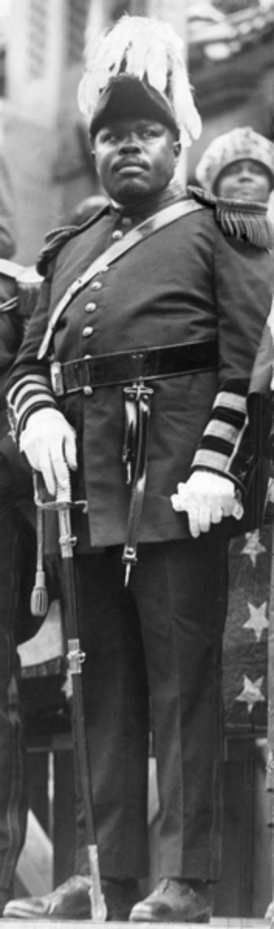
Marcus Garvey in full uniform

Marcus Garvey

Thought by many blacks to be another Moses, Marcus Garvey rose from humble beginnings in Jamaica, West Indies, to become the number one advocate of the “Back to Africa movement.”

He left school at sixteen and went to work as an apprentice printer, organizing the printing workers in Kingston, Jamaica.

In 1917, he came to America and founded the Universal Negro Improvement Association (UNIA), whose major goal was to create a strong Negro Nation in Africa. By 1920, the UNIA claimed more than 1 million members. In August of that year, their International Convention was held in New York City, where 25,000 people gathered to hear Garvey speak.

In 1923, Garvey was charged with and found guilty of using the mail service to defraud in connection with his fundraising to buy ships for the return to Africa. While imprisoned he wrote his famous “First Message to the Negroes of the World from Atlanta Prison,” where he said: “Look to me in the whirlwind or the storm, look for me all around you, for, with God’s grace I shall come and bring with me countless millions of black slaves who have died in America and the West Indies and the millions in Africa to aid you in the fight for liberty, freedom and life.”

Garvey died in 1940 in London, England. He was named Jamaica’s first national hero and buried in the National Heroes Park in Jamaica. This entry contributed by Curriculum Concepts International

Related Media


Video
Columbia University Professor of History Kenneth Jackson talks about Marcus Garvey Park, and the man for whom it was named.
Kellie Jones, Columbia University Professor of Art History and Archeology, describes New York's Marcus Garvey Park.

Images
The Marcus Garvey Memorial Park interrupts Fifth Avenue between 120th and 124th Streets. Its 70-foot hill offers a view of the site of Garvey’s Liberty Hall on West 138th Street.
A black nationalist, Marcus Garvey immigrated to Harlem in 1916. There he established Liberty Hall as headquarters for a movement that would grow to almost 2 million members.
This envelope calls for joining and contributing to the Universal Negro Improvement Association.
A 1924 UNIA flyer announces "Biggest Negro Convention in the History of the World: Program for Big Conclave Outlined."


99(((((((((((((((((((((((((((((((((((((((((((((((((((((((((((((((((((((((((((((((((((((((((((((((((((((((((((((((((((((((
 http://minglecity.com/group/knowledgeisking/forum/topic/show?id=2322904%3ATopic%3A14847509

Mingle City

A people without the knowledge of their past history, origin and culture is like a tree without roots.
Marcus Garvey

Marcus Mosiah Garvey, Jr., ONH (17 August 1887 – 10 June 1940), was a publisher, journalist, entrepreneur, Black Nationalist, Pan-Africanist, and orator. Marcus Garvey was founder of the Universal Negro Improvement Association and African Communities League (UNIA-ACL).

Prior to the twentieth century, leaders such as Prince Hall, Martin Delany, Edward Wilmot Blyden, and Henry Highland Garnet advocated the involvement of the African diaspora in African affairs. Garvey was unique in advancing a Pan-African philosophy to inspire a global mass movement focusing on Africa known as Garveyism. Promoted by the UNIA as a movement of African Redemption, Garveyism would eventually inspire others, ranging from the Nation of Islam, to the Rastafari movement (which proclaims Garvey as a prophet). The intention of the movement was for those of African ancestry to "redeem" Africa and for the European colonial powers to leave it. His essential ideas about Africa were stated in an editorial in the Negro World titled “African Fundamentalism” where he wrote:
“ Our union must know no clime, boundary, or nationality… let us hold together under all climes and in every country… ”


God and Nature first made us what we are, and then out of our own created genius we make ourselves what we want to be. Follow always that great law. Let the sky and God be our limit and Eternity our measurement.
Marcus Garvey


Early years

Garvey was born in St. Ann's Bay, Jamaica, on 17 August 1887, to Marcus Mosiah Garvey, Sr., a mason, and Sarah Jane Richards, a domestic worker and farmer. Of eleven siblings, only Marcus and his sister Indiana reached maturity. Garvey's father was known to have a large library, and it was from his father that Marcus gained his love for reading. Sometime in the year 1900, Garvey entered into an apprenticeship with his uncle, Alfred Burrowes. Like Garvey Sr., Burrowes had an extensive library, of which young Garvey made good use.When he was about fourteen, Garvey left St. Ann's Bay for Kingston, where he found employment as a compositor in the printing house of P. A. Benjamin, Limited. He was a master printer and foreman at Benjamin when, in November 1907, he was elected vice-president of the Kingston Union. However, he was fired when he joined a strike by printers in late 1908. Having been blacklisted for his stance in the strike, he later found work at the Government Printing Office. In 1909, his newspaper The Watchman began publication, but it only lasted for three issues.

In 1910 Garvey left Jamaica and began traveling throughout the Central American region. He lived in Costa Rica for several months, where he worked as a time-keeper on a banana plantation. He began work as editor for a daily newspaper titled La Nacionale in 1911. Later that year, he moved to Colón, Panama, where he edited a biweekly newspaper before returning to Jamaica in 1912.

After years of working on the Caribbean, Garvey left Jamaica to live in London from 1912 to 1914, where he attended Birkbeck College, worked for the African Times and Orient Review, published by Dusé Mohamed Ali, and sometimes spoke at Hyde Park's Speakers' Corner.


I have no desire to take all black people back to Africa; there are blacks who are no good here and will likewise be no good there.
Marcus Garvey


Founding and Projects of the UNIA-ACL

During his travels, Garvey became convinced that uniting Blacks was the only way to improve their condition. Towards that end, he departed England on 14 June 1914 aboard the S.S. Trent, reaching Jamaica on 15 July 1914. He founded the Universal Negro Improvement Association (UNIA) in August 1914 as a means of uniting all of Africa and its diaspora into "one grand racial hierarchy." Amy Ashwood, who would later be Garvey's first wife, was among the founders. As the group's first President-General, Garvey's goal was "to unite all people of African ancestry of the world to one great body to establish a country and absolute government of their own."

Following much reflection the following day and night about what he learned, he named the organization the Universal Negro Improvement Association and African Communities (Imperial) League."

After corresponding with Booker T. Washington, Garvey arrived in the U.S. on 23 March 1916 aboard the S.S. Tallac to give a lecture tour and to raise funds to establish a school in Jamaica modeled after Washington's Tuskegee Institute. Garvey visited Tuskegee, and afterward, visited with a number of Black leaders. After moving to New York, he found work as a printer by day. He was influenced by Hubert Harrison. At night he would speak on street corners, much like he did in London's Hyde Park. It was then that Garvey perceived a leadership vacuum among people of African ancestry. On 9 May 1916, he held his first public lecture in New York City at St Mark's Church in-the-Bowery and undertook a 38-state speaking tour.

In May 1917, Garvey and thirteen others formed the first UNIA division outside Jamaica and began advancing ideas to promote social, political, and economic freedom for Blacks. On 2 July, the East St. Louis riots broke out. On July 8, Garvey delivered an address, titled "The Conspiracy of the East St. Louis Riots," at Lafayette Hall in Harlem. During the speech, he declared the riot was "one of the bloodiest outrages against mankind." By October, rancor within the UNIA had begun to set in. A split occurred in the Harlem division, with Garvey enlisted to become its leader; although he technically held the same position in Jamaica.

Garvey next set about the business of developing a program to improve the conditions of those of African ancestry "at home and abroad" under UNIA auspices. On 17 August 1918, publication of the widely distributed Negro World newspaper began. Garvey worked as an editor without pay until November 1920. By June 1919 the membership of the organization had grown to over two million.

On 27 June 1919, the Black Star Line of Delaware, was incorporated by the members of the UNIA with Garvey as President. By September, it obtained its first ship. Much fanfare surrounded the inspection of the S.S. Yarmouth and its rechristening as the S.S. Frederick Douglass on 14 September 1919. Such a rapid accomplishment garnered attention from many.

One person who noticed was Edwin P. Kilroe, Assistant District Attorney in the District Attorney's office of the County of New York. Kilroe began an investigation into the activities of the UNIA, without finding any evidence of wrongdoing or mismanagement. After being called to Kilroe's office numerous times, Garvey wrote an editorial on Kilroe's activities for the Negro World. Garvey was arrested and indicted for criminal libel in relation to the article, but charges were dismissed after Garvey published a retraction.

While in his Harlem office at 56 West 156th Street on 14 October 1919, Garvey received a visit from George Tyler, who told him that Kilroe "had sent him" to get Garvey. Tyler then pulled a .38-caliber revolver and fired four shots, wounding Garvey in the right leg and scalp. Garvey was taken to the hospital and Tyler arrested. The next day, it was let out that Tyler had committed suicide by leaping from the third tier of the Harlem jail as he was being taken to his arraignment.

By August 1920, the UNIA claimed four million members. That month, the International Convention of the UNIA was held. With delegates from all over the world in attendance, over 25,000 people filled Madison Square Garden on 1 August to hear Garvey speak.

Another of Garvey's ventures was the Negro Factories Corporation. His plan called for creating the infrastructure to manufacture every marketable commodity in every big U.S. industrial center, as well as in Central America, the West Indies, and Africa. Related endeavors included a grocery chain, restaurant, publishing house, and other businesses.

Convinced that Blacks should have a permanent homeland in Africa, Garvey sought to develop Liberia.

The Liberia program, launched in 1920, was intended to build colleges, universities, industrial plants, and railroads as part of an industrial base from which to operate. However, it was abandoned in the mid-1920s after much opposition from European powers with interests in Liberia. In response to suggestions that he wanted to take all Americans of African ancestry back to Africa, he wrote, "We do not want all the Negroes in Africa. Some are no good here, and naturally will be no good there."

Garvey has been credited with creating the biggest movement of people of African descent. This movement that took place in the 1920s is said to have had more participation from people of African descent than the Civil Rights Movement. In essence the UNIA was the largest Pan-African movement.


Our success educationally, industrially and politically is based upon the protection of a nation founded by ourselves. And the nation can be nowhere else but in Africa.
Marcus Garvey


Charge of mail fraud

In a memorandum dated 11 October 1919, J. Edgar Hoover, special assistant to the Attorney General, and head of the General Intelligence Division (or "anti-radical division") of The Bureau of Investigation or BOI (after 1935, the Federal Bureau of Investigation), wrote a memorandum to Special Agent Ridgely regarding Marcus Garvey. In the memo, Hoover wrote that:
“ Unfortunately, however, he [Garvey] has not as yet violated any federal law whereby he could be proceeded against on the grounds of being an undesirable alien, from the point of view of deportation. ”

Sometime around November 1919 an investigation by the BOI was begun into the activities of Garvey and the UNIA. Toward this end, the BOI hired James Edward Amos, Arthur Lowell Brent, Thomas Leon Jefferson, James Wormley Jones, and Earl E. Titus as its first five African-American agents. Although initial efforts by the BOI were to find grounds upon which to deport Garvey as "an undesirable alien", a charge of mail fraud was brought against Garvey in connection with stock sales of the Black Star Line after the U.S. Post Office and the Attorney General joined the investigation.

The accusation centered on the fact that the corporation had not yet purchased a ship with the name "Phyllis Wheatley".[clarification needed] Although one was pictured with that name emblazoned on its bow on one of the company's stock brochures, it had not actually been purchased by the BSL and still had the name "Orion". The prosecution produced as evidence a single empty envelope which it claimed contained the brochure. During the trial, a man by the name of Benny Dancy testified that he didn't remember what was in the envelope, although he regularly received brochures from the Black Star Line. Another witness for the prosecution, Schuyler Cargill, perjured himself after admitting[ to having been told to mention certain dates in his testimony by Chief Prosecutor Maxwell S. Mattuck. Furthermore, he admitted that he could not remember the names of any coworkers in the office, including the timekeeper who punched employees' time cards. Ultimately, he acknowledged being told to lie by Postal Inspector F.E. Shea. He said Shea told him to state that he mailed letters containing the purportedly fraudulent brochures. The Black Star Line did own and operate several ships over the course of its history and was in the process of negotiating for the disputed ship at the time the charges were brought. Assistant District Attorney, Leo H. Healy, who was, before he became a District Attorney, attorney for Harris McGill and Co., the sellers of the first ship, the S. S. Yarmouth, to the Black Star Line Inc. was also a key witness for the government during the trial.

Of the four Black Star Line officers charged in connection with the enterprise, only Garvey was found guilty of using the mail service to defraud. His supporters called the trial fraudulent. While there were serious accounting irregularities within the Black Star Line and the claims he used to sell Black Star Line stock could be considered misleading, Garvey's supporters still contest that the prosecution was a politically motivated miscarriage of justice, given the above-mentioned false statement testimony and Hoover's explicit regret that Garvey had committed no crimes.

When the trial ended on 23 June 1923, Garvey had been sentenced to five years in prison. He initially spent three months in the Tombs Jail awaiting approval of bail. While on bail, he continued to maintain his innocence, travel, speak and organize the UNIA. After numerous attempts at appeal were unsuccessful, he was taken into custody and began serving his sentence at the Atlanta Federal Penitentiary on 8 February 1925. Two days later, he penned his well known "First Message to the Negroes of the World From Atlanta Prison" wherein he makes his famous proclamation:
“ Look for me in the whirlwind or the storm, look for me all around you, for, with God's grace, I shall come and bring with me countless millions of black slaves who have died in America and the West Indies and the millions in Africa to aid you in the fight for Liberty, Freedom and Life. ”

Professor Judith Stein has stated, “his politics were on trial.”

Garvey's sentence was eventually commuted by President Calvin Coolidge. Upon his release in November 1927, Garvey was deported via New Orleans to Jamaica, where a large crowd met him at Orrett's Wharf in Kingston. A huge procession and band converged on UNIA headquarters.


The Black skin is not a badge of shame, but rather a glorious symbol of national greatness.
Marcus Garvey


Criticism

While W. E. B. Du Bois expressed the Black Star Line was “original and promising,” he also said: “Marcus Garvey is, without doubt, the most dangerous enemy of the Negro race in America and in the world. He is either a lunatic or a traitor.”Du Bois feared that Garvey's activities would undermine his efforts toward black rights.

Garvey suspected Du Bois was prejudiced against him because he was a Caribbean native with darker skin. Du Bois once described Marcus Garvey as "a little, fat black man; ugly, but with intelligent eyes and a big head." Garvey called Du Bois “purely and simply a white man's n*****" and "a little Dutch, a little French, a little Negro … a mulatto … a monstrosity.” This led to an acrimonious relationship between Garvey and the NAACP. Garvey accused Du Bois of paying conspirators to sabotage the Black Star Line to destroy his reputation.

At the National Conference of the Universal Negro Improvement Association in 1921 a Los Angeles delegate Noah Thompson spoke on the floor complaining on the lack of transparency in the group's financial accounts. When accounts were prepared Thompson highlighted several sections with what he felt were irregularities.

Garvey recognized the influence of the Ku Klux Klan, and in early 1922, he went to Atlanta, Georgia for a conference with KKK imperial giant Edward Young Clarke.

According to Garvey, “I regard the Klan, the Anglo-Saxon clubs and White American societies, as far as the Negro is concerned, as better friends of the race than all other groups of hypocritical whites put together. I like honesty and fair play. You may call me a Klansman if you will, but, potentially, every white man is a Klansman, as far as the Negro in competition with whites socially, economically and politically is concerned, and there is no use lying.”[27] Leo H. Healy publicly accused Garvey of being a member of the Ku Klux Klan in his testimony during the mail fraud trial.

After Garvey's entente with the Ku Klux Klan, a number of African American leaders appealed to U.S. Attorney General Harry M. Daugherty to have Garvey incarcerated.

Although historians tend to side with Du Bois, Theodore Vincent's "Black Power and the Garvey Movement" contends that, "Cronon and most other scholars dealing with Garvey have misunderstood their subject, and have written off as unimportant a man who founded a most significant movement for black freedom." This book is devoted to dispelling "militant" criticism of Garvey from people like W. E. B. Du Bois.


There shall be no solution to this race problem until you, yourselves, strike the blow for liberty.
Marcus Garvey


Later years

1928, Garvey travelled to Geneva to present the Petition of the Negro Race. This petition outlined the worldwide abuse of Africans to the League of Nations. In September 1929, he founded the People's Political Party (PPP), Jamaica's first modern political party, which focused on workers' rights, education, and aid to the poor.

Also in 1929, Garvey was elected councilor for the Allman Town Division of the Kingston and St. Andrew Corporation (KSAC). However, he lost his seat because of having to serve a prison sentence for contempt of court. But, in 1930, Garvey was re-elected, unopposed, along with two other PPP candidates.

In April 1931, Garvey launched the Edelweiss Amusement Company. He set the company up to help artists earn their livelihood from their craft. Several Jamaican entertainers — Kidd Harold, Ernest Cupidon, Bim & Bam, and Ranny Williams — went on to become popular after receiving initial exposure that the company gave them.

In 1935, Garvey left Jamaica for London. He lived and worked in London until his death in 1940. During these last five years, Garvey remained active and in touch with events in war-torn Ethiopia (then known as Abyssinia) and in the West Indies. In 1937, he wrote the poem Ras Nasibu Of Ogaden[29] in honor of Ethiopian Army Commander (Ras) Nasibu Emmanual. In 1938, he gave evidence before the West Indian Royal Commission on conditions there. Also in 1938 he set up the School of African Philosophy in Toronto to train UNIA leaders. He continued to work on the magazine The Black Man.

In 1937, a group of Garvey's American supporters called the Peace Movement of Ethiopia openly collaborated with Mississippi Senator Theodore Bilbo in the promotion of a repatriation scheme introduced in the US Congress as the Greater Liberia Act. In the Senate, Bilbo was a supporter of Franklin Roosevelt's New Deal. Bilbo was an outspoken supporter of segregation and white supremacy and, attracted by the ideas of Black separatists like Garvey, Bilbo proposed an amendment to the federal work-relief bill on 6 June 1938, proposing to deport 12 million black Americans to Liberia at federal expense to relieve unemployment.[30] He took the time to write a book titled Take Your Choice, Separation or Mongrelization, advocating the idea. Garvey praised him in return, saying that Bilbo had "done wonderfully well for the Negro".[31]

During this period, Evangeline Rondon Paterson the grandmother of the current (55th) Governor of New York, David Paterson served as his secretary.


Marcus Garvey


Death

n 10 June 1940, Garvey died after two strokes, putatively after reading a mistaken, and negative, obituary of himself in the Chicago Defender which stated, in part, that Garvey died "broke, alone and unpopular". Because of travel conditions during World War II, he was interred at Kensal Green Cemetery in London. Rumours claimed that Garvey was in fact poisoned on a boat on which he was travelling and that was where and how he actually died.

In 1964, his remains were exhumed and taken to Jamaica. On 15 November 1964, the government of Jamaica, having proclaimed him Jamaica's first national hero, re-interred him at a shrine in National Heroes Park.


The flag of the Universal Negro Improvement Association (UNIA)