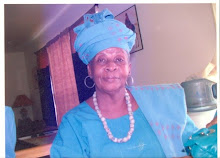
"THE BLACKER THE BERRY THE SWEETER THE JUICE/
I SAY THE DARKER THE FLESH,THEN THE DEEPER THE ROOTS!"
TUPAC SAYS

BLACK SKINNED BEAUTY SUPREME!

BLACK SKINNED BEAUTY SUPREME!

"BLACK IS BEAUTIFUL" -NEW YORK CITY STREET SAYING

"BLACK IS BEAUTIFUL!
BROWN IS HIP,
PUERTO RICAN IS OKAY
BUT white AIN'T S___T!"

BLACK SKINNED BEAUTY OOO!

BLACK SKINNED BEAUTY OOO!

BLACK SKINNED BEAUTY OOO!

BLACK SKINNED BEAUTY OOO!

BLACK SKINNED BEAUTY SUPREME

BLACK SKINNED BEAUTY SUPREME
BLACK SKINNED BEAUTY SUPREME!

BLACK SKINNED BEAUTY SUPREME

BLACK SKINNED BEAUTY SUPREME

BLACK SKINNED BEAUTY

BLACK SKINNED BEAUTY

Search This Blog

Pages

WE MUST HAVE A BLACK STANDARD OF BEAUTY BASED ON THE BLACK SKINNED BLACKEST WOMAN

Thursday, November 18, 2010

OYOTUNJI VILLAGE IN SOUTH CAROLINA,UNITED STATES-BLACK PEOPLE LIVING LIKE YORUBAS ORIGINALLY DID!

from bookrags.com

ADEFUNMI II (NEW KABAYESI,SON OF THE FOUNDING KABAYESI)


OYO TUNJI: A YORUBA COMMUNITY IN THE USA

Religious beliefs and ceremonies, visual culture, and social organization closely based on traditional Yoruba prototypes from Nigeria and Benin Republic are embraced by African American members of Oyo Tunji in Beaufort County, South Carolina, as viable alternatives to mainstream American culture. Oyo Tunji (“Oyo Returns” or “Oyo Rises Again”) is a metaphor for the reconstruction, in the United States, of the ancient kingdom of old Oyo, which flourished in Nigeria (c.1600 to 1830 CE).
Oyo Tunji is popularly referred to as “the African village.” The current leader, known as Oba (king) Efuntola Oseijeman Adefunmi I, along with a handful of priests and priestesses, established Oyo Tunji in 1970, near the town of Sheldon, where routes 17 and 21 intersect.
Oyo Tunji encompasses ten square miles of semi-forest, agricultural land in a rural, agricultural terrain. It follows a traditional town plan that can still be seen in the outlying areas of small Yoruba villages in West Africa. Oyo Tunji’s land is partitioned into precincts radiating from the central focus where the palace (called the Afin) is located. Oba Adefunmi I apportions the land to male and female householders who pay annual taxes to the Oba for this land. All the dwellings adhere to the traditional Yoruba architectural plans, which consist of small, usually windowless, enclosed dwelling units (used for storage and sleeping), built around large, open, square courtyards where most daily tasks are performed (Ojo 1966). The size and elaboration of architecture signifies status, ranging from the sprawling, immense palace through the middle-size homes of the chiefs to the small houses of the general populace.
Oyo Tunji is, first and foremost, a religious community. The primary criterion of membership is initiation into “Yoruba” religion, which, in fact, while foregrounded there, accommodates an intertextual blend of borrowing from other African religions including Fon, Asante, Edo (ancient Benin kingdom), and ancient Egyptian. The king’s name is an excellent example of the .influence of multiple African elements: Efuntola signifies his initiation into Yoruba religion as a priest of Obatala (in Nigeria, the Yoruba deity credited with human creation through his modeling of human bodies from primordial clay). Efun in Yoruba is white chalk and ola denotes abundance. Oseijeman (or “savior of the people” in Akan) is a customary name for chiefs in Ghana. Adefunmi (“crown for me”) builds upon the Yoruba traditional of designating all royal lineage families by prefixing their names with ade (“crown”). Funmi is a conscious signifier of Oyo Tunji’s king’s (formerly Walter Serge Roy King of Detroit, Michigan) proactive appropriation of Yoruba royal names and a conceptual pun on his “slave” name. Adefunmi can thus be seen as a “New World” oriki (Yoruba praise name) that puns on the fact that Walter Serge Roy King originated the “kingdom” of Oyo Tunji and created a royal lineage for himself and his family, with the right to rule and wear the crown (ade, the sign par excellence of royalty among the Yoruba in West Africa).
A very large number of African American men and women have been initiated in Oyo Tunji by Kabiyesi (Yoruba, “royal highness”) Queen Iy Orite and others since 1970. These priests and priestesses maintain close and continuous ties with the community, although many have chosen not to remain permanently in Oyo Tunji. They have dispersed throughout the United States to found small religious satellites of Oyo Tunji in Chicago, Indiana, Wisconsin, New York, Virginia, Florida, and Los Angeles. The major deities (orisha) are conceived as embodiments of organic, supernatural, and mortal power that often calibrate with numerology and astrology. Thus, Orunmila (while equated with the domain of Ifa divination among the Yoruba in Africa) is associated with the Sun. Olokun (a deity associated with rulership and wealth in the ancient Nigerian Benin kingdom) is identified with the planet Neptune and the sign Pisces. In Oyo Tunji, Olokun is also conceptualized as the] deity representing the souls of all descendants of Africans transferred from their homeland by ships sailing the Atlantic Ocean and, as such, serves as the patron deity of all African Americans. Obatala (the creation deity who first molded humans from earth) is the patron deity of Oyo Tunji and the one with the most initiates. Obatala is linked with the planet Jupiter and the sign Sagittarius. Sango (whose domain is thunder and who was a former king of old Oyo, an ancient Yoruba city) is governed by Uranus and linked to Aquarius. Yemoj (the mother of deities not born by Nanan), seen in Oyo Tunji as a powerful iyami (enchantress), governs the Gelede society organized by men to honor elderly women of tremendous spiritual authority. As a moon goddess, Yemoj is connected with the sign of Cancer and the numbers 4 and 7. Esu-Elegba, the prankster, is seen as, simultaneously, the youngest and the oldest of all the deities. He is linked to the planet Mercury, the signs Gemini and Virgo, and the numbers 1, 3, 11, and 21. His domains are the marketplace and the crossroads. He possesses the spiritual force to open and close roads and place or remove obstacles, all metaphors for positive or negative opportunities and success or failure.
In Oyo Tunji, a separate temple complex exists for each deity, which includes the main shrine, a smaller shrine for the Esu-Elegba of the deity, and a building where initiates are housed during their seclusion. Priests and priestesses function as diviners and herbalists who provide guidance for the inhabitants of Oyo Tunji, as well as visitors or local South Carolinians. They combine healing with herbs, fasting, divination, palmistry, tarot cards, numerology, and astrology.
Known ancestors are honored by paintings, photos, and Egungun cloth ensembles, as in Africa, while unknown ancestors are determined by roots-reading divinations and honored by fresh water, flowers, candles, and prayers. An innovation introduced in Oyo Tunji is the initiation of women into the Egungun society.
Finally, the visual culture of Oyo Tunji exemplifies a deliberate creative project that departs from the mainstream, exhibition-directed arts created by many African American artists, who position themselves within the American mainstream. In contrast, Oyo Tunjians look toward conventional Yoruba art forms still commonplace in the African homeland and available through African art books, journals, or early ethnographies.
In sum, Oyo Tunji occupies a unique place among African diaspora communities; it is a uniquely intellectual entity, consciously created by African Americans as a counterpoint to, and revitalization effort within, mainstream American society and culture. Rooted in West African Yoruba religious, sociopolitical, and artistic epistemologies, Oyo Tunji testifies to the agency and activity of African Americans in the diaspora.

References

Gregory, Steven. 1999. Santeria in New York City: A Study in Cultural Resistance. New York: Garland.
Murphy, Joseph M. 1988. Santeria: An African Religion in America. Boston: Beacon Press.
——. 1994. Working the Spirit: Ceremonies of the African Diaspora. Boston: Beacon Press.
Hunt, Carl. 1979. Oyo Tunji, Ph.D. dissertation, University of Virginia.
Ojo, G.J.A. 1966. Yoruba Culture: A Geographical Analysis. London: University of London Press.
Omari, Mikelle Smith. 1984. From the Inside to the Outside: The Art and Ritual of Bahian Candomble. Monograph Series no. 24. Museum of Cultural History, University of California, Los Angeles.
——. 1989. The Role of the Gods in Afro-Brazilian Ancestral Ritual: African Arts Journal XXIII, no. 1.
——. 1990. Creativity in Adversity: Afro-Bahian Women, Power, and Art. The International Review of African American Arts 9, no.1:35–41.
——. 1991. Completing the Circle: Notes on African Art, Society, and Religion in Oyo Tunji, South Carolina. African Arts, July, 66–75, 96.
——. 1994. Aesthetics and Ritual of Candomble Ago. In African Religions: Experience and Expression, ed., Thomas Blakely, pp. 135–9. London: James Curry; Portsmouth, N.H.: Heineman.
——. 2002. Manipulating the Sacred: Yoruba Art, Ritual and Resistance in Brazil. Detroit: Wayne State University Press.
Pinn, Anthony. 1998. Varieties of African American Religious Experience. Minneapolis: Fortress Press.
MIKELLE SMITH OMARI-TUNKARA


Monday, November 08, 2010

AKON! -BLACK SKINNED HANDSOME BLACK MAN STARS IN NIGERIA-ILLORIN,OCT.2,2010!

FROM jaguda.com

Live in Kwara state was some of the biggest events of the Independence Day weekend for Nigeria turning 50. The concert was held on October 2nd at Metropolitan Square in Illorin, Kwara State. The Concert featured International artist, Akon along with the biggest names in Naija entertainment, Dbanj, Sasha, Naeto C, Wande Coal, P-Square, YQ, Sauce Kid & co. Check out pics:
Source: Obi Asika’s FB album
Akon
Akon
Wande Coal
Wande Coal
YQ
...
Crazy Crowd In Illorin
Dbanj
Dbanj
The Eva Blazing DJ Neptune
Naeto C
Naeto C
P-Square
P-Square
General Pype
Sasha P
Sauce Kid
Tony Tetuila
(Visited 882 times, 8 visits today)

Related Posts

5 Comments

  1. Khalvict says:
    Akon was da man.they al tried but their crazy stunt wasn’t crazy enough.
  2. HALIMAT says:
    infact that day is most happest in my life for seening Akon 4 live,oh i love akon so much,barvo!! to our dear governor of kwara state (bukola saraki)
  3. nexus says:
    ummm dbanj looks a little crazy almost busted without his sunglasses..so does naeto c. psquare taking off their shirts for men?! ok oh!
  4. temz says:
    1. What the heck is sasha wearing? Ugh
    2. Sauce kid look like “were”, im sorry, but he does.
    3. D-banj, i love you, but make una go put on weight
    4. General pype: 3 gbosas for you
    5. psquare: 3gbosa-1, bcos of that sagging pant
     

Friday, November 05, 2010

AFRICAN HERITAGE RESEARCH LIBRARY IS THE 1ST RURAL BASED AFRICAN STUDIES LIBRARY ON THE CONTINENT- WITH YOUR SUPPORT WE CAN BECOME THE LARGEST IN THE WORLD BEATING AMERICAN AND BRITISH COLLECTIONS-SEND US BOOKS TODAY!


Home | Arts | Life (Midweek Magazine) | Library locked in forest of elephants

Library locked in forest of elephants


Adeyipo is fast becoming a tourist destination. Located on the outskirts of Ibadan in Lagelu Local Government Area of Oyo State, the village has become home of culture, tradition and knowledge, attracting scholars. Yet, it is still lacking basic social amenities.
As one of the over 200 villages that was once part of the Igbo-Elerin District, the place has not lost its natural appeal. When translated, literally, Igbo-Elerin means "Forest occupied by elephants". According to the oldest man in the place, Baba Eniayewu, elephants once occupied the place. "Then, it was a thick forest." Even though, elephants no longer tread its path, nevertheless, Adeyipo, today, remains an enclave surrounded by thick forest; home of traditional drummers, singers, dancers, story-tellers and rara chanters, having its natural habitat intact. These local artistes are always on ground to entertain visitors at occasions.
In addition to its arts, its serene environment has continued to inspire filmmakers, writers and musicians, serving as a setting for literary, artistic works and films. The novel, The Virgin by Bayo Adebowale, which Tunde Kelani’s adapted in his film The Narrow Path, is set in the village. Academic films depicting poems studied by senior secondary students such asEbiks waec Poems on CD have also been set in the place, among others.
Interestingly, the village is a small community with not more than 10 buildings belonging to eight families, and a population of not more than 700. Small as it is, the place prides itself as home to a unique edifice – the African Heritage Research Library and Cultural Centre (AHRLC).
For years, visitors have continued to troop into the place in search of knowledge. On a visit to the place, one will find AHRLC, a documentation resort of a sort, where one can camp and do research at the same time. Researchers on any subject relating to Africa will find the place helpful; its libraries are full of such books. The place houses the African Heritage Research Library, Afe Babalola Rural Community Service building, N.O. Idowu Visitors Chalets, Victor Olaiya Music of Africa Library, and African Talking Drum Museum.
The place, founded by Dr. Bayo Adebowale in 1989, has as its Chief Librarian, Chief Yeye Akilimali Fanua Olade, an African-American who has worked in AHRLC since inception. Overtime, it has come to mean different things to each visitor. Students of literature would find the place an interesting repertoire.
According to Olade, AHRLC has hosted many dignitaries and groups from within and outside the country, who left their marks behind. "We have had the opportunity of hosting the Governor of Oyo State, Otunba Adebayo Alao-Akala, ex-governor of Oyo State, Chief Omololu Olunloyo, Ambassador Segun Olusola, former Minister of Justice and Attorney-General, Chief Akin Oluyinmi (SAN), former Commissioner of Women Affairs, Community Development and Social Welfare, Oyo State, Princess A. Babalola, Egbe Omo Yoruba USA and Canada and Prof. Akinwunmi Ishola, Hon. Abike Dabiri, Chief N.O. Idowu, Chief Afe Babalola (SAN), Prof. Femi Osofisan, Prof. Demola Dasilva, Adebayo Faleti, Tunde Kelani, among others," she said.
Olade said the AHRLC project is the manifestation of how one man’s dream can affect many lives. Aside storing research materials, she added the centre is an all-round educational and cultural centre geared towards serving the academic needs of enlightened Africans and the people of the community.
She said: "The centre runs a Rural Community Development and Literacy Centre aimed at educating and enlightening the non-literate inhabitants of Adeyipo and villages such as Akokura, Kufi, Aderogba, Ladunni, Apon Onilu, etc. The library was established with the mind of meeting the educational needs of scholars, researchers and students, and, the non-educated indigenes - farmers, petty traders and artisans."
Speaking on the founding of AHRLC, Olade said: "When the Director of the centre, Dr. Bayo Adebowale, first established the library in March 1988, it was at Ila-Orangun, Osun State. It began with 500 books, journals and magazines, at Prince Isaac Adebayo’s home. Later, it moved to an old post office building in the central part of the town; while in Ila-Orangun, the collection grew to 12, 000 volumes, she said.
With a mind of moving educational enlightenment to his people, Olade said: "It moved to Adeyipo in 1992, and by this time, the collection and vision had grown. Today, AHRLC is a centre of culture and knowledge; a depository and clearing house for all publications on Africa, Africans in the Diaspora of the Americas, Europe, Asia the Pacific and the Caribbean Island. We have the largest collection of books on Africa. AHRLC currently has over 100, 000 volumes that cuts across all branches of knowledge as they relate to Africa. And our chalets are open to visitors wishing to lodge while carrying out research. "
As an indigene of Adeyipo, Adebowale said: "The need to give back to his community, inspired the moving of the library to his hometown. The love for education motivated the establishing the library initially.
Aside books, Adebowale added that: "The music library and museum is aimed at preserving African musical heritage. Recently, the centre named a poetry section in honour of the acclaimed poet, J.P. Clark. And we are currently working on a Wole Soyinka African Writers’ Enclave which would run a writer-in-residence programme."
Surrounded by such impressive qualities, one would have thought Adeyipo would have experienced tremendous development. However, this is not the case. The place is in dire need of government intervention. Visitors still have to contend with the bad road leading to the place, among other amenities that are lacking. The road from Idi-Igba to Adeyipo is actually a bumpy and jagged broad path consisting of red earth in dry season that turns muddy and almost impassable during the rainy season. Describing his experience to the place, J.P. Clark called the experience a "turbulent ride".
Aside the writer, the community people are lamenting everyday over the state of the road. Most of them are farmers. They complained they are faced with tremendous suffering while transporting their goods to neighbouring towns.
A woman, known simply as Iya Alakara, wondered why the government had abandoned them. She said most of their children going to school also contend with the road, leaving their socks and uniforms dirty. Speaking in Yoruba, she said: "They (the government) have refused to come to our aid. Please tell them to give us light and water. A ni ina".
A female writer, Chief Ada Onwu, once wrote "AHRLC is a wonderful library. The Oyo State government should be interested in it, and see to the terrifying state of the road leading to it."
The bad road is not their only challenge. There is no pipe-borne water in the place; the people are still ultilising a small stream, and very recently, a well dug by AHRLC. Visitors at the centre will also need to arm themselves with purified water, as there is no borehole.
Like the villagers, visitors who intend to lodge in in the place, also have to contend with fighting the darkness as the place is yet to be connected with electricity. A staff of AHRLC who pleaded anonymity lamented: "The governor and some government officials have been here several times. In fact, when the governor first visited on December 20, 2007, he promised he would do something about the road and the electricity, but till date nothing had been done."
As it is with most lofty projects managed by one person, the centre is also faced with its own challenges; hence, the need for financial assistance from individuals and corporate bodies. Some of the structures, particularly the chalets, are beginning to experience cracks, probably due to lack of constant maintenance.
Olade, who welcomes support from well-meaning groups, called on the Government to fulfill its promises towards the centre and the village.
On his part, Adebowale said he is not unaware of the teething problems facing the centre but, added that determination against the odds had kept the dream alive
While praising the centre’s advisory board for its effort at ensuring the edifice continuous existence, Adebowale said: "It is our desire to continue to share or wealth of knowledge with the natives and the world. This has kept the dream alive. I cannot but appreciate the friends of AHRLC which have not left us alone to the arduous work of this centre. We call on the government to come to our aid, in terms of amenities for the people of Adeyipo," he said.
AFRICAN HERITAGE RESEARCH LIBRARY P.O.BOX 36330 AGODI,IBADAN,NIGERIA=========africanheritagelibrary@yahoo.com

Subscribe to comments feed