


 Posts
Posts





Saturday, June 26, 2010


Thursday, June 24, 2010
NIGERIAN LANGUAGES ARE DYING-THIS DAY NEWSPAPER,NIGERIA TELLS SOMEWAYS TO SAVE THEM!-JUNE 2010
geFROM allafrica.com

With western education came the fad of speaking the "whiteman's language". In Nigeria for instance, the ability to speak the English language was then, the most ready proof of "belonging" to a social class, high and above the local platform of those considered as mere natives. School children were then forbidden from speaking their local languages in the classroom. Offenders were punished for speaking vernacular. Over the years, this malaise has worsened.
Today, fewer and fewer people are able to speak, let alone write their native languages. If some indigenous languages have suffered poor orthographical development, that should not affect the ability to speak it. But modern day children, especially those in the urban centres now consider their mother tongue as a linguistic anathema.
This and other issues inform former Executive Secretary of National Universities Commission (NUC), Professor Munzali Jibril's warning that unless deliberate measures are taken to preserve and promote Nigerian languages, they stand the risk of going extinct. Already, some languages have "died", with nobody speaking them anymore.
According to Prof. Jibril, 45 per cent of the world's population speak only five languages: Chinese, English, Hindi, Spanish and Russian, just as the top 100 languages of the world are spoken by 95 per cent of the world's people. The remaining five per cent speak over 6,000 languages, with some languages having just about 100 or even less speakers. This, to say the least, is worrisome.
That Nigerian languages are dying is no longer news. The present generation of children are hardly able to understand or communicate in their mother tongues. The craze for the English Language has long become a kind of status symbol. This is even worse among the children of the elite and urban dwellers. Worse still, is the adoption of pidgin English in most cities as the unofficial lingua franca. The blame for this loss is largely on the parents, some of whom are also unable to speak their native languages, and so find it difficult to train their children in their native tongues. Left unchecked, what that means is that generation after generation in such family lineage will miss out on the mother tongue, with the grave and telling effect of a steady but gradual disconnect with the native language.
It is in a bid to rescue the languages from extinction that the Federal Ministry of Education introduced the policy of ensuring that at least, one or two major Nigerian languages are taught in schools. Almost two decades after, this has not quite improved the health of native languages. Prof Babatunde Fafunwa, former Education minister had also directed, at the time, that teachers should give instructions in native languages as a way of building and developing the local languages. But most of the languages are shallow and poorly developed. That has restricted their use as medium of instruction. Worse still, several words in the English Language have no exact equivalent in the native language. For example it may not be easy to find the Yoruba or Igbo equivalent of the word "Chlorine" or "mega watts"?
But despite the challenges, Nigerian languages can be revived, at least in the spoken form, until more scholarly attention is devoted to their orthographical development. The place to kick-start this is at the home. Children in their early formative years have Tabula Rasa brain, literally meaning blank memory, on which parents must make initial linguistic imprints.
This is achievable even before the children attain school age. Conscious efforts must be made by parents to speak their native languages to their children, who in turn will grow to cherish the language and pass same on to their children, thereby sustaining the life of the languages. The regulated exposure of the children to Language lessons in the school is not enough to achieve the resuscitation of Nigerian languages. Parents must embrace the habit of speaking the local languages to the children. And the time is now.
An Index of Nigerian Languages
Twelve Nigerian languages: A handbook on their sound systems for teachers of English,
The Early Study of Nigerian Languages: Essays and Bibliographies (Modern Revivals in African Studies)
Higi phonology (Studies in Nigerian languages)
The development and preservation of Nigerian languages and cultures: The role of the local government. (Linguistics).: An article from: Studia Anglica ... international review of English Studies
The Early Studies of Nigerian Languages
APNILAC A Journal of Nigerian Languages and Culture Volume 1 (October 1997) Numbers 1 and 2
A preliminary study of Angas phonology (Studies in Nigerian languages)
Duka sentence, clause and phrase (Studies in Nigerian languages)
Nigerian languages and cultural development: Proceedings of the National Seminar on the Use of Local Languages for Cultural Development and Application, held at Durbar Hotel, Kaduna 22-24 June, 1981
Fundamentals of syntax and the study of Nigerian languages
A Vocabulary of primary science and mathematics in nine Nigerian languages
Nigerian languages yesterday, today, and tomorrow: Proceedings of the Twentieth Year Commemorative Symposium of the Centre for the Study of Nigerian Languages, Bayero University, Kano
Ten Nigerian tone systems (Language data : African series ; us.4)
Nigeria: Saving the Local Languages
21 June 2010


editorial
Lagos — One of the strongest effects of western civilization is the gradual but steady erosion of the culture of the people, especially of former colonies. There is no where this has been demonstrated more than in the language of the people.Today, fewer and fewer people are able to speak, let alone write their native languages. If some indigenous languages have suffered poor orthographical development, that should not affect the ability to speak it. But modern day children, especially those in the urban centres now consider their mother tongue as a linguistic anathema.
According to Prof. Jibril, 45 per cent of the world's population speak only five languages: Chinese, English, Hindi, Spanish and Russian, just as the top 100 languages of the world are spoken by 95 per cent of the world's people. The remaining five per cent speak over 6,000 languages, with some languages having just about 100 or even less speakers. This, to say the least, is worrisome.
Relevant Links
This is achievable even before the children attain school age. Conscious efforts must be made by parents to speak their native languages to their children, who in turn will grow to cherish the language and pass same on to their children, thereby sustaining the life of the languages. The regulated exposure of the children to Language lessons in the school is not enough to achieve the resuscitation of Nigerian languages. Parents must embrace the habit of speaking the local languages to the children. And the time is now.
An Index of Nigerian Languages
Twelve Nigerian languages: A handbook on their sound systems for teachers of English,
The Early Study of Nigerian Languages: Essays and Bibliographies (Modern Revivals in African Studies)
Higi phonology (Studies in Nigerian languages)
The development and preservation of Nigerian languages and cultures: The role of the local government. (Linguistics).: An article from: Studia Anglica ... international review of English Studies
The Early Studies of Nigerian Languages
APNILAC A Journal of Nigerian Languages and Culture Volume 1 (October 1997) Numbers 1 and 2
A preliminary study of Angas phonology (Studies in Nigerian languages)
Duka sentence, clause and phrase (Studies in Nigerian languages)
Nigerian languages and cultural development: Proceedings of the National Seminar on the Use of Local Languages for Cultural Development and Application, held at Durbar Hotel, Kaduna 22-24 June, 1981
Fundamentals of syntax and the study of Nigerian languages
A Vocabulary of primary science and mathematics in nine Nigerian languages
Nigerian languages yesterday, today, and tomorrow: Proceedings of the Twentieth Year Commemorative Symposium of the Centre for the Study of Nigerian Languages, Bayero University, Kano
Ten Nigerian tone systems (Language data : African series ; us.4)
Thursday, June 17, 2010


Wednesday, June 16, 2010
BLACK SKINNED WOMEN-QUEEN MOTHERS OF ALL BEAUTY!


BLACK SKINNNED WOMEN-QUEEN MOTHERS OF ALL BEAUTY!
BLACK-SKINNED WOMEN: QUEEN MOTHERS OF THE BLACK RACE AND ALL BEAUTY!
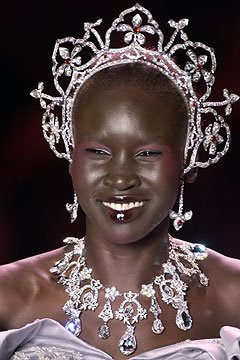
Why do I sing Praises of your Beautiful, Black, ebony,velvet skin,”Blacker than the sky at midnight”{1},your full mushroomed mouth, your beautiful broad nose, your generous “Congo hips” {2}and full-flowered backside? Because for too long many of the Black Race have abused, dishonored you, degraded and denied you your crown, Queen of Queens,Queen Mother of the Black Race, Black Beauty Supreme! From you all the beauty of the Black Race springs forth.In fact all the world’s beauty springs from you,Mother of all beauty of all the races of the world! Your Black midnight,licorice,dark black chocolate,beauty, is Blackness concentrated in your beautiful “Black-blueberry”{3} face!
First in the order of creation is always given respect by Afrikan tradition. The 1st wife, the 1st elder, the 1st kingdom, the 1st original inhabitants, of the earth-all are considered with honor. So it should be with Black Beauty-our darkest -skinned Sisters are the 1st Mothers of the Universe-Black as a color came before all the many tones of brown,red,yellow and white. But for too long our Dark-skinned Queens have not been given the respect and place of honor they deserve. IN FACT THE WHITE BOY HAS INTIATED the cycle of reversing the true order of things by turning upside down the pyramid of Beauty, and placing white-light on top and relegating the most beautiful Black-skinned Beauties to rock bottom!
So Black people have been taught well how to deny our most
beautiful one her crown, taught how to reject our Blackest, most Afrikan features, full lips and nose and mouth and woollest hair, for the weaker characteristics of the white race. Shame on Black people! When will we wake up to this Black Beauty concentrated, from whence all our lesser beauty comes. When will we give the crown of crowns,the throne of thrones, to the Blackest Queen of Queens?
Most of us who suffer from”mulatto-mentality” and “yellow fever”, as Fela, our great Nigerian Musician calls it, will go on and on about what about us lighter queens-aren’t we/they beautiful too, yet you/we should be aware that such queens have gotten all the play in the past and that even in Black Egypt one of the reasons for its downfall was the allowing the lighter ones of the race, to place themselves above the rest of us in the name of lightness and pride of light-closer/to/whiteness. So if we’re yellow,to light brown/red, then we should give respect where respect is due and not live off of the artificial white thrill of having “white features” as if it is an advantage. Where would you be without your BLACKEST great Grandmother? We should honor the Blackest part of ourselves, thus giving us true pride of Blackness, not verbal signifyin’ but real testifyin’ that BLACK is beautiful! If the Blackest, most Afrikan-featured Sister isn’t respected as the Supreme Beauty of the Race,the Black woman’s beauty is not really respected at all for what it really is(only in terms of how closer to white we look). We all reflect the strengths of this concentrated beauty in ourselves, all the manifestations of how Blackness can present itself are seen in our faces. Down to the milk-lightest of us, our Blackness is what dominates us whether physically or mentally. But the Mother is greater than the child and so the Blackest is greater than all the other tones of the Black Race. If we don’t respect our Blackest Queen, we don’t respect our True Black selves. We must have a Black value for BLACKNESS in features and skin tone. We must have a Black Standard of Beauty based on the Black-skinned woman. ALL PRAISES DUE TO OUR BLACK-SKINNED QUEEN-MOTHERS!
Sister Yeye Akilimali Funua Olade


Subscribe to:
Posts (Atom)


Add New Comment
Showing 0 comments
Reactions